 Society

China’s Professional Hair Care Brand ISYUN Announces Victoria song as Global Brand Ambassador, Accelerating Global Expansion with Strategic Focus on Southeast Asia
1.
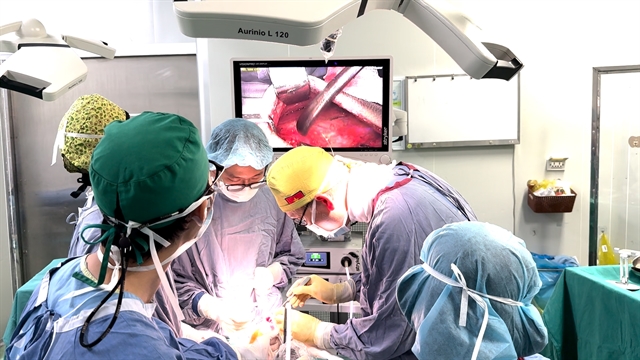 |
| Dr Nguyễn Hồng Hà and other surgeons operate on Nguyễn Minh Anh at Việt Đức Hospital. — Photos courtesy of Việt Đức Hospital. |
Bảo Long & Paul Kennedy
Việt Đức Hospital is becoming a trailblazer in one of the most difficult procedures in reconstructive plastic surgery.
Thanks to support from UK-based charity Facing the World, the hospital in Hà Nội is gradually being seen as the envy of the global health sector.
This is due to the advancements made in a specific kind of plastic surgery – one that is often considered the most complex and challenging in the medical profession.
In simple terms, 'endoscopic fascia harvest' is a way for surgeons to ‘borrow’ a small piece of tough, saran-wrap-like tissue from one part of a patient's body to fix another, using only tiny incisions and a camera.
Carrying out the method to rebuild an ear in the past posed many challenges for medics to overcome.
But thanks the donation of new equipment, and the dedication and skills of Vietnamese medical staff, replacing an ear has become faster, safer and a lot less painful.
Nguyễn Hồng Hà, head of the Department of Maxillofacial and Reconstructive Plastic Surgery, said: “Ear reconstruction or plastic surgery of the ear in general is considered one of the most difficult procedures in the field of reconstructive plastic surgery.
“Because our auricle is a three-dimensional structure with nearly 20 tiny details that we must shape, sculpt, and recreate to make it look like an ear. This is completely different from, say, a low nose where we can just place a silicone bridge and, whether it's pretty or not, people can still recognise it as a nose.
“With endoscopy, we can stitch it up so beautifully that people won't even know if it’s real or fake; they just know it looks great.”
In the past, the traditional method to treat congenital microtia – the condition that causes a child to be born with a tiny ear, or no ear at all – has been using autologous rib cartilage, which can take up to four separate surgeries to complete.
The cartilage also needs ‘time to live’ meaning it can take up to three years before the patient fully recovers, which can be an extremely painful process, especially when operating on a child.
There’s also the added complication that worldwide, the recommended age for rib cartilage surgery is 10 to 12 years old.
“Surgeons worldwide are always looking for a way to operate so that patients are given the fastest results with the fewest surgeries, the best aesthetics, and the safest and least painful,” Dr Hà said.
“What’s great and new about this method is that when using high-quality, standard porous polyethene, the framework is already pre-moulded into a very beautiful ear shape. But more importantly, there are hundreds or thousands of tiny pores – like a coral skeleton – so once it’s implanted under the scalp and covered well for one to two months, the body's own tissue can grow into the framework, holding it very durably and securely.
“The surgery is much lighter, less painful, and much faster. We no longer have to wait until the age 10 or 12. We can completely perform this for children before they start first grade. So, before the school year begins, they already have an ear, and classmates won't tease them anymore. They integrate very well.”
Katrin Kandel, CEO of Facing the World, added: “Providing the tools is just one small part of the process.
“It’s no good having the right equipment if it can’t be used to its full potential, and that’s exactly what the amazing staff at Việt Đức Hospital have mastered.
“The work they are doing is not only pioneering from a medical perspective, but it also massively reduces pain, allows for just a single, quick procedure, and gives the opportunity for patients to have the surgery earlier, allowing them to fit in from a very young age.”
Carrying out so many of these procedures, often on a weekly basis, has caught the eyes of medical professionals all over the world.
“Currently, almost only Việt Đức Hospital's Plastic Surgery Centre performs this endoscopic fascia harvest routinely – nearly every week – with 50 to 100 cases a year,” Dr Hà said.
“Because we can perform such a high-level, complex technique that the rest of the world finds difficult, many doctors from major centres in Germany, Switzerland, Thailand, Hong Kong and Indonesia have contacted us to come and observe how we do it and to exchange technology.” — VNS
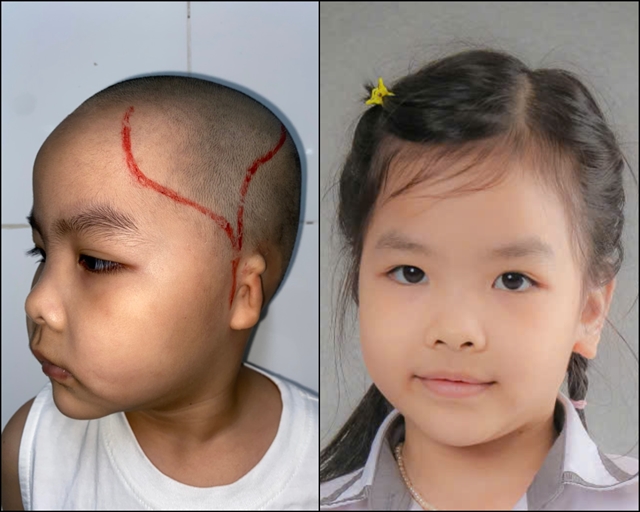 |
| Nguyễn Minh Anh before her surgery (left) and after. |
CASE STUDY - Nguyễn Minh Anh
Nguyễn Minh Anh looks just like any of her friends and classmates as she plays and learns at Archimedes School in Hà Nội’s Long Biên District.
But just last year, she was very, very different.
Minh Anh was born with a rare condition that meant one of her ears was missing.
Her parents researched correctional methods but discovered how painful procedures were for the patient and how their daughter would normally have to wait four or five more years before she would be old enough to operate on.
Then, they learned of the work being carried out at Việt Đức Hospital.
“What felt truly miraculous was that Dr Hà decided on the spot, asking a colleague whether there was any available surgery slot,” said her father, Nguyễn Tuấn Cương.
“And just like that, we were told our child could be operated on in only two weeks.
“After the surgery, the doctors and nurses gave us very detailed instructions. Almost every day, they video-called to monitor our daughter’s ear and check for any changes. At home, we took turns caring for her.
“The first month was demanding and required great caution, but once the wound healed, she gradually returned to normal daily activities.
“Since the operation, Minh Anh has definitely become much more confident. She loves dressing up and taking care of her appearance. She often admires herself, and she finally feels confident like her peers.
“Before, she would ask why her friends could wear earrings while she couldn’t. Now she can do all those things. She’s happy that she can finally do whatever she likes.”
And as for the patient herself, she’s just happy she’s able to fit in with her friends and live a normal life.
She said: “After my ear surgery, I can wear a mask and glasses without them falling off. I feel more confident now, and I play with my friends more.” VNS
FACING THE WORLD
Facing the World is a UK-based medical charity founded in 2002 by craniofacial surgeons to help children with severe facial deformities.
Since 2008, Việt nam has become the charity’s main area of work. The organisation sends international surgical teams to Vietnamese hospitals to perform operations and train local doctors in advanced craniofacial techniques.
The charity has funded millions of dollars in medical equipment, telemedicine systems and more than 200 international fellowships for Vietnamese surgeons.
Today, more than 200 international fellowships have been awarded. Each represents not only professional development for an individual doctor, but a ripple effect of expertise that benefits thousands of patients over time.
Through these initiatives, thousands of children have received life-changing surgery, while Vietnamese doctors gain the skills needed to treat patients independently, ensuring long-term improvements in the country’s healthcare system.
What began as a response to urgent need has grown into one of the most sustained and impactful surgical partnerships between the United Kingdom and Việt Nam.
Society
 Society
 Society
 Society
 Society
 Society
 Society
 Society
 Society
 Society
 Society
 Society
 Society
 Society
 Society