 Society
Joint replacement: AI moves towards more personalised treatment
1.
|
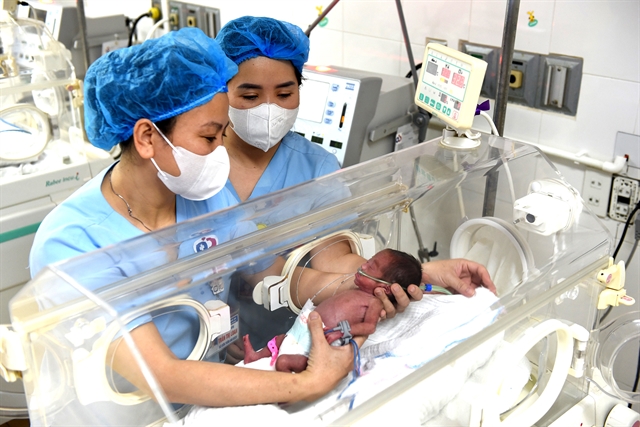
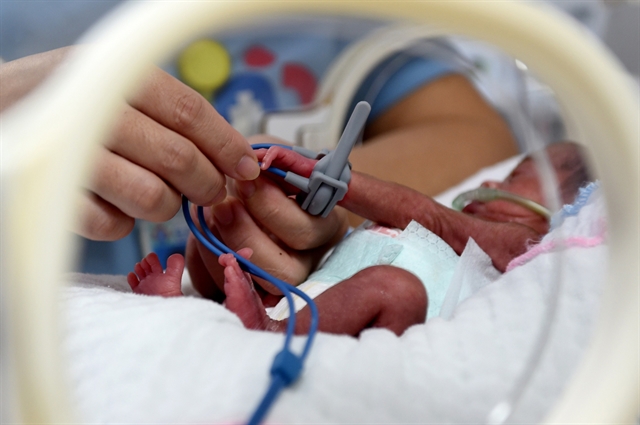
| Medical staff takes care of a little warrior at the Neonatal Intensive Care Unit at the Nghệ An Obstetrics and Paediatrics Hospital. — Photo suckhoedoisong.vn |
NGHỆ AN — There are battles fought without guns, where tension builds minute by minute and survival depends on the smallest gains. Inside the Neonatal Intensive Care Unit at Nghệ An Obstetrics and Paediatrics Hospital, newborns weighing only a few hundred grammes begin life surrounded by machines and constant vigilance, relying on doctors and nurses they call their second mothers to help them draw each fragile breath.
The unit is permanently bathed in white light, filled with the steady hum and sharp rhythm of medical equipment. Along one wall, the ward’s smallest patient lies motionless in an incubator - a baby born at just 24 weeks, weighing barely 500 grammes. Its skin is so thin that a web of blue veins is clearly visible beneath the surface.
Trương Lệ Thi, head of the NICU, leans forward to check the infant’s vital signs. Her voice falters as she looks at a child who has never been breastfed and lacks the strength to produce a full cry. Yet the baby continues to cling to life with instinctive resilience.
For Thi and her colleagues, the infant is no longer a medical record but the centre of a prolonged battle that can stretch for weeks or even months, leaving no room for haste or exhaustion.
Extremely premature babies
Each year, the NICU admits around 1,000 to 1,200 newborns, with up to 10 per cent classified as extremely premature, born before 28 weeks of pregnancy.
“These babies arrive into life before their lungs are fully developed, their guts are not ready to receive nutrition and their immune systems are almost a blank sheet. The moment they are placed on the resuscitation table is the start of a race against death to seize life back. Some babies are born not crying, not breathing, not responding. The first thing we must do is intubate in the delivery room to regain every breath for the babies,” Thi said.
If Thi directs treatment decisions on a razor’s edge between life and death, doctor Nguyễn Thị Tâm carries them out breath by breath beside the incubators. In this world of glass cots, modern machines extend human capability, but clinical judgement and constant observation remain at the core of survival.
After more than eight years working in the unit, Tâm still moves slowly through the ward each morning, pausing at every incubator to review readings and examine each line and monitor.
She remembers every little warrior in detail: one learning to breathe without mechanical ventilation, another struggling with abdominal swelling, others able to receive only one or two millilitres of milk through a nasogastric tube at each feed.
“In the NICU, every plan is calculated step by step. The daily goal is sometimes simply to nudge the child a little further towards life. There are no mild cases here, only severe and more severe ones,” Tâm said.
Here, time is measured not by clocks but by sudden changes in a child’s condition. A baby stable in the morning may require emergency intervention by midday. Even the most advanced machines cannot always match the speed of human instinct.
Tâm briefly turns towards a small table in the corner where a nurse finishing her shift eats a late meal. Nurses, she says, spend the longest hours beside the incubators and act as living sensors, often detecting subtle warning signs before alarms sound.
Among them is nurse Nguyễn Thị Lan, who volunteers to serve as the quiet bridge sustaining life for infants weighing only a few hundred grammes, feeding and monitoring them through the long, silent battles fought each day inside the ward.
Feeding with tiny drops
|
| The 500-gram life lies still in the incubator, beginning its existence with resilience. — Photo suckhoedoisong.vn |
When speaking about nourishing premature babies, nurse Nguyễn Thị Lan smiles gently. However, her expression reflects the weight of responsibility carried by those tasked with delivering nutrition as safely as possible.
For infants unable to feed independently, nurses become the vital bridge delivering maternal milk to fragile bodies still learning how to survive outside the womb.
“It’s a task that requires infinite patience. Each few-millilitre feed can take up to half an hour to administer. While feeding, you must listen to the gut’s reactions and check for any residual milk to adjust immediately,” Lan said.
Some babies, she said, can only tolerate feeds of 1ml at a time, administered slowly over hours. Staff may then wait two days for the reassurance needed to increase the next feed by just half a millilitre.
In the NICU, even the least progress carries immense meaning. A weight gain of 10 grammes after a week of treatment is enough to lift the spirits of the entire medical team, marking what feels like a hard-won victory.
Alongside every drop of milk comes another task demanding even greater precision: maintaining fragile medical lines safely day after day.
One of the unit’s most technically demanding procedures is inserting a central venous line through a peripheral vein. For babies weighing only 500 to 600 grammes, whose veins are as fine as threads, even the slightest tremor can require the procedure to begin again. Lan said inserting the line is difficult, but keeping it stable and functional for a month presents an even greater challenge.
“We cradle the baby as if it were our own child,” Lan said softly.
For babies whose parents cannot remain at the hospital, nurses often become constant companions, speaking softly, singing lullabies and offering comfort. In the stillness of the NICU, the lights of the night shift never go out. Beyond monitoring machines, they illuminate the quiet work of touch, reassurance and warmth that accompanies a child’s first days of life.
For nurses who are mothers themselves, professional pressure can at times feel easier to bear than personal sacrifice. Many are accustomed to hurried meals during shifts, missing their own children’s birthdays or preparing for Tết celebrations late while families gather elsewhere. Season after season passes with reunions taking place outside the hospital while they remain on duty, safeguarding the lives of babies not biologically theirs but cared for with familial devotion.
“My own child is used to mum being away at Tết,” one nurse remarked, a seemingly light comment that reflects a quieter sacrifice.
In the NICU, rewards often arrive long before discharge day. Joy emerges through small but decisive milestones: when a 500-gramme baby gains another 20 grammes, when a 24-week infant begins breathing independently, or when the long-awaited child of parents who had struggled with infertility for 15 years finally opens its eyes to the world. Each survival represents not only medical progress but hope restored to families.
“The image of a father in his fifties standing still before a glass cot, crying like a child at his tiny baby’s side… that is the motivation, the energy that fuels us in the NICU,” Lan said.
Medical ethics and sustained investment
Deputy Director of the Nghệ An Department of Health Lê Thị Hoài Chung said achievements at the Neonatal Intensive Care Unit of Nghệ An Obstetrics and Paediatrics Hospital reflected not only professional expertise but also medical ethics, dedication and the impact of targeted public investment.
According to Chung, neonatal resuscitation, particularly the care of extremely premature infants, demands advanced technical skills and close multidisciplinary coordination, though the decisive factor remains medical personnel.
“In many situations, equipment merely supports. Early detection and timely action depend mainly on the experience, sensitivity, and responsibility of the medical team,” she said.
Chung added that the NICU plays a central role in the province’s development of advanced healthcare services. Alongside neonatal intensive care, Nghệ An has progressively adopted high-technology procedures including open-heart surgery, interventional cardiology, in vitro fertilisation and organ transplantation, helping reduce patient transfers while improving access to treatment locally.
“The health sector will continue to prioritise advanced training, retain high-quality staff, and invest strategically to build a coherent, sustainable health system. Saving lives of extremely preterm babies today lays the foundation for improving population health and strengthening public trust in the health sector,” Chung concluded. — VNS
Society
 Society
 Society
 Society
 Society
 Society
 Society
 Society
 Society
 Society
 Society
 Society
 Society
 Society
 Society
.jpg)