 Society
84 individuals investigated for transnational online frauds
1.
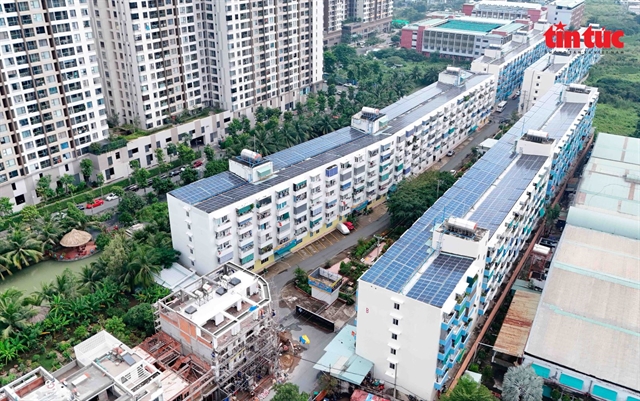 |
| A social housing project in An Lạc Ward, HCM City. Experts have urged the city to adopt a more flexible approach in line with Việt Nam’s newly revised housing and land laws. — VNA/VNS Photo |
HCM CITY — A leading real estate expert has urged HCM City to adopt a "more flexible approach" to social housing obligations in commercial projects, warning that rigid enforcement could undermine both affordability goals and investor confidence under Việt Nam’s revised housing and land laws.
In a formal petition to the HCM City People’s Committee, Dr Đỗ Thị Loan, former standing vice chairwoman and secretary general of the HCM City Real Estate Association (HoREA), called on the city to allow developers to choose how they fulfill social housing obligations, rather than mandating construction on 20 per cent of land within each commercial project.
Her recommendation comes as the HCM City Department of Construction considers stricter sanctions against non-compliant projects, including banning off-plan sales, rejecting new project approvals, denying timeline extensions or reclaiming the designated 20 per cent land allocation.
Loan said the proposals have unsettled developers, particularly as the legal framework governing social housing has changed significantly.
Under current regulations, developers may meet obligations by allocating land within a project, providing land at another location or paying an amount equivalent to the required land value.
Under the 2023 Housing Law and 2024 Land Law, effective from 2025, commercial housing projects are no longer automatically required to reserve 20 per cent of on-site land for social housing.
Instead, provincial authorities determine land allocation during urban planning and project approval stages, allowing social housing to be developed within projects, nearby areas or in concentrated zones.
HCM City, which has been assigned a national target of more than 181,000 social housing units by 2030, continues to face major challenges due to high land prices, site clearance difficulties and limited financial incentives.
Loan said experience shows that integrating social housing into high-end commercial developments often creates practical problems, as operating and management costs exceed the affordability of low-income households, while parallel management systems can cause friction between resident groups.
Developers have also warned that soaring land prices make on-site social housing increasingly unviable. On many central city roads, land prices now range from VNĐ50-80 million (US$2,000-3,200) per square metre, potentially pushing social housing prices far beyond the reach of eligible buyers.
Nguyễn Văn Đính, vice chairman of the Việt Nam Real Estate Association, said a flexible mechanism would improve efficiency.
“Concentrated social housing developments allow better cost control and infrastructure planning than scattered units within luxury projects,” he said.
Loan proposed allowing developers to select suitable compliance methods, including land swaps at alternative locations or cash contributions calculated at market-based land prices and channelled into the HCM City Housing Development Fund to finance State-led social housing projects.
She said a shift away from rigid on-site requirements would better align with the updated legal framework, reduce pressure on developers and enable the city to pursue social housing development in a more efficient and sustainable manner. — VNS
Society
 Society
 Society
 Society
 Society
 Society
 Society
 Society
 Society
 Society
 Society
 Society
 Society
 Society
 Society