 Society
Hà Nội adorned in red ahead of Liberation Day
1.

|
| A student assembles a variety of Tết gift baskets tailored to customers’ requests. VNS Photo Việt Anh |
Khánh Linh
HÀ NỘI — As the Lunar New Year approaches, Hà Nội’s seasonal job market is buzzing, with employers racing to staff up for the Tết rush. Demand for temporary workers has surged across retail, food and beverage services and other holiday-driven sectors, turning the weeks before Tết into one of the most dynamic periods of the year for part-time employment.
Despite sharply higher wages compared with normal days, many businesses are still struggling to fill vacancies, particularly among young workers and university students.
For Phùng Thị Hiền, a final-year student at the Hanoi University of Business and Technology, early February marked the start of her annual working season.
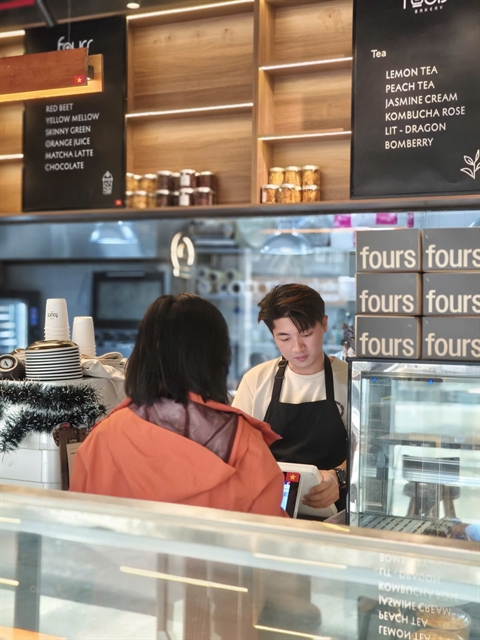
As universities entered their Tết break, Hiền took on a part-time job at a bakery in the Times City urban area, hoping to ease her parents’ financial burden and earn extra money for the year ahead.
Working the morning shift from 7am to 2pm, she earns between VNĐ25,000 and VNĐ30,000 per hour, with higher pay and bonuses in the days leading up to Tết.
“There are plenty of jobs out there, but not all of them are safe,” Hiền said. “I was very cautious and checked the information carefully before applying for this job.”
|
| A student applies for a service staff and cashier position at a bakery in the Times City urban area. VNS Photo Khánh Linh |
A similar story is shared by Bùi Bảo Thanh, a second-year student at the Polytechnic College, who began working full time as soon as his semester ended.
Thanh said seasonal job postings have flooded online forums this year, making the market appear more vibrant than ever, although securing a suitable position remains a challenge.
|
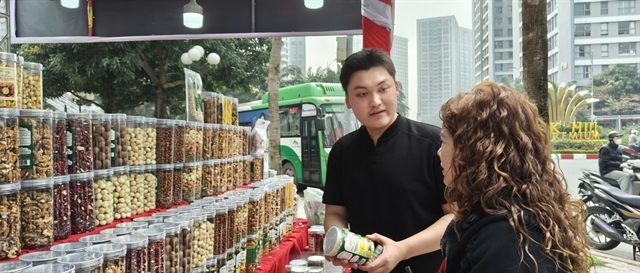
| Bùi Bảo Thanh, a second-year student at the Polytechnic College, advises customers on nut products at a local fair. VNS Photo Khánh Linh |
With three years of retail experience, Thanh quickly landed a sales job at a food stall at a local fair in Hoàng Mai Ward. The pay is VNĐ500,000 (US$19.33) per day for long shifts from 8am to 10pm. He plans to work right up until Tết and is actively looking for jobs that run through the holiday.
“Besides higher hourly wages, Tết jobs really help students improve their communication skills,” Thanh said. “Last Tết, I earned around VNĐ7 million ($270). If you work consistently during peak days, the income is quite decent.”
Strong demand, attractive pay
For many students, Tết offers a rare chance to significantly boost their income. Seasonal jobs are diverse, but the greatest demand comes from retail and service roles catering to the year-end shopping rush. Popular positions include sales assistants, cashiers, gift packers and delivery workers at shops and supermarkets.
The food and beverage sector is equally busy. Restaurants, major coffee chains and cinema complexes often recruit additional staff to serve customers during uninterrupted holiday operations. Other Tết-specific jobs such as caring for ornamental plants and house cleaning also attract strong interest from students.
Pay during the Tết period is particularly appealing. Wages are typically 20–50 per cent higher than usual and can be up to three times higher for work on key holiday days. Under normal conditions, part-time jobs pay around VNĐ25,000–30,000 per hour or VNĐ100,000–120,000 per day. During Tết, daily earnings can reach VNĐ300,000–500,000, depending on the position. Night shifts may get paid as much as VNĐ500,000 per shift, compared with around VNĐ270,000 on regular days, not including weekly or monthly bonuses.
On job-seeking forums, posts such as 'Looking for seasonal work from the 25th day of the lunar month to the fifth day of Tết' or 'Available to work throughout Tết – can start immediately' are increasingly common. While the number of jobseekers is rising, employer demand remains even higher, leaving many businesses struggling to secure temporary staff.
Chu Quang Linh, a recruiter for Pepper Lunch Vietnam, said the restaurant chain needs nearly 10 part-time workers for kitchen assistants, baristas, cashiers and service staff at its three Hà Nội outlets before Tết, but has yet to meet its targets.
“We prioritise part-time student workers,” Linh said. “The base hourly wage is VNĐ26,000, but it is multiplied by four during the days leading up to and throughout Tết, not including allowances.”
“Recruitment has been difficult because most students have already returned to their hometowns. Some are also picky about jobs or reluctant to take on physically demanding work.”
He added that the company is expanding its recruitment channels to reach students who remain in the city during the holiday.
Short supply of young workers
Labour shortages are also evident among major retail chains. Đỗ Hoàng Giang, recruitment supervisor at Circle K Vietnam’s Hà Nội branch, said the company needs around 600 seasonal workers for Tết but has so far filled only about 70 per cent of demand.
“Students are our main workforce,” Giang explained. “They are young, energetic, quick learners, flexible with their schedules and easy to train. However, they often lack stability, long-term commitment, discipline and experience.”
Circle K stores operate around the clock throughout Tết, requiring staff to work in three shifts. While regular wages range from VNĐ25,000 to VNĐ30,000 per hour, Tết pay can reach VNĐ100,000–130,000 per hour, excluding allowances.
According to a survey by the Hà Nội Employment Service Centre, total recruitment demand across the city in January was estimated at around 40,000 positions. Data from more than 900 businesses showed that wholesale, retail and service activities accounted for 57.4 per cent of total demand.
In terms of qualifications, unskilled labourers and technical workers without degree requirements made up about 44 per cent of total vacancies. Salaries in the VNĐ5–10 million ($193–386) per month range accounted for 62 per cent, while positions offering VNĐ10–20 million ($386–773) per month, typically requiring higher skills or expertise, made up 36 per cent.
Vũ Quang Thành, deputy director of the Hà Nội Employment Service Centre, said part-time and seasonal jobs tend to surge in the run-up to Tết.
“This is a good opportunity for young workers and students, especially those from other provinces, to make use of the holiday break to earn extra income and gain experience,” he said.
However, Thành cautioned that seasonal work is not as easy as it may appear.
“For the same position, there can be many applicants, forcing employers to screen more carefully,” he said. “Even for short-term jobs, requirements for soft skills, work attitude and adaptability are higher. The general trend is to recruit workers who can start immediately and perform effectively from day one.”
He warned that while the year-end and early-year labour market is vibrant, it also carries risks, particularly for young jobseekers with limited experience. Workers are advised to apply only through reputable channels, verify employer information carefully and never pay fees or deposits under any circumstances.
To truly benefit from Tết job opportunities, he said, workers must stay alert, proactive and well prepared rather than chasing high pay for just a few short holiday shifts. — VNS
Society
 Society
 Society
 Society
 Society
 Society
 Society
 Society
 Society
 Society
 Society
 Society
 Society
 Society
 Society