 Society

Việt Nam, New Zealand convene 14th political consultation
1.
By Lê Hương
The hillsides of Bướt village in Xuân Nha Commune, Sơn La Province, are carpeted in lush green, with maize fields curving along the slopes and groves of bamboo whispering in the wind, a scene that hints at more than natural beauty.
Hidden within this landscape is a resilient source of livelihood for local people.
In the forests near their homes, bamboo shoots have become an important forest product, closely tied to daily meals and household incomes, especially for ethnic minority women whose shoulders often bear heavy baskets and whose skilful hands know how to select each tender shoot.
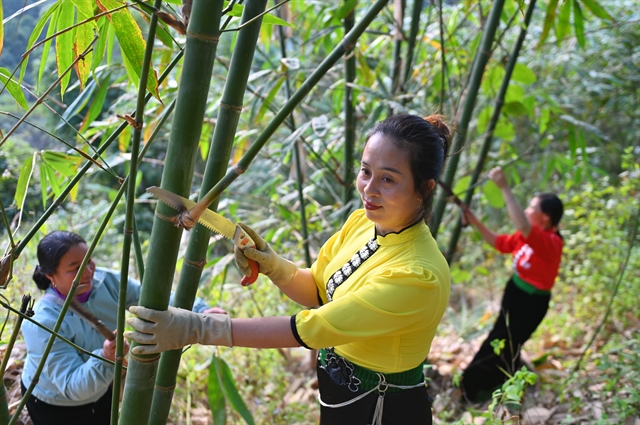 |
| Hà Thị Cúc (front) and other local women are now fluent at planting and caring for bamboo shoots. VNS Photos Nguyễn Nam |
Producing bamboo shoots demands stamina and meticulous care, yet it is fraught with uncertainty, from unstable markets and fluctuating prices to fragmented processing and preservation techniques and a lack of equipment and information.
Overexploitation of forests has made wild bamboo shoots increasingly scarce, leaving household incomes precarious.
“We live by the forest, but the forest is also being exhausted because of us,” said Hà Thị Cúc, a local Thái ethnic woman, with concern.
Despite these challenges, people like Cúc have chosen to persevere, hoping that one day bamboo shoots will be not only a gift of the forest but also a stable livelihood, so that each shoot carries faith in a less uncertain future.
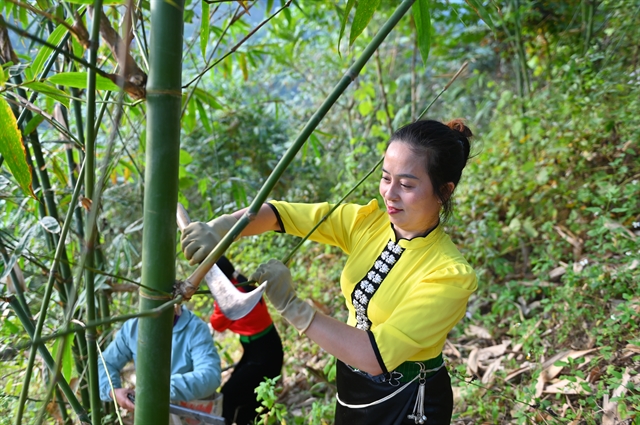 |
| Cúc has persuaded locals to shift from wild bamboo to Bát Độ bamboo for higher yield. |
A market turning point
Before 2022, bamboo shoot production in the village was fragmented, with each household doing what it knew best. Bumper harvests led to price drops, while shortages meant there were no buyers.
Women were hesitant to engage with outsiders and rarely used digital channels, while information on standards, techniques and markets arrived slowly and unevenly.
As a result, incomes were unstable and trust in a 'work together – sell together' model had yet to take hold.
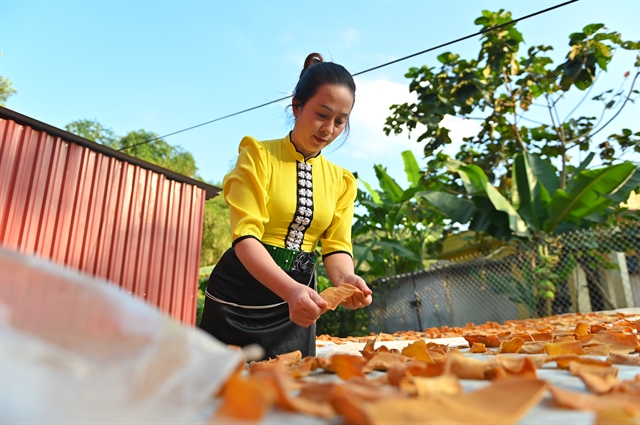 |
| The bamboo shoot is dried naturally under the sun. |
In this challenging context, Cúc did not give up.
She decided to join the Tân Xuân Organic Bamboo Shoot Co-operative with a single aspiration, to find a sustainable livelihood for herself and her community.
With many years of experience working with the local Women’s Union, she understood the livelihoods of each household and enjoyed the trust of village leaders and core groups.
Within a short time, she was elected to lead the co-operative.
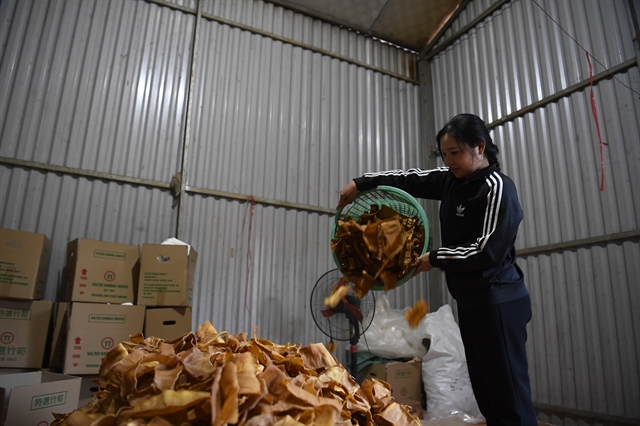 |
| The co-operative harvests higher amound of bamboo shoots year by year. |
An opportunity arose when the Tân Xuân Organic Bamboo Shoot Co-operative was selected for support by the Australian Government’s Gender Responsive Equitable Agriculture and Tourism Project (GREAT) through a sub-project on bamboo shoot value chain development in Sơn La Province, implemented by the CRED Agricultural and Tourism Consulting Solutions Company.
Through training courses on bamboo cultivation, care and harvesting techniques, co-operative management, leadership skills and gender equality, Cúc gradually discovered her own strength.
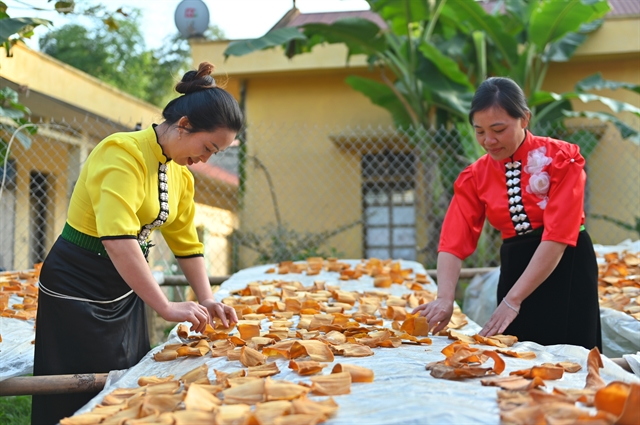 |
| The products have been sold widely inside the country. |
“I learned how to listen and speak with evidence. To persuade others, you need a plan, belief and real results,” she said.
Through the project, the co-operative received support to build a processing workshop, drying kilns and steam boilers for bamboo shoots, enabling Cúc and the members to access a semi-industrial production model for the first time.
At the same time, she took part in study visits to the nearby Xuân Nha Organic Bamboo Shoot Co-operative, which had successfully cultivated, processed and marketed Bát Độ bamboo shoots.
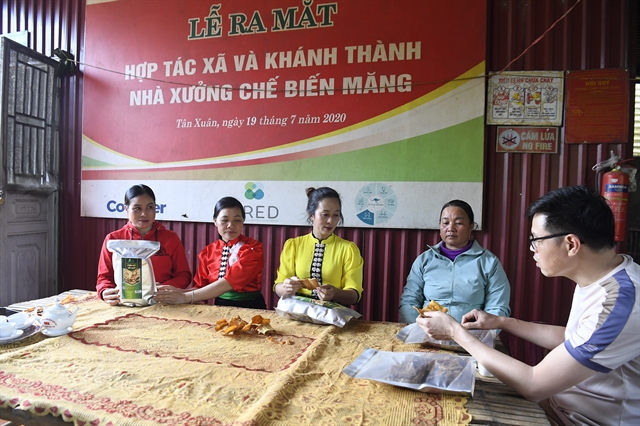 |
| Cúc (middle) and her neighbours working in the same co-operative. |
Bát Độ bamboo shoots differ from ordinary bamboo shoots in that they are crunchier, sweeter, less bitter and have no pungent smell.
“I saw the future of our co-operative in their story,” she said. “We have land, people and experience with bamboo shoots. We were only lacking confidence and the courage to move forward.”
Opening the door to change
To go the distance, Tân Xuân needed a suitable bamboo variety to standardise quality from the outset.
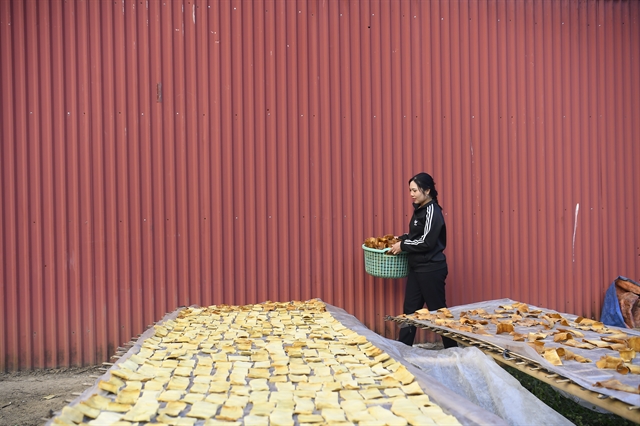 |
| The steady income from planting and processing bamboo shoots has improved the co-operative members' lives. |
From her surveys and self-learning, Cúc proposed a shift from harvesting wild forest bamboo shoots to planting, purchasing and processing Bát Độ bamboo shoots: large, easy to grow and well suited to standardised processing.
The early days were far from easy: people were reluctant to invest, feared risks and worried about crop failure.
Cúc visited each village and household, explaining and confirming that enterprises would purchase the output and that the co-operative would accompany farmers from seedlings to procurement.
Gradually, Bát Độ bamboo plots began to spread across Tân Xuân’s forest land.
By the end of 2023, the commune had planted 43 hectares of Bát Độ bamboo, with trust growing alongside each clump of green shoots.
After a smooth 2023 season, in early 2024 Yên Thành Company proposed signing a 15-year contract.
Cúc immediately presented the logic of a bamboo grower: Bát Độ bamboo takes three years to yield products; if the contract term is too short, farmers will not dare invest in seedlings, care and processing, and the co-operative will hesitate to invest in equipment.
To ensure a stable raw material area and batch quality, a long-term contract was essential.
Her clear reasoning, combined with convincing practical results (the October 2022 batch met requirements; the 2023 season delivered smoothly), persuaded Yên Thành Company to extend the contract to 30 years – a historic decision for the Tân Xuân Co-operative.
For the first time, people in Bướt village could plan long-term livelihoods, rather than living season by season.
 |
| Cúc and her neighbour pose for a photo to advertise their products. |
Remarkable achievements
By 2025, the Tân Xuân Organic Bamboo Shoot Co-operative had expanded its raw material area to 147 hectares and processed more than 50 tonnes of bamboo shoots – double that of 2024 (24 tonnes) and nearly eight times that of 2023 (seven tonnes).
It created stable local employment for dozens of women, particularly from ethnic minority groups. Household incomes rose steadily, with cash flow circulating quarterly rather than seasonally.
Each bamboo shoot season, the workshop buzzed with laughter, the hum of machines and warm steam filling the air.
For three consecutive years, Hà Thị Cúc received certificates of merit for Effective Mass Mobilisation from the provincial People’s Committee Chairman for encouraging people to shift to Bát Độ bamboo cultivation through value chain linkages.
She personally visited villages to raise awareness, organised group meetings, provided basic technical guidance and connected output markets with enterprises, helping many households confidently switch crops.
This achievement recognises her pivotal role in expanding raw material areas, creating more local jobs and steering the co-operative towards a more stable and professional trajectory.
On this journey, Cúc has not only been a managing director but also an inspirer.
“Change begins with belief, believing that you can and believing that the community can do it together,” she said.
Thanks to her leadership, women in the village no longer stand outside co-operative meetings. They take part in technical teams and production management groups, confidently voicing opinions and making decisions.
Cúc is a typical example of an ethnic minority woman empowered by the GREAT Project with leadership skills and technical mastery in bamboo cultivation and processing in remote areas of Lào Cai and Sơn La provinces, regions with high poverty and ethnic minority populations, where bamboo shoots are an important income source for households living in forest buffer zones.
Giàng A Ký, Chairman of Xuân Nha Commune’s People’s Committee, noted that the Tân Xuân Co-operative had been operating effectively and sustainably.
“They ensure the purchase of bamboo shoots at good wholesale prices for locals and have created stable jobs for the co-operative’s members,” he said.
Vì Thị Tươi, who has been a member of the co-operative since its establishment in 2020, said her income had improved significantly.
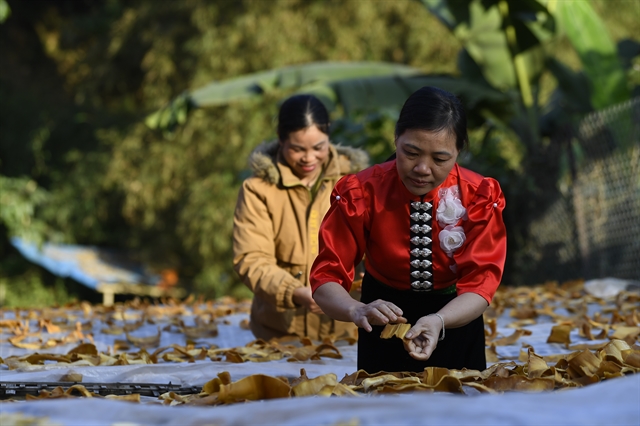 |
| The bamboo shoot products of the co-operative has been also exported to Japan. |
“We didn’t know anything about bamboo shoots before the co-operative was set up,” she said. “Now we are proficient in planting, caring for and harvesting bamboo shoots. This year, our family harvested eight tonnes.”
The project aims to develop 5,000 hectares of bamboo plantations across the two provinces, improve the living standards of more than 5,000 families and mobilise 80 per cent of local women to take part in the production process.
Việt Nam is currently the world’s third-largest exporter of bamboo shoots, with significant growth potential in both domestic and international markets. The bamboo shoot sector, particularly in the north-western region, offers promising opportunities for economic development and poverty reduction. VNS
Society
 Society
 Society
 Society
 Society
 Society
 Society
 Society
 Society
 Society
 Society
 Society
 Society
 Society
 Society
.jpg)