 Society
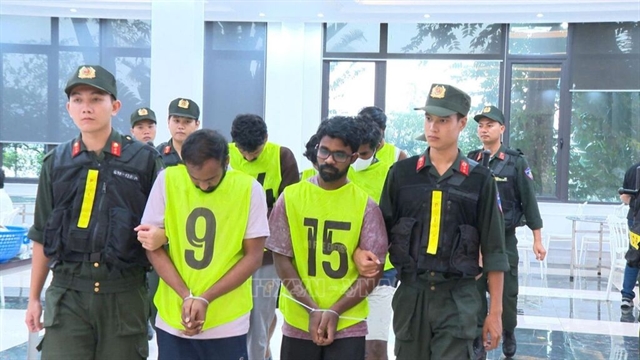
84 individuals investigated for transnational online frauds
1.
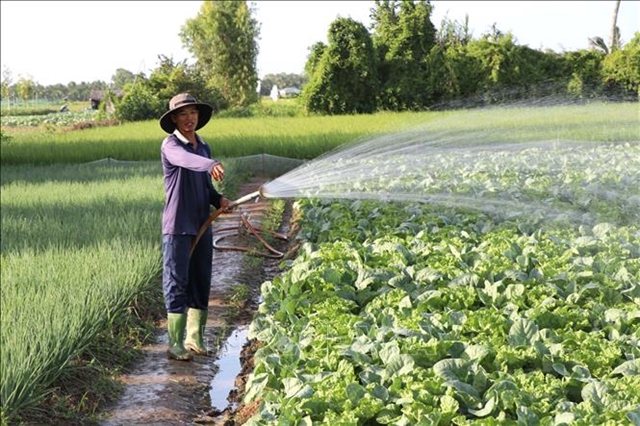 |
| Vegetables are planted to sell for the Tết (Lunar New Year) Festival in Vĩnh Long Province’s Hưng Mỹ Commune. — VNA/VNS Photo |
MEKONG DELTA — Farmers in the Cửu Long (Mekong) Delta localities are busy sowing vegetable crops to secure supply for the coming Tết (Lunar New Year) festival, which falls on February 17, as they hope prices will stay stable and bring good profits.
In An Giang Province, work in specialised vegetable growing areas is busier than usual.
Đoàn Hữu Việt, who has a 7,000sq.m field growing mustard greens, herbs and lettuce in Mỹ An 2 Hamlet, Mỹ Hòa Hưng Commune, said he has sown a new vegetable crop for Tết after harvesting the previous crop.
In the previous season, vegetable prices rose sharply due to floods that reduced supply, making farmers very pleased, he said.
“Although prices have now fallen, they remain profitable, and farmers hope prices will hold until the coming Tết, allowing families to enjoy a more prosperous holiday,” he said.
Đặng Thanh Phong, deputy head of the An Giang Plant Cultivation and Protection Sub-department, said the province has a dyke system that controls floods well in each sub-region, allowing year-round vegetable farming on nearly 70,000ha.
At present, the province grows nearly 60,000ha of vegetables, focused on specialised areas growing cucumbers, gourds, pumpkins, chillies, mustard greens, spring onions, okra, white radish and herbs.
An Giang is focusing on large-scale vegetable zones using high technology under Vietnamese and global good agricultural practices (VietGAP and GlobalGAP) standards to raise value and adapt to climate change, he said.
In Vĩnh Long Province, farmers began sowing vegetables for Tết more than a week ago.
Phan Thị Ngọc Cẩm in Hưng Mỹ Commune’s Ngãi Hiệp Hamlet has just planted mustard greens, spring onions and coriander on her 4,000sq.m field.
Her field previously grew rice with low yield, so she shifted to specialised vegetable farming in 2015.
Tết vegetables usually bring the highest profit of the year, with prices about 1.5 times higher than normal days, she said.
“Vegetable farming not only increases income but also provides regular jobs for my family members, especially at the end of the year,” she said.
Nguyễn Văn A, secretary of the Ngãi Hiệp Hamlet Party Cell, said the hamlet has 445 households, mainly engaged in agriculture, with many growing vegetables for Tết.
For this Tết crop, the hamlet has sown more than 20ha, mostly leafy vegetables with a growth period of 30–40 days, ready for harvest during Tết, he said.
With yields of about one tonne per 1,000sq.m, farmers earned profits of around VNĐ30 million (US$1,140) per 1,000sq.m per crop, he said.
Cà Mau Province now grows nearly 15,000ha of vegetables, and vegetables for the Tết market are growing well, according to its Plant Cultivation and Protection Sub-department.
The sub-department advises farmers to closely monitor pests and diseases and apply proper pest control measures.
Farmers should use biological plant protection products and pesticides approved for vegetables, and follow proper spraying and isolation periods to ensure food safety and protect consumer health, it said.
Vĩnh Long currently has nearly 17,100ha of land for growing vegetables. This is linked to the shift from low-efficiency rice land to vegetables with higher economic value.
According to Lê Văn Dũng, deputy director of the Vĩnh Long Department of Agriculture and Environment, the province converted 26,220ha of rice fields to other crops and livestock last year.
This year, it plans to convert nearly 30,000ha of low-efficiency rice land, including 28,400ha for annual crops, to improve land-use efficiency and farmer incomes.
In Vĩnh Long’s Ngũ Lạc Commune, vegetable production for Tết is seen as a suitable direction, especially for the Khmer community.
Many Khmer households grow two rice crops and one vegetable crop a year to raise incomes.
Thạch Thị Phôi from Lạc Hòa Hamlet said: “For more than five years, my family has grown two rice crops and one vegetable crop, such as peanuts and chillies, a year.”
Joining the hamlet’s co-operative group helps her family receive technical support, choose easy-to-sell crops and time harvests close to Tết, she said.
Sơn Huỳnh Luận, chairman of the Ngũ Lạc Commune People’s Committee, said the commune has identified vegetable cultivation as one of the key solutions to raise incomes and stabilise livelihoods for the Khmer community.
In Cần Thơ City, farmers are expected to sow about 4,000ha of vegetables for the Tết market.
For many years, the city’s vegetables have not only met local demand but have also supplied many provinces in the Mekong Delta and the Southeast region.
Phạm Thị Minh Hiếu, head of the Cần Thơ Plant Cultivation and Protection Sub-department, said the city’s agricultural sector focuses on developing clean and safe vegetable production linked to markets and exports.
“Along with orientation and support, farmers are guided to develop clean vegetable production, ensuring quality and safety to meet domestic demand and expand exports,” she said. — VNS
Society
 Society
 Society
 Society
 Society
 Society
 Society
 Society
 Society
 Society
 Society
 Society
 Society
 Society
 Society