 Society

Hit Vietnamese song featured in British album
1.
|
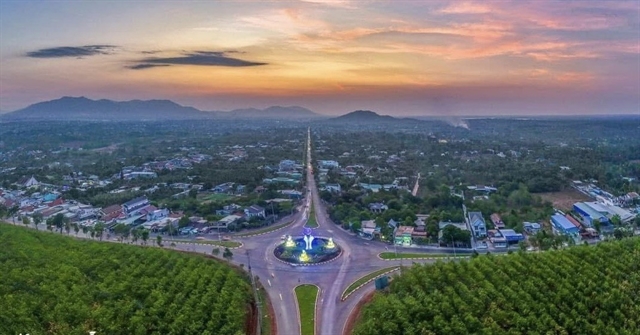
| New-style rural area Châu Đức in Bà Rịa-Vũng Tàu. — VNA/VNS Photo |
HÀ NỘI — The Government Office on Wednesday held an online conference to review and announce the preliminary results of the 2025 rural and agricultural census.
Deputy Prime Minister Hồ Đức Phớc, who also heads the central steering committee for the census, chaired the conference.
The 2025 census is Việt Nam's sixth nationwide survey focusing on rural areas and agriculture. It aims to collect fundamental data for compiling socio-economic statistical indicators, serving assessments of the current situation, analyses of trends, and the formulation of plans and strategies for rural development and agricultural, forestry and fisheries production at both national and local levels.
It collected baseline data from 15,838,814 households in rural areas, as well as information from survey units including households, farms, enterprises, cooperatives and commune-level People’s Committees.
The preliminary findings offer a fairly complete view of Việt Nam's rural and agricultural progress from 2016 to 2025. Over the last decade, rural infrastructure has seen significant improvements. The national power grid now reaches all communes and most villages, alongside expanded use of renewable energy, such as solar, wind, and biomass power. Rural transport networks have continued to expand and improve in both scale and quality, facilitating agricultural production, services, tourism, investment attraction and regional connectivity, thereby fundamentally transforming the rural landscape.
Agriculture, forestry and fisheries have also recorded positive changes, with small-scale household production gradually shifting towards larger-scale operations. The number of farms, enterprises and cooperatives in these sectors has steadily increased.
As of July 1, 2025, following the reorganisation of administrative units and the adoption of the two-tier local government model, Việt Nam had 2,634 communes and special zones at the commune level, and 63,619 villages. Compared to June 2025, the number of communes fell by 5,058 due to consolidation into larger units, while the number of villages increased by 1,669 as many former urban neighbourhood groups were reclassified as villages under newly established communes.
The census also shows a clear structural shift in rural households and labour. As of July 1, 2025, the country had 15.84 million rural households, of which 8.02 million were engaged in agriculture, forestry and fisheries, accounting for 50.61 per cent, down 3.05 percentage points from 2016. Non-agricultural households numbered over 6.95 million, or 43.92 per cent, up 3.89 percentage points.
Notably, among agricultural households, 85.75 per cent derived their main income from agriculture-related activities, while 14.25 per cent earned most of their income from non-agricultural sources.
At the same time, agricultural, forestry and fisheries workers accounted for 51.94 per cent of the rural labour force, down 4.36 percentage points from 2016, while non-agricultural labour rose to 48.06 per cent from 43.7 per cent in 2016.
Despite these achievements, challenges remain. Rural infrastructure development is uneven across regions, structural shifts in households and labour remain slow, small-scale production is widespread, and the number of enterprises in agriculture-related sectors remains limited. In some areas, rural living standards continue to face difficulties due to natural disasters, disease outbreaks and market fluctuations.
Addressing the conference, Deputy PM Phớc stressed the historic significance of the 2025 census, noting that it provides invaluable data to support socio-economic management, policy-making and strategic planning in the new development period. He called for continued refinement of the data to produce official results that will be integrated into national databases to serve governance and development in the time ahead. — VNA/VNS
Society
 Society
 Society
 Society
 Society
 Society
 Society
 Society
 Society
 Society
 Society
 Society
 Society
 Society
 Society