 Society

AIMCONNECT 2026 Held in Singapore, Bringing Global Automotive Leaders Together to Explore the Future of AI, Trust and Connected Mobility
1.
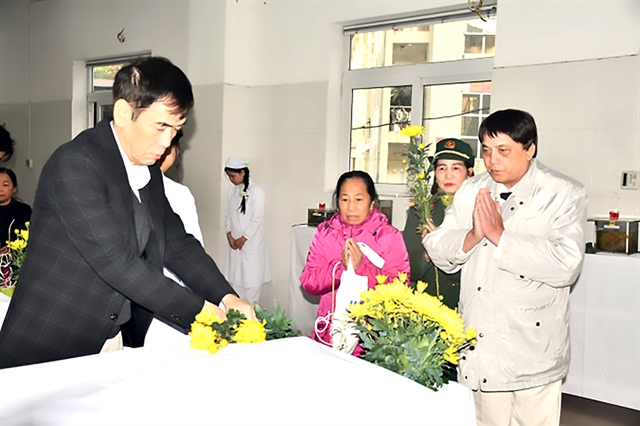 |
| Relatives of body donors lay flowers in tribute at the exhibition and specimen archive hall. — VNA/VNS Photo |
HÀ NỘI — The Việt Nam Military Medical University recently held a ceremony honouring those who have donated their bodies to medical science, a quiet tribute to sacrifices that continue to shape generations of doctors.
Among the seats reserved for relatives of donors, Nguyễn Thị Mai Hương from northern Ninh Bình Province followed each ritual in silence.
Six years have passed since the day her father, Nguyễn Đại Lượng, died and donated his body to medicine.
Her presence at the event recalled a private family memory and embodied a deeply humane choice that transcends conventional boundaries between life and death.
Here, death was not spoken of merely as a loss, but as a transfer of values.
Those who have donated their bodies to medical science may no longer exist biologically, yet they continue to live on in anatomy lectures, hands-on training sessions and every generation of doctors educated through their silent sacrifice.
According to the university’s Department of Anatomy, in 2025 the unit provided counselling to more than 1,000 individuals interested in body donation and received 75 registrations.
The department also accepted seven donated bodies, including several from southern provinces.
Doctors conducted full dissections of two bodies for training and scientific research and returned the remains of two donors to their families and localities for burial in accordance with traditional customs.
According to experts, no method has yet been able to fully replace direct learning on the human body, despite remarkable advances in science and technology in recent years.
This direct experience allows medical students to understand human anatomy and the limits of life itself in the most comprehensive way.
The acceptance of donated bodies for teaching and scientific research is not only a regular need but also a fundamental prerequisite for medical training institutions.
Lieutenant General Professor Trần Viết Tiến, director of the Việt Nam Military Medical University, said this was an extraordinarily noble sacrifice that overcomes psychological barriers, customs and social prejudices.
"It is a special contribution to a special cause, the cause of medical education and research," he said.
“The quiet sacrifice has helped the university train thousands of doctors and healthcare workers for Việt Nam’s health sector in general and the military medical system in particular. Hundreds of morphological scientific studies have been applied in medical examination and treatment, saving lives and restoring health to countless patients,” he said.
“Without these silent teachers, there would be no solid foundation for future physicians.”
For families of donors, gratitude is expressed not only in words but also through the way the university receives, preserves and returns the remains.
Hương said: “Over the past six years, our family has always felt the dedication and respect shown by the Việt Nam Military Medical University toward my father. We have never felt that he was forgotten.
“Every ritual and every small detail have been carried out with care and solemnity.”
When the university organised funeral rites and returned Lượng’s remains to his hometown for burial at the end of 2025, the thoughtfulness and compassion shown by its staff, lecturers and students left a deep impression on both the family and local authorities, she said.
“That was not merely the fulfilment of a duty, but a very clear expression of medical ethics and professional character,” Hương said.
Beyond commemorating those who have passed away, the gratitude ceremony also honoured those who are living and have registered to donate their bodies to medical science.
Nguyễn Thị Vân, 61, from Bình Minh Commune in Hà Nội, who has registered as a body donor at the university, said this was not an easy decision, especially given the weight of traditional beliefs.
“After death, if one’s body can become a source of learning materials that help train good doctors and save more lives, then it is not an end, but a continuation of life,” she said.
"Donating one’s body to medical science is not an act of abandonment, but a meaningful and humane transformation of life’s value into another form.
“Leaving one’s body for teaching and scientific research is one of the most important decisions in a lifetime. We may not be able to change the world, but we can change ourselves, breaking down outdated notions that death is the end.
“We firmly believe that our sacrifice and contribution will never be forgotten.”
At the Việt Nam Military Medical University, body donors are commemorated regularly on the first and fifteenth days of the lunar month and on death anniversaries.
Solemn ceremonies are held for the reception and return of remains.
All donors are regarded as an inseparable part of the university’s medical training tradition.
Sergeant Nguyễn Lê Tường Vy, a student at the university, referred to body donors as silent teachers who impart the most profound lessons not only in professional knowledge but also in medical ethics.
“Every moment of learning on donated bodies is a privilege. We pledge to study with utmost dedication, caution and respect. We will train not only our skills but also our medical ethics, so as to be worthy of this noble sacrifice,” Vy said.
“Medicine is an empirical science. Without these donated bodies, our knowledge would remain mere dry lines of text on paper, lifeless simulated images lacking the vitality of the wondrous human structure,” she said. VNS
Society
 Society
 Society
 Society
 Society
 Society
 Society
 Society
 Society
 Society
 Society
 Society
 Society
 Society
 Society