 Society
Top leader hails friendship association's role in nurturing Việt Nam–Denmark ties
1.
|
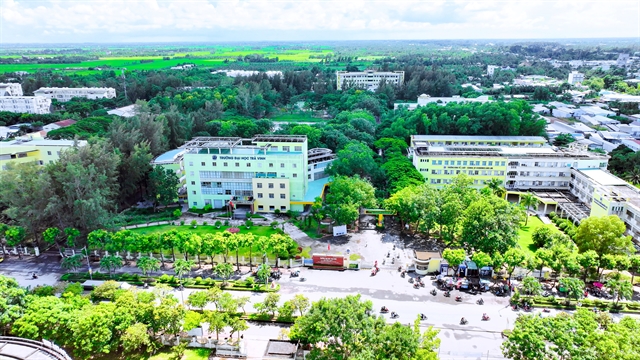
| A view of Trà Vinh University in Vĩnh Long Province. — Photo courtesy of Trà Vinh University |
VĨNH LONG — Trà Vinh University in Vĩnh Long Province has entered a new stage of development after being officially recognised as a university following 25 years of formation.
It was upgraded under a Government decision issued on January 12, 2026, opening a new development phase with greater scale and standing in Việt Nam’s higher education system.
With this recognition, it becomes the 13th university nationwide and the second in the Cửu Long (Mekong) Delta after Cần Thơ University.
It is now a public higher education institution under the Vĩnh Long Province People’s Committee, with full legal status, its own seal and accounts and headquarters in Vĩnh Long Province.
The transformation marks an important step forward in scale, organisational structure and governance capacity, in line with the Law on Higher Education.
To be recognised as a university under the Government’s Decree 99 issued in 2019, an institution must meet strict requirements related to quality accreditation, training scale, doctoral programmes, and approval from competent authorities.
The predecessor of Trà Vinh University was Trà Vinh Community College, established in 2001 under the Việt Nam–Canada Community College Project.
On June 19, 2006, the Prime Minister signed the decision establishing Trà Vinh University, marking a major turning point for higher education development in the province.
According to Professor Phạm Tiết Khánh, chairman of the University Council and former rector, the university’s establishment was intended not merely to add another higher education institution to the region but to develop a community-linked university model directly serving provincial and Mekong Delta development needs.
The university was oriented towards expanding quality learning opportunities for local people, especially those in remote areas and Southern Khmer communities, while training human resources for key sectors such as agriculture, fisheries, healthcare, engineering and technology, economics and socio-cultural fields.
Another major milestone was Trà Vinh University becoming one of the first 23 higher education institutions nationwide to pilot university autonomy under Resolution 77/NQ-CP in 2014. By 2017, it was granted full autonomy by the Prime Minister.
|
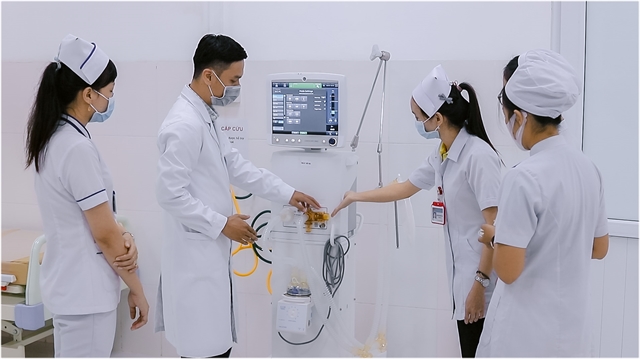
| Medical students get clinical training at Trà Vinh University Hospital. — Photo courtesy of Trà Vinh University |
Currently, the university is licensed by the Ministry of Education and Training to enrol students nationwide, offering 10 doctoral programmes, 20 master’s programmes, nine level-1 specialist programmes, one level-2 specialist programme, 50 undergraduate programmes and one college-level programme.
It has five member schools: the School of Economics and Law; the School of Southern Khmer Language, Culture, Arts and Humanities; the School of Medicine and Pharmacy, together with Trà Vinh University Hospital; the School of Engineering and Technology; and the School of Pedagogical Practice.
Remaining steadfast in its mission as a “university for the community”, Trà Vinh University is among the few public institutions implementing a comprehensive study promotion policy.
During the 2021–25 period, it provided tuition exemptions and reductions, learning support, social allowances and scholarships to more than 13,100 students, with total funding exceeding VNĐ60 billion (US$2.28 million).
From this learning environment, many individuals have grown and made positive contributions to society.
Among them is Dr Ngô Sô Phe, principal of the School of Southern Khmer Language, Culture, Arts and Humanities.
Coming from a disadvantaged Khmer community, she has followed a path closely linked to the university, from a staff member recruited in 2001 to an education manager, with support from the university alongside her own efforts.
“If it were not for the community university model and the university’s humane study promotion policies, it would have been difficult for me to complete my academic journey from intermediate level to doctorate.
“The university helped me believe that knowledge can change destiny – not only for an individual but for an entire community,” she said.
|
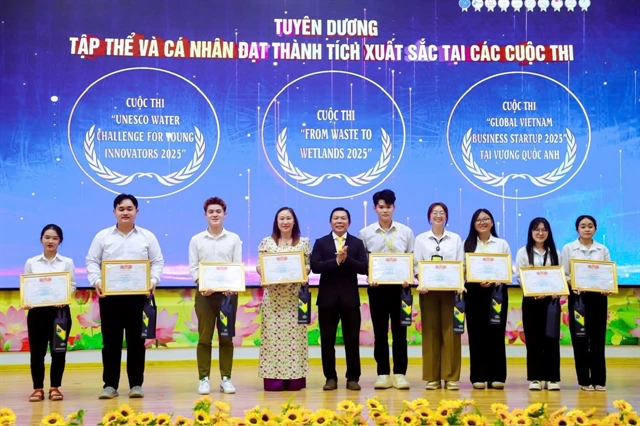
| Trà Vinh University gives certificates of merit to students with outstanding achievements in competitions. — Photo courtesy of Trà Vinh University |
Associate Professor Nguyễn Minh Hòa, rector of Trà Vinh University, said higher education today is not only about transmitting knowledge but about transforming it into a tool for human and community development.
The university has consistently pursued the principle of placing learners at the centre, focusing on equipping students with solid professional knowledge linked to soft skills, critical thinking, adaptability and social responsibility, he said.
At the same time, it has strengthened practice-oriented training through its co-operative education (Co-op) model and promoted international cooperation, scientific research and innovation.
Last year, the university ranked 29th among 400 leading innovative universities worldwide in the World’s Universities with Real Impact (WURI) Ranking, up 13 places from 2024.
It placed 133rd out of 1,477 institutions globally in the UI GreenMetric World University Rankings, received the National Digital Transformation Award for three consecutive years and was honoured at the Smart Education Initiative (SEI) Awards 2025 in the “Smart Education Initiative” category.
To date, 27 training programmes have achieved international accreditation under standards such as the Foundation for International Business Administration Accreditation (FIBAA – Europe), ASEAN University Network Quality Assurance (AUN-QA – Southeast Asia) and the Accreditation Board for Engineering and Technology (ABET – the US), placing it among institutions with the highest number of internationally accredited programmes in the Mekong Delta.
During the 2021–24 period, the university published more than 2,100 scientific papers, including over 570 international publications, many with practical application value for socio-economic development in the Mekong Delta.
Hồ Thị Hoàng Yến, standing deputy secretary of the provincial Party Committee, said the university’s recent development clearly demonstrates the effectiveness of a community-linked university model.
From an initial 3,000 students in 2001, Trà Vinh University had trained around 30,000 students, trainees and doctoral candidates by 2025, making an important contribution to supplying high-quality human resources for the province and the region, while fulfilling a national key task in training Southern Khmer language, culture and arts. — VNS
Society
 Society
 Society
 Society
 Society
 Society
 Society
 Society
 Society
 Society
 Society
 Society
 Society
 Society
 Society