 Society
84 individuals investigated for transnational online frauds
1.
 |
| The urban operations centre in Bắc Giang Ward, Bắc Ninh Province. Photos courtesy of Bắc Ninh Province |
BẮC NINH — In 2026, Bắc Ninh Province will implement the application and development of artificial intelligence (AI) across sectors and fields, aiming to create a technological breakthrough and contribute to the province’s socio-economic development.
The initiative is among key measures to advance the construction of a smart city as well as e-government and digital government, which the province has prioritised for the coming year.
According to Mai Sơn, Standing Vice Chairman of the Bắc Ninh Provincial People’s Committee, the province has effectively implemented its Digital Transformation Strategy for the period of 2025–2030 and the Digital Transformation Plan for the period of 2021–2025, with a vision to 2030.
Notable initiatives include the establishment of 'community digital technology teams' and 'rapid response support teams' to promptly assist officials and residents at the grassroots level in addressing difficulties and technical issues.
Next year, Bắc Ninh will roll out the provincial AI application and development scheme, launch the 'Digital Literacy for All' movement, and update the e-government architecture to version 4.0.
The province will also ensure the stable and uninterrupted operation of shared information systems to support the two-tier local government model following the provincial merger. At the same time, AI tools will be developed to support administrative procedures, particularly in investment and construction activities.
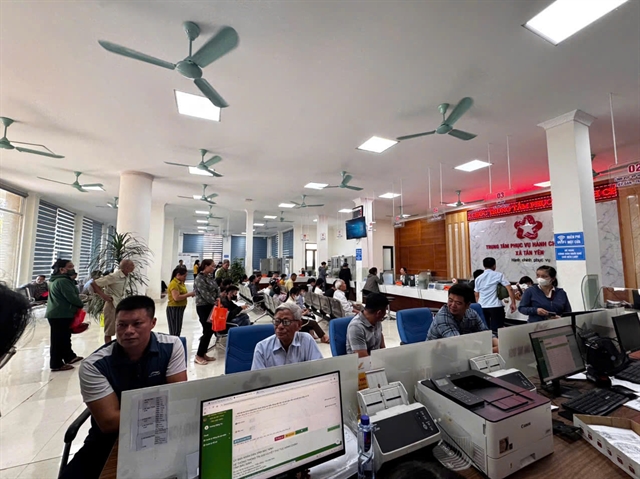 |
| Applying information technology and digital transformation in handling administrative procedures for citizens at the Tân Yên Commune Public Administration Service Centre, Bắc Ninh Province. |
Agencies will advise the provincial People’s Council on issuing a resolution on policies to promote semiconductor industry development in Bắc Ninh, and submit to the provincial People’s Committee a plan for transitioning to an IPv6-only network across the province during the period of 2026–2030.
In addition, Bắc Ninh will step up digital skills training for residents, implement programmes to support citizens in digitisation and online application submission and strengthen proactive and transparent communication. These efforts aim to highlight the benefits of online public services and enhance two-way interaction between citizens, businesses and state agencies.
In 2025, the province placed strong emphasis on improving the quality and effectiveness of administrative reform, implementing tasks in a responsible, systematic, proactive and innovative manner. This was in line with Directive No 03-CT/TU dated August 28, 2025, issued by the Standing Board of the provincial Party Committee on strengthening administrative discipline, order and working style within Party agencies and the political system.
These efforts have helped enhance the efficiency and effectiveness of the two-tier local government apparatus.
In advancing digital transformation alongside information technology application and the development of e-government and digital government, Bắc Ninh has issued several key documents to implement Politburo Resolution No 57-NQ/TW dated December 22, 2024, on breakthroughs in science and technology development, innovation and national digital transformation.
The province has also consolidated its Steering Committee on science and technology development, innovation, digital transformation and Project 06, and established inspection teams on administrative reform and digital transformation in 2025, covering 36 communes and wards and four provincial departments.
As a result, in 2025 Bắc Ninh ranked sixth among 34 centrally governed cities and provinces in the innovation index, and second nationwide in meeting all 16 criteria of Phase 1 for the two-tier local government digital transformation. The province also remained among the leading localities in fulfilling 96 indicators of Phase 2.
Notably, Bắc Ninh has continued to hold the top national position in the index for leadership, governance and quality of services provided to citizens and businesses in the digital environment, reaffirming its pioneering role in administrative reform, digital transformation and the development of a service-oriented government.
The province’s digital infrastructure has expanded rapidly, with 4G coverage reaching 99 per cent and 5G coverage 53 per cent. Meanwhile, 97 per cent of eligible administrative procedures, 959 out of 989, are now available through fully online public services, laying a solid foundation for building digital citizens and a digital society. — VNS
Society
 Society
 Society
 Society
 Society
 Society
 Society
 Society
 Society
 Society
 Society
 Society
 Society
 Society
 Society