 Society

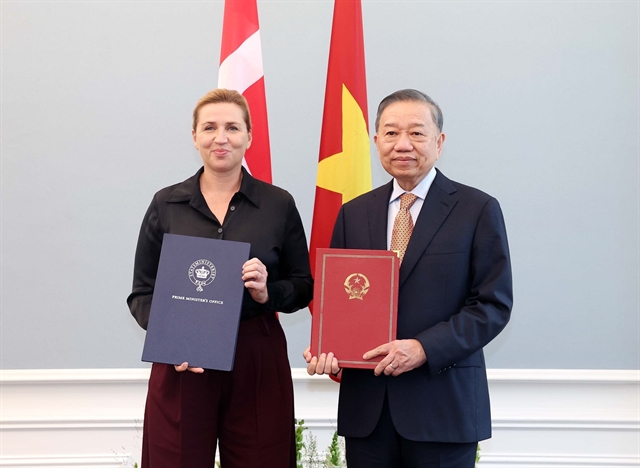
Việt Nam, Denmark issue joint statement on establishment of Comprehensive Strategic Partnership
1.
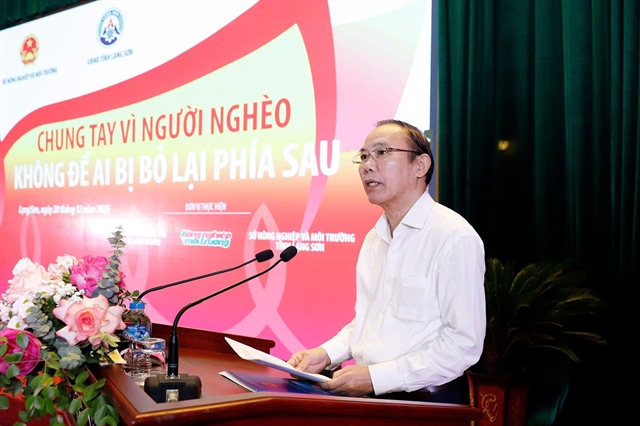 |
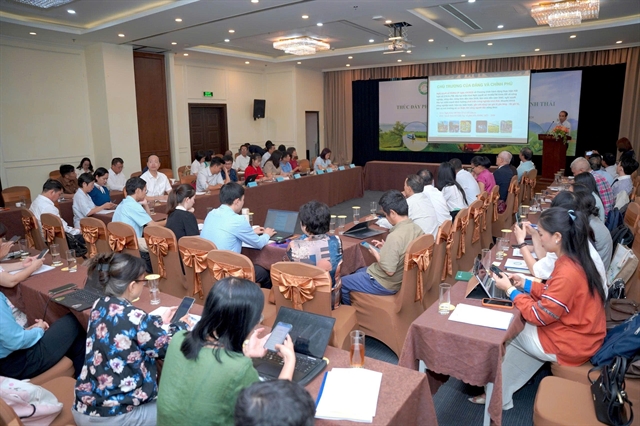
| Deputy Minister Phùng Đức Tiến speaks at the event. — Photo courtesy of the Agriculture and Environment Newspaper |
LẠNG SƠN — The 2021–2025 period marks a significant turning point for Việt Nam in implementing multidimensional, inclusive and sustainable poverty reduction.
With a people-centred approach, linking poverty reduction to livelihood development, improving quality of life and ensuring social security, Việt Nam has achieved remarkable results, recognised by the international community as a bright spot in Asia.
Practice shows that only when people have stable livelihoods and a safe, sustainable living environment can the goal of "leaving no one behind" truly become a reality.
The Ministry of Agriculture and Environment (MAE), in collaboration with the Lạng Sơn Province People's Committee, on Saturday morning organised the event "Joining hands for the poor – Leaving no one behind" in Lạng Sơn Province.
The event took place as the National Target Programme on Sustainable Poverty Reduction for 2021–2025 entered its final phase, providing an opportunity to assess achievements, share experiences and outline directions for the next development period.
Speaking at the event, Deputy Minister of Agriculture and Environment Phùng Đức Tiến affirmed that sustainable poverty reduction was one of the major, consistent and overarching policies of the Party and State throughout the process of leading, building and developing the country.
This policy had been concretised through the National Target Programme on Sustainable Poverty Reduction for 2021–2025 and orientations for 2026–2030.
According to Deputy Minister Tiến, as the country entered a new development phase with higher requirements for growth quality, social equity and sustainable development, the National Target Programme on Sustainable Poverty Reduction holds even greater long-term strategic significance.
This is clear evidence of the superiority of our regime, which places people at the centre and ensures no one is left behind in the development process.
The Deputy Minister emphasised the Government's consistent view that progress and social equity must not be sacrificed for purely economic growth.
This requires ministries, sectors, and localities to closely and effectively integrate poverty reduction policies with economic and social development, ensuring inclusive and sustainable growth.
For the MAE, sustainable poverty reduction must be linked to ecological agriculture, modern rural areas and civilised farmers, efficient resource use and environmental protection.
It should also be connected to vocational training, science and technology transfer, and expanding markets for agricultural products.
Implementation practice shows that only when people have stable livelihoods and a safe, sustainable living environment can the goal of "leaving no one behind" be achieved substantively.
A key milestone highlighted by Deputy Minister Tiến is that on December 11 this year, the National Assembly approved the policy to invest in the national target programmes on new rural development, sustainable poverty reduction, and socio-economic development in regions of ethnic minority communities and mountainous areas for 2026–2035.
This is a decision of special importance, reflecting the Party and State's long-term, consistent vision in ensuring social security and inclusive, sustainable development.
Under the new orientation, the three national target programmes will be integrated to optimise resources, enhance investment efficiency, and focus more on difficult areas, especially those of ethnic communities and mountainous regions.
This integration does not reduce existing policies but aims for more focused and efficient resource use, thereby improving people's material and spiritual living standards.
Sharing local poverty reduction results, Trần Thanh Nhàn, Deputy Chairwoman of the Lạng Sơn Provincial People's Committee, said that from the start of the 2021–2025 period, the province identified sustainable poverty reduction as a key political task requiring synchronised efforts from the entire political system and consensus from the people.
During this period, Lạng Sơn Province allocated over VNĐ1.1 trillion (US$41.7 million) to implement the National Target Programme on Sustainable Poverty Reduction, focusing on investing in economic and social infrastructure in poor districts, supporting housing for poor and near-poor households, as well as deploying practical social security policies.
The province completed the construction and repair of 1,367 houses for poor and near-poor households in poor districts, helping to improve living conditions and enable people to settle down with peace of mind.
Alongside this, essential infrastructure such as transport, irrigation, electricity, health stations and educational facilities continued to be invested in and upgraded, creating a vital foundation to promote grassroots economic and social development.
In livelihood diversification, Lạng Sơn implemented 249 poverty reduction models and 164 production development support projects. Over 8,400 households benefited through support for crop seeds, livestock, production materials, and training in science and technology transfer.
According to Nhàn, linking livelihood support with technical transfer has helped people gradually enhance production capacity and increase income sustainably.
Thanks to synchronised solutions, the average annual poor household rate in Lạng Sơn Province for 2021–2024 decreased by 2.95 per cent, and the multidimensional poverty rate fell by 4.3 per cent.
It is projected that by the end of this year, the province's overall poor household rate will be below three per cent, meeting the set targets and laying a solid foundation for the next poverty reduction phase.
From a national perspective, Phạm Hồng Đào, Deputy Head of the National Office on Poverty Reduction, affirmed that Việt Nam's achievements in 2021–2025 had been recognised by the international community as a bright spot in Asia for multidimensional, inclusive, and sustainable poverty reduction.
According to Đào, this success is not only evident in 19 particularly difficult communes in coastal, lowland and island areas, along with some poor districts, escaping poverty, but also in a fundamental shift in people's mindset.
In reality, in many localities, poor households have proactively submitted requests to escape poverty, yielding support to those in greater need.
Additionally, many localities have proactively issued specific policies to support groups unable to work, such as elderly people without pensions, clearly demonstrating the humanitarian spirit of "leaving no one behind".
However, Đào frankly pointed out bottlenecks affecting the sustainability of poverty reduction efforts: reluctance, avoidance and shirking of responsibility by some officials; delays in issuing guiding documents; limitations in applying information technology and communication work; and a mindset of dependency on the State still existing among some people.
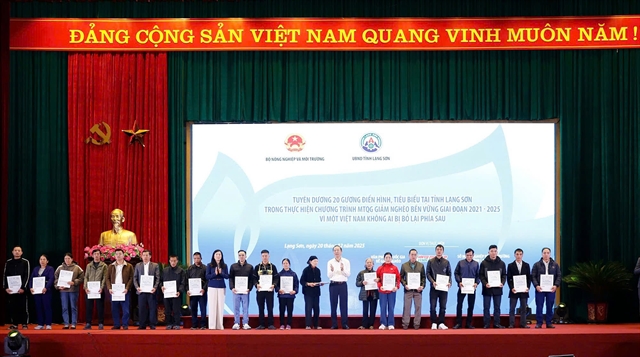 |
| Outstanding organisations and individuals receive certificates of merit for their contribution to sustainable poverty reduction in the 2021-2025 period. — Photo courtesy of the Agriculture and Environment Newspaper |
Moving into 2026–2035, Việt Nam will witness a "revolution" in organisation as the three national target programmes are integrated into a single unified programme.
The 2026–2030 target is to maintain a multidimensional poverty reduction rate of 1–1.5 per cent annually, with ethnic minority areas striving to reduce the poverty rate below 10 per cent. The focus is not just numerical reduction but building "happy communities" linked to people's actual quality of life.
Within the event framework, practical activities were implemented, such as honouring individuals and organisations with positive contributions to social security work, introducing and displaying typical products linked to sustainable livelihoods and local people's poverty escape journeys.
Businesses and social organisations also donated agricultural materials, seeds, and livestock to support production development, job creation and income improvement.
Additionally, the programme provided free medical examinations and treatments, legal and vocational counselling for poor, near-poor households and vulnerable groups, delivering direct and timely support.
These activities helped strengthen the social security network and promote sustainable poverty reduction nationwide.
The event continued to spread the message of solidarity, social responsibility and political determination in achieving multidimensional, inclusive and sustainable poverty reduction, for a harmoniously developing Việt Nam where no one is left behind. — VNS
Society
 Society
 Society
 Society
 Society
 Society
 Society
 Society
 Society
 Society
 Society
 Society
 Society
 Society
 Society