 Society
84 individuals investigated for transnational online frauds
1.

|
| The extended March 2 Road in An Giang Province connects with National Highways 61 and 63. In 2020–25 the province built 95 modern transport infrastructure projects. – VNA/VNS Photo Lê Huy Hải |
AN GIANG – An Giang Province is focusing on implementing three national target programmes to promote comprehensive socio-economic development and improve the living standards of its people, especially those living in remote, isolated areas and belonging to ethnic communities.
The programmes are sustainable poverty reduction, new-style rural area development, and socio-economic development in ethnic minority and mountainous areas.
They form an important pillar of the province’s strategy for fast and sustainable development.
Following the merger with former Kiên Giang Province on July 1, An Giang now has 85 communes, 14 wards and three special zones.
Lê Hữu Toàn, director of the Provincial Department of Agriculture and Environment, said steering committees for new-style rural area development have been established at all levels, with operational regulations issued and responsibilities assigned to their members for execution.
The Cửu Long (Mekong) Delta province now has 69 new-style rural communes.
Nine have achieved “advanced new-style rural commune” status, and one has been recognised as an “exemplary new-style rural commune,” Toàn said.
The province prioritises investment in essential infrastructure and human development, building and upgrading roads, bridges, canals, and water works, and improving schools and healthcare facilities.
It also supports effective production models while offering vocational training and technical transfer to boost farmers’ productivity and access to modern technologies.
These efforts help improve rural living conditions and the environment, contributing to the quality of new-style rural communes.
An Giang has 12,736 poor households, accounting for 1.27 per cent of the province’s total poor households. It also has 24,687 near-poor households, equivalent to 2.46 per cent of the total.
As of mid-September over VNĐ31.6 billion ($1.2 million) had been spent to support poor and near-poor households by providing seeds, other inputs for agriculture and equipment, improve transport and utilities, support aquaculture and agriculture, build houses, offer vocational training, create jobs, and ensure access to healthcare and education.
|
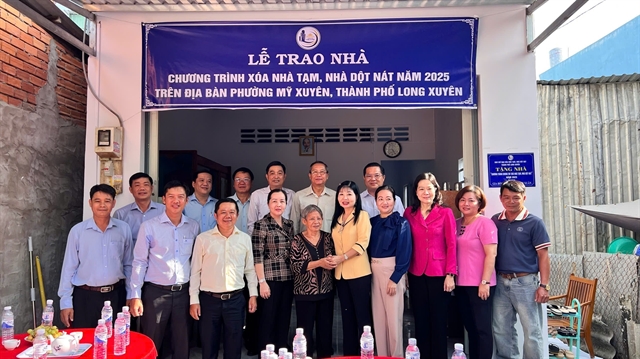
| A ceremony to hand over new houses under a national programme to eliminate temporary and dilapidated homes was held in the former Long Xuyên City’s Mỹ Xuyên Ward (now part of the Long Xuyên Ward) in An Giang Province. – VNA/VNS Photo Thanh Sang |
In implementing the national emulation movement of “The whole country joins hands to eliminate temporary and dilapidated houses nationwide,” the province has provided support for 9,082 houses for disadvantaged families, 7,185 of them newly built and 1,897 renovated. The total cost was nearly VNĐ490 billion ($18.6 million).
Completing the programme to eliminate temporary and dilapidated houses helps disadvantaged households have safe homes.
This motivates poor and near-poor households to improve their lives, contributes to sustainable poverty reduction and spreads a spirit of mutual support with deep humanitarian significance, ensuring “no one is left behind,” according to local authorities.
For the programme on socio-economic development in ethnic community and mountainous areas, the province has developed plans and promptly implemented projects for local people, prioritising State budget resources for especially disadvantaged communes and villages.
However, its Department of Finance said the implementation of the three national target programmes still faces many difficulties.
Guidance mechanisms and policies are inconsistent, often unsuitable for practical conditions, and frequently change, and the handover of funds at the commune level remains slow.
Targets
In 2026–30 An Giang aims for all communes to meet new rural standards and to reduce the multi-dimensional poverty rate by an average of 0.3–0.5 percentage points per year.
During the period it will focus on effectively implementing the three programmes, contributing to socio-economic development and aiming for average five-year economic growth of 11 per cent or more.
|
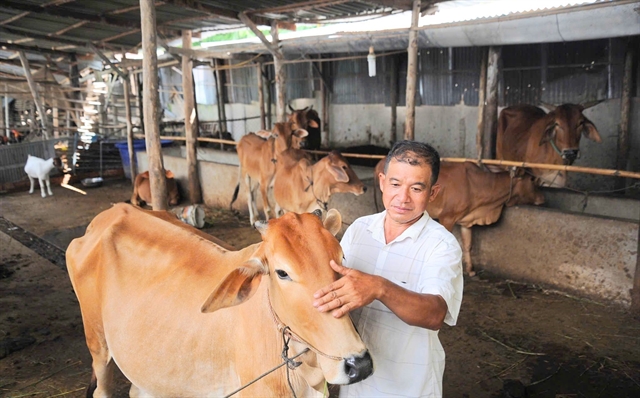
| With a loan from the Vietnam Bank for Social Policies, Chau Kóp, an ethnic resident of Ô Lâm Commune in An Giang Province, breeds cattle, providing his family with a steady income. – VNA/VNS Photo Công Mạo |
To effectively implement these programmes, it will mobilise and allocate resources reasonably, integrate them with related policies, and harness the community’s role to create breakthroughs in socio-economic development.
It will prioritise investment in particularly disadvantaged communes, border areas and ethnic regions, mobilise funding also from outside the State budget, especially from businesses and the community, to implement the programmes.
It will link the national target programmes with local economic development projects such as eco-tourism, high-tech agriculture and aquaculture, border trade, and the maritime economy.
It offers intensive training for commune officials in project management and community monitoring, uses IT to track progress and investment efficiency and promotes citizen participation.
It enhances communications to raise awareness of the national target programmes, fosters sustainable border-area development through trade and tourism with Cambodia and builds smart, digitally connected rural communities with higher incomes. – VNS
Society
 Society
 Society
 Society
 Society
 Society
 Society
 Society
 Society
 Society
 Society
 Society
 Society
 Society
 Society