 Society

Atlantis Studio's Two-Player Horror Game Beyond the Dark: Nightwatch to Be Published by Q-Games!
1.
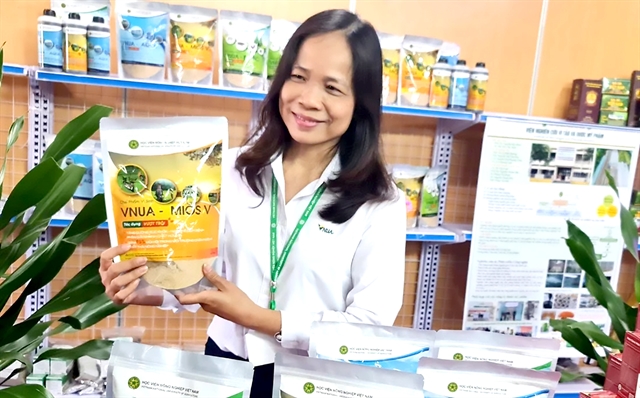 |
| Professor Nguyễn Thị Minh and her products, which make use of superior technology to support farmers in livestock and aquaculture. — Photo danviet.vn |
HÀ NỘI — Scientific and technological start-ups formed by establishing spin-off enterprises are helping the Việt Nam Academy of Agriculture break the barrier between scientists, farmers and businesses.
Using the start-ups as a model is putting scientific research into reality, paving the way for laboratory-based, technology-driven studies to be applied in practice and help farmers overcome problems.
The start-up model originated from ideas developed in the laboratory by Associate Professor Dr Nguyễn Thị Minh, creating a circular cycle in agricultural production and supporting the development of organic and green agriculture.
Starting with this idea, Minh and her colleagues have worked to implement the programme 'Applying advanced technology to support livestock farmers and aquaculture'.
Many of the new products created by Minh come from laboratory ideas and apply advanced technology to help farmers solve some of the many issues they face.
Minh told danviet.vn: “We can absolutely develop organic and circular agriculture in a synchronised way by bringing research products with outstanding features into actual production.
“This provides highly practical benefits, not only increasing value for livestock farmers, reducing environmental pollution and making use of waste, but also making the most of abundant rural labour and improving farmers’ livelihoods."
“These are the things we find truly useful for farmers, and we always strive to innovate and research even more superior products for farmers. We will continue to accompany and support them in developing livestock and aquaculture models at any scale so they can expand and contribute to organic agriculture in Việt Nam,” she said.
Putting farmers at the centre was the core principle for Minh when she founded JAMITECH-VNUA, one of the companies applying the spin-off model. The firm aims to bring laboratory products to the market and meet the needs of green, organic and circular agricultural development that adapts to climate change.
Out of research on farming, scientific studies are now being applied in reality, helping farmers escape hardship and improve their incomes.
Trial results in provinces like Hòa Bình, Bắc Giang and Bến Tre show that when farmers use these advanced scientific and technological products and follow a closed-cycle process in livestock farming and aquaculture, they can reduce production costs by more than 20 per cent, lower labour intensity and cut livestock odours by over 95 per cent.
On average, input costs are reduced by up to VNĐ300,000 (US$12) per pig, and VNĐ20,000 ($0.80) per chicken.
In addition, these products help reduce environmental pollution, lower livestock odours by over 90 per cent and ensure no negative impact on farmers’ health, which in turn increases acceptance among surrounding communities, Minh said.
The quality of meat, eggs and milk is also improved, meeting safety and export standards as antibiotic residues used for disease prevention are eliminated, she added.
Livestock waste is then used to produce organic fertiliser for crops, increasing value for livestock farmers while protecting the environment.
True to her core principle, the products are made with the benefit of farmers at the centre.
“If this technology application programme is implemented correctly within a closed livestock and aquaculture cycle, it will strongly support the development of circular economies in localities,” Minh said.
“Livestock waste and crop by-products will be used and treated with biological products and composted into organic or microbial organic fertiliser for crops, reducing the need to purchase chemical fertilisers and pesticides,” she added.
“Crops then provide high-quality raw materials for processing livestock feed and biological products, creating a circular cycle in agricultural production and promoting the development of organic and green agriculture synchronously."
The programme is currently being implemented in Hòa Bình and Bến Tre provinces, and a combination of goods developed in the lab, including the firm's Ja-MiosV, Ja-Biotic and Ja-Aqua products, is being introduced more widely to farmers.
JAMITECH-VNUA plans to continue expanding to other provinces, including Bắc Giang, Hải Phòng, Hải Dương, Thanh Hóa and Ninh Bình. It will also replicate the model in more localities, contributing to value chains for livestock and aquaculture farmers while still protecting the environment.
This aligns with the national goal of promoting green, organic and circular agriculture. — VNS
Society
 Society
 Society
 Society
 Society
 Society
 Society
 Society
 Society
 Society
 Society
 Society
 Society
 Society
 Society