 |
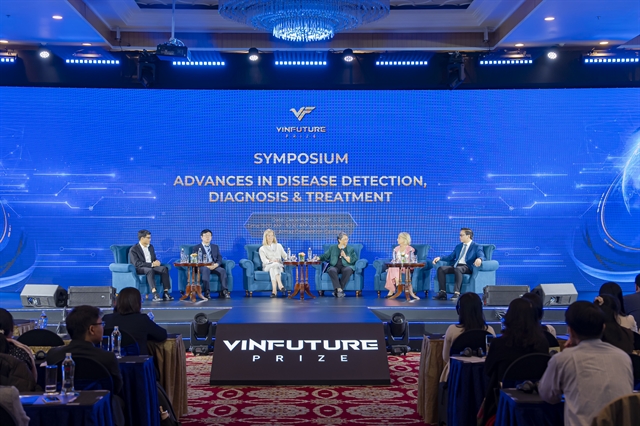
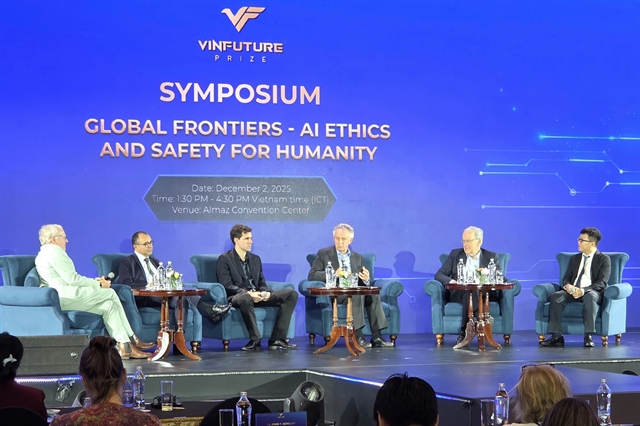
| A panel discussion as part of the symposium in Hà Nội on December 3. — Photo courtesy of the organiser |
HÀ NỘI — The rapid rise of digital technology, artificial intelligence (AI), gene technology and biomaterials is reshaping global health care, marking what experts describe as a pivotal moment for Việt Nam to accelerate the application of science and technology in health care and protection.
Participants heard this at an international symposium themed Advances in Disease Detection, Diagnosis and Treatment in Hà Nội on December 3.
The symposium is part of the Science for Life symposia under the framework of the 2025 VinFuture Sci-Tech Week, held in Hà Nội from December 2 to 6.
Speaking at the event, Director of the Department of Science, Technology and Training under the Ministry of Health Nguyễn Ngô Quang affirmed that the Ministry has identified science and technology as a key driving force to improve the quality of medical examination and treatment and strengthen the capacity of the health system.
According to Dr Quang, in 2025, humanity continues to face growing and complex global health burdens. The incidence of non-communicable diseases, particularly cancer, diabetes and cardiovascular disease, continues to rise sharply in many regions. Re-emerging and new infectious diseases put pressure on health systems, especially in the context of climate change, which increases the risk of epidemics.
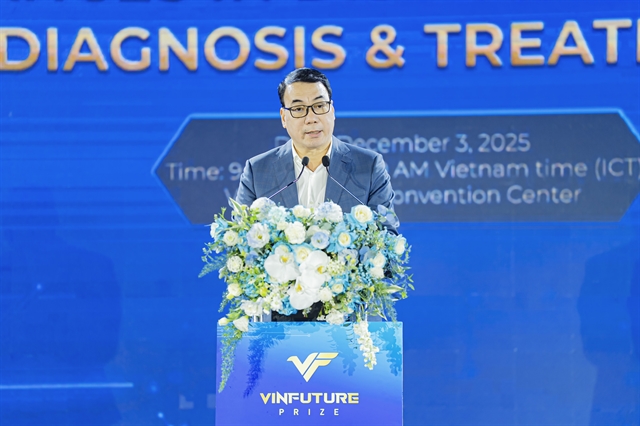 |
| Director of the Department of Science, Technology and Training under the Ministry of Health, Nguyễn Ngô Quang, speaks at the symposium. — Photo courtesy of the organiser |
Quang stressed that antibiotic resistance is approaching alarming levels, threatening to reverse many of the medical achievements of the past century. Disparities in access to health services between countries and population groups are becoming increasingly evident, creating an urgent need for innovation to deliver more precise, effective and sustainable medical solutions.
However, Quang said unprecedented opportunities are emerging from the rapid expansion of digital technology, AI, gene technology and biomaterials in disease diagnosis and treatment. From phage therapies to combat drug resistance to the application of 3D printing technology in surgery, new breakthroughs in hearing science and advanced biomedical trends are key research directions that the Vietnamese health care sector is prioritising to access and apply.
“I do hope that today’s discussion will not only stop at academic exchange, but also be the beginning of many extensive cooperations between Việt Nam and the world’s leading research institutes, universities and hospitals," Quang said. "This will be an important driving force to help us access advanced technologies, conduct joint research and bring scientific advances closer to Vietnamese patients.”
According to Precedence Research, the global precision medicine market is projected to reach US$175 billion by 2030, paving the way for a new era of precision and personalised health care. These breakthroughs not only enhance the quality of diagnosis and treatment but also open prospects for improving life expectancy, raising quality of life and reshaping health care systems worldwide.
At the event, participants heard that global health care is witnessing remarkable progress driven by the convergence of AI, biotechnology, big data and smart medical devices.
Speakers shared cutting-edge developments in the application of technology to health care, including precision medicine, next-generation pharmaceuticals, digital solutions for disease monitoring and management and technologies enabling personalised treatment.
Professor Ana Belén Elgoyhen from the University of Buenos Aires, Argentina, presented new findings on therapeutic strategies for hearing loss. Her research explains why many people are vulnerable to hearing damage when exposed to loud noise and opens new treatment pathways for tinnitus and hearing loss, which are increasingly common in modern society.
The World Health Organisation estimates that more than 1.5 billion people are currently living with some degree of hearing loss. This figure is projected to increase significantly, with an estimated 2.5 billion people affected by 2050.
Without effective interventions, the annual global cost of hearing loss is estimated at more than US$980 billion. The burden is particularly heavy in low and middle-income countries, according to Professor Elgoyhen.
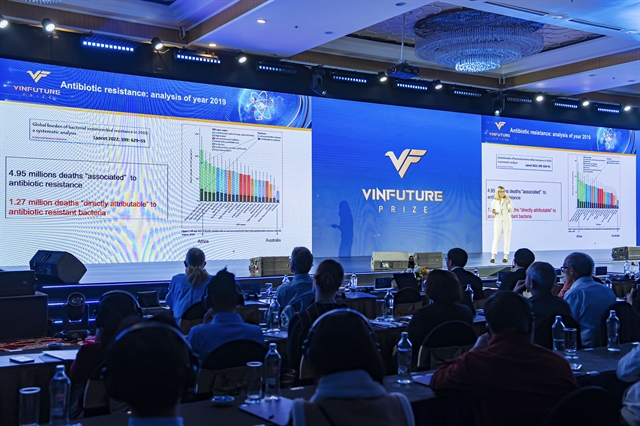 |
| Professor Pascale Cossart from the Pasteur Institute of Paris speaks at the event. — Photo courtesy of the organiser |
Meanwhile, Professor Pascale Cossart of the Pasteur Institute in Paris, a pioneering infection biologist renowned for her groundbreaking research on how bacteria infect and survive within host cells, shared findings on phage therapies in the fight against antibiotic resistance.
Professor Cosart’s phage therapy is a potential solution, taking advantage of the high specificity and self-replication ability of phages to destroy pathogenic bacteria without affecting beneficial bacteria. The therapy has currently been applied in many countries such as Georgia, Poland, France and the US.
Her research has not only introduced a new approach to infectious diseases but also paved the way for targeted therapies that could fundamentally change future strategies for disease prevention.
Professor Chuanbin Mao of the Chinese University of Hong Kong also shared new research on phage therapy involving cancer-hunting viruses.
According to Professor Mao, the most promising application is the use of phage therapy to treat bacterial infections and overcome antibiotic resistance. He added that phages may not always kill bacteria but can multiply on them, which has allowed the therapy’s scope to expand over time.
“Phage can diagnose and treat cancer, not just antibiotic resistance. The therapy’s application in the near future is to treat bacterial infections or diagnose cancer for use in hospitals, and in the future, to treat cancer in immunotherapy,” said Professor Mao.
3D printing technology, a breakthrough in orthopaedic surgery
Professor Trần Trung Dũng of the Vinmec Health care System and VinUni University shared his achievement in applying in-hospital 3D printing technology as a breakthrough in orthopaedic surgery.
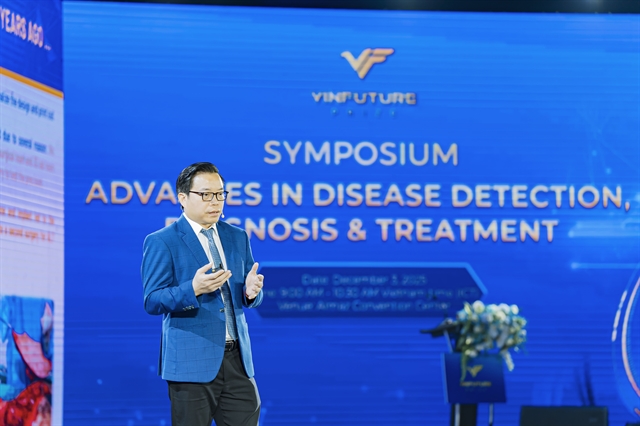 |
| Professor Trần Trung Dũng, Vinmec Healthcare System and VinUni University, speaks at the event. — Photo courtesy of the organiser |
Professor Dũng has pioneered the use of advanced surgical techniques and 3D medical technologies in Việt Nam, performing thousands of complex procedures that have set new standards in patient care. The technology enables the reconstruction of complex bone structures with high precision, helping patients regain better function and improve their quality of life.
According to Professor Dũng, bone cancer, especially in complex locations such as the pelvis or femur, has long been associated with the "decision" of amputation because this is the solution to preserve the patient's life.
In recent years, world medicine has developed bone regeneration techniques using individually designed metal implants, but the cost is too high for most patients to access. As a result, up to 30 per cent of patients with indications for amputation due to cancer have refused surgery.
The Vinmec medical team, led by Professor Dũng, has worked with VinUni’s Centre for 3D Technology in Medicine to apply specialised 3D techniques in the treatment of bone cancer patients. The use of 3D printing in medicine has delivered significant benefits and life-changing results for patients.
“Thanks to this technology, hospitals can use surgical instruments that fit Vietnamese anatomy at a cost much lower than imported products from the US or Europe. Of which, we successfully performed about 200 surgeries and supported 1,000 cases.”
“In addition, we also worked with domestic hospitals, oncology specialists, engineers and technicians from Japan, Korea and the United States to cooperate in research on material science, such as implants and 3D. We are currently continuing to collect clinical data to compare with research to find new directions, new and optimal solutions for the future,” added Professor Dũng.
The annual event is expected to become a platform connecting scientists, healthcare experts, industry leaders and policymakers to share visions, promote collaboration and advance breakthrough solutions for human health in the digital era. — VNS
 Society
















.jpg)