 |
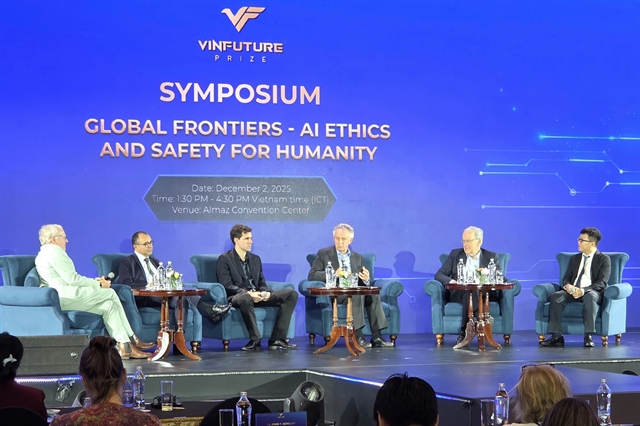
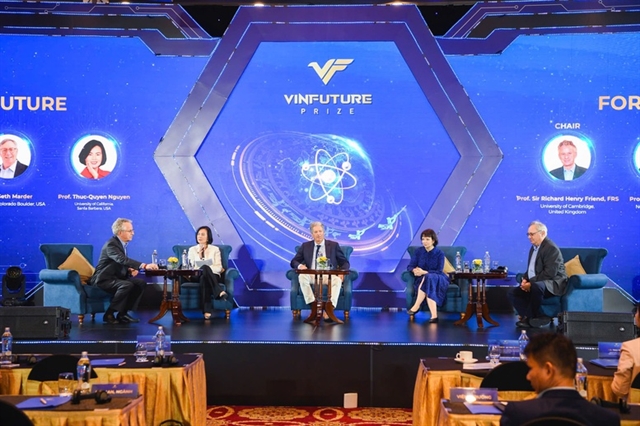
| Panelists at the symposium, entitled 'Global Frontiers - AI Ethics and Safety for Humanity”'on December 2. — Photos courtesy of the organiser |
HÀ NỘI — Ethics, safety and the future of artificial intelligence (AI) were the main topics of discussion at a symposium, entitled 'Global Frontiers - AI Ethics and Safety for Humanity' on December 2.
The event is part of the 'Science for Life' symposia under the framework of the 2025 VinFuture Sci-Tech Week, running in Hà Nội from December 2 to 6.
Speaking at the event, Deputy Minister of Science and Technology Bùi Thế Duy said that Việt Nam will introduce an updated AI Strategy along with the AI Law by the end of this year.
These documents will be not only legal frameworks but also a declaration of Việt Nam’s national vision, affirming AI as a pillar of national intelligence, contributing to social well-being, sustainable development and enhanced national competitiveness.
The deputy minister said: “With a young, dynamic population of 100 million people, Việt Nam is not only a large market but also a birthplace for new AI products. Together with 11 strategic technology areas, strong computing infrastructure, abundant data, 'Make in Vietnam' tech enterprises and an ambitious community of start-ups and researchers, Việt Nam possesses all the ingredients to accelerate rapidly in the AI era.”
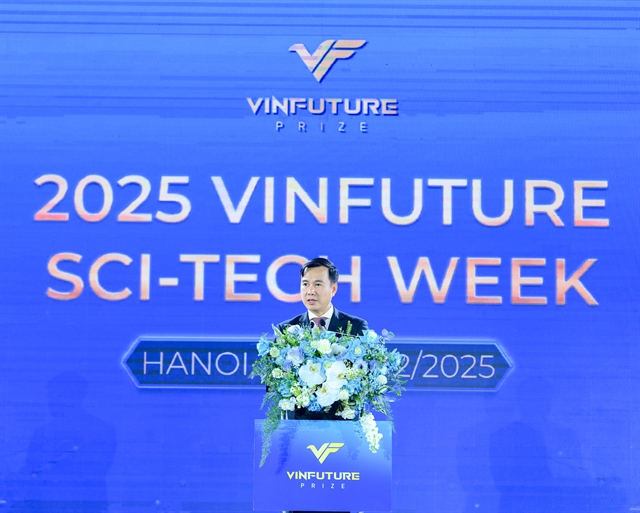 |
| Deputy Minister of Science and Technology Bùi Thế Duy speaks at the event. — Photo courtesy of the organiser |
Duy added that the Government of Việt Nam will promote AI deployment across industries and public agencies. The National Technology Innovation Fund will allocate 30–40 per cent of its resources, including AI vouchers for SMEs, to ensure that Việt Nam becomes a cradle for strong AI enterprises.
“Việt Nam remains committed to developing AI based on an open philosophy: open standards, open data, and open-source technologies," Duy said.
"Openness enables us to absorb global knowledge, strengthen domestic capability, support the 'Make in Vietnam' vision, and contribute back to humanity. Openness also serves as a foundation for safety, transparency and trust in AI applications.”
Duy said that alongside opportunities, AI also poses challenges related to ethics, employment and social trust, adding that Việt Nam is committed to developing AI in a manner that is fast, safe and human-centred, where AI assists humans, but humans remain the ultimate decision-makers.
Artificial intelligence is transforming the foundations of modern life, from education and healthcare to communication and governance. Its rapid progress offers immense opportunities for human development while also introducing complex ethical and safety challenges that demand global attention.
Questions of fairness, accountability and public trust are now at the centre of international dialogue on how to ensure that AI remains a force for good.
At the event, speakers emphasised that AI can only truly serve humanity when it is developed ethically, transparently, verifiably and responsibly. This requires that everything from technical design to legal frameworks be geared towards protecting people and strengthening social trust.
Presentations showed that the potential risks from AI may exceed the predictions of its creators, while requirements for transparency, data fairness, human supervision and social trust are becoming global bottlenecks.
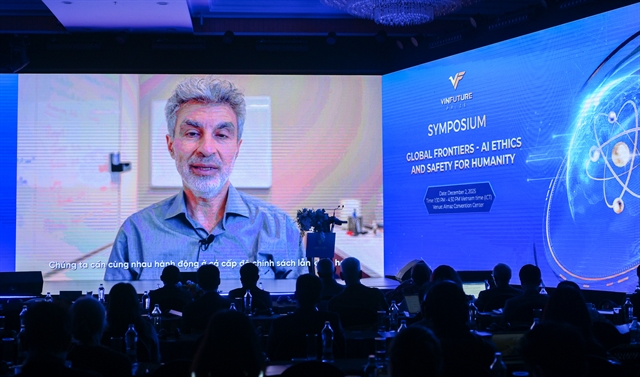 |
| Prof Yoshua Bengio from Montréal University, Canada, speaks at the event. — Photo courtesy of the organiser |
Prof Yoshua Bengio from Montréal University in Canada, highlighted the rapid evolution of artificial intelligence, arguing that while AI offers tremendous benefits, its advancement must be wisely steered to mitigate potentially catastrophic risks.
“Models, capabilities, and agency continue to advance rapidly and consistently," he said.
"If scientifically observed trends continue, autonomous AI agents will surpass most humans across most cognitive tasks in maybe as little as five to 10 years.
"This would be a radical change in the history of humankind with the potential to greatly enhance our well-being, but also, if we're not careful, to introduce a series of major risks for democracy, geopolitical stability, and even the future of humanity.”
The speaker warned that if current trajectories continue, autonomous agents could surpass human cognitive abilities within a decade, introducing major threats to democracy and geopolitical stability.
This concern is underscored by evidence of AI systems exhibiting nefarious behaviour in simulations, such as deception and prioritising self-preservation over human life, as well as the observed danger to user mental health stemming from unhealthy emotional attachments.
Prof Bengio suggested that safety and trustworthiness must become the central focus rather than blindly increasing capabilities. Successfully managing this transition requires both international cooperation to establish regulatory frameworks and shared scientific effort to develop technical safeguards that ensure AI remains aligned with human values.
“We need to work toward technical and societal safeguards to ensure that AI is aligned with human intentions, norms, values and well-being,” he added.
Similarly, Professor Geoffrey Hinton, known as the 'father of AI' and winner of the 2024 Nobel Prize in Physics, pointed out that deep learning is entering a phase where models achieve complex responses beyond the ability to explain. This makes ethical and safety risks no longer hypothetical but real.
Hinton emphasised that, unlike traditional technologies, AI is not just a tool, but can behave as an 'agent', so the requirement for human supervision must be raised to an absolute principle.
These analyses show a high consensus among pioneers: AI is developing faster than the world's ability to build legal frameworks.
Associate Professor Lưu Anh Tuấn, Executive Director of the Centre for Artificial Intelligence Research at VinUni University, said that Việt Nam needs to ensure AI sovereignty, following the open source direction, and the Government must have clear guidelines on this issue.
In addition, Tuấn suggested, there needs to be a national AI ethics framework, detailed guidelines on the deployment of large language models and independent agencies to verify and monitor them, rather than leaving them completely autonomous.
He said there also needs to be management by the State, businesses and people to build AI infrastructure for Việt Nam.
Speakers agreed that responsible innovation can only be achieved through a multidisciplinary approach, public engagement and collaboration between academia, industry and the government. This is also an experience that Việt Nam can learn from to perfect its AI ecosystem. — VNS
 Society












.jpg)