 Politics & Law
Việt Nam, Singapore promote cooperation through Party-to-Party channel
1.
|
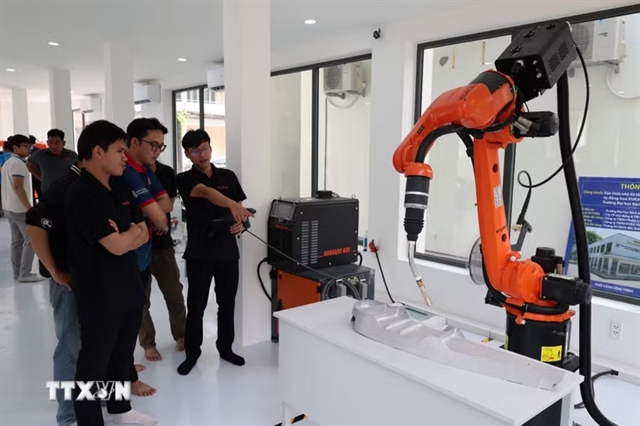
| Testing industrial robots at the Centre for Training, Research and Development of Industrial Robotics and Artificial Intelligence Applications, the University of Đà Nẵng - University of Science and Technology.— VNA/VNS Photo |
LAW No. 134/2025/QH15
On Artificial Intelligence
...
Chapter III
DEVELOPMENT OF NATIONAL ARTIFICIAL INTELLIGENCE INFRASTRUCTURE AND ASSURANCE OF NATIONAL ARTIFICIAL INTELLIGENCE SOVEREIGNTY
Article 16. National artificial intelligence infrastructure
1. National artificial intelligence infrastructure is strategic infrastructure, including infrastructure built by the State, enterprises, and social organisations, and shall be developed as a unified, open and safe ecosystem capable of connection, sharing, and expansion, ensuring that it meets artificial intelligence development and application requirements.
2. The State shall play a leading and coordinating role and ensure infrastructure capacity for national artificial intelligence development; encourage enterprises, research institutes, universities and social organisations to invest in, build and share artificial intelligence infrastructure; and strengthen public-private partnerships in artificial intelligence infrastructure development.
3. The State shall invest in, build and operate artificial intelligence infrastructure as public services for research, development, state management, and provision of support for innovative startups, including: computing capacity and shared data; training platforms, testing platforms, and sandbox environments; foundation models, multi-purpose artificial intelligence models, large language models for Vietnamese and ethnic minority languages; and other infrastructure components.
4. National artificial intelligence infrastructure built by the State, enterprises, and social organisations shall be connected, shared and utilised according to standards, technical regulations, and safety, security and data protection requirements.
5. The application of important artificial intelligence systems in essential sectors on the list promulgated by the Prime Minister shall be deployed on the national artificial intelligence infrastructure to ensure safety, security, and controllability.
6. The Government shall issue detailed regulations on mechanisms for coordination, sharing, provision of incentives, and application of measures to promote the development of the national artificial intelligence infrastructure appropriate to each period and national safety and security assurance requirements.
Article 17. Databases for artificial intelligence
1. Databases for artificial intelligence constitute an important component of the national artificial intelligence infrastructure, including the national databases, databases of ministries, ministerial-level agencies, Government-attached agencies and People’s Committees at all levels, and databases of organisations and individuals, which are established, managed and utilised to serve the training, testing, assessment and development of artificial intelligence applications in accordance with the laws on data, personal data protection, and intellectual property.
2. The national database on artificial intelligence, which is built and operated by the State at the National Data Centre, shall be organised in an open, safe and controlled manner, meeting the requirements for quality, connectivity and use; it includes open data, conditional open data, and commercial data as specified by law.
3. Databases for artificial intelligence of ministries, ministerial-level agencies, Government-attached agencies and People’s Committees at all levels shall be built, updated and connected uniformly with the national database on artificial intelligence, ensuring conformity to standards and technical regulations, data quality and information safety.
4. Databases of organisations and individuals for artificial intelligence are encouraged to be shared with state agencies and other organisations and individuals under agreed mechanisms; database sharing must comply with the laws on data, personal data protection, and intellectual property, ensuring lawful rights and interests of stakeholders.
5. The Prime Minister shall promulgate the list of datasets serving artificial intelligence development in essential sectors, prioritising data on culture, Vietnamese and ethnic minority languages, administrative procedures, healthcare, education, agriculture, the environment, transport, socio-economic activities, and other important fields.
6. The Government shall issue detailed regulations on principles for connection, mechanisms for data sharing and utilisation, and assurance of data safety within databases for artificial intelligence.
Article 18. Mastery of artificial intelligence technology
1. The State shall prioritise the development and mastery of core artificial intelligence technologies; prioritise resources for research and development of general-purpose artificial intelligence models, large language models for Vietnamese and ethnic minority languages, Vietnamese knowledge processing technology, high-performance computing and training technology, hardware, and semiconductors for artificial intelligence; and promote the development and application of open-source technologies to enhance technological autonomy, safety and national sovereignty in the digital environment.
2. The State shall promote research, development, improvement and application of domestic artificial intelligence technology; provide support for organisations and individuals in developing models, algorithms, software, hardware, and platform technologies; promotes resource-efficient solutions that are easy to implement and suitable to Vietnamese conditions; strengthen domestic capacities and artificial intelligence innovation ecosystem; and intensify public-private partnerships to master technology.
3. Organisations and individuals researching, developing and mastering core artificial intelligence technologies are entitled to special preferential and support policies provided by law.
4. The State shall promote the application of artificial intelligence for scientific research, analysis and simulation, technological design and testing, and automation of research, development and innovation processes in order to raise the national scientific and technological capacity; and create conditions for building the capacity to create and master the entire artificial intelligence technology lifecycle.
5. The Government shall issue detailed regulations on mechanisms, criteria and measures to promote the mastery of artificial intelligence technology as appropriate to each stage of development and national safety and security assurance requirements.
Chapter IV
APPLICATION OF ARTIFICIAL INTELLIGENCE AND DEVELOPMENT OF THE INNOVATION ECOSYSTEM AND HUMAN RESOURCES
Article 19. National Strategy for Artificial Intelligence
1. The Prime Minister shall promulgate the National Strategy for Artificial Intelligence, and review, evaluate and update it at least once every 3 years or when there is a major change in technology or the market. Ministries, ministerial-level agencies, Government-attached agencies and People’s Committees at all levels shall integrate objectives and tasks of the Strategy into their sectoral and local development strategies and plans, and ensure resources for implementation.
2. The National Strategy for Artificial Intelligence shall be developed based on development orientations for technology, infrastructure, data and human resources; promote research, mastery and application of artificial intelligence in priority sectors; ensure safety, innovation and national sovereignty in the digital environment. The Strategy must provide a system of indicators, methods and measurement mechanisms to evaluate the level of national artificial intelligence development.
3. The State shall promote the development of artificial intelligence technology groups suitable to Vietnam’s conditions, with the potential to create added value, environmental friendliness, capability for widespread application, and contribution to ensuring national sovereignty in the digital environment.
Article 20. Development of the artificial intelligence ecosystem and market
1. Organisations and individuals operating in the field of artificial intelligence are entitled to the highest incentives and support as provided by the laws on science and technology, investment, digital technology industry, high technology, digital transformation, and other relevant regulations; and may be provided with access to infrastructure, data, and sandbox environments for research, production, and commercialisation of artificial intelligence products and services.
2. The State shall provide support for the development of the artificial intelligence ecosystem and market, including:
a/ Prioritising the use of artificial intelligence products and services in accordance with the law on bidding;
b/ Developing markets for artificial intelligence products and services, including technology exchanges and supply-demand matching platforms;
c/ Ensuring fair and transparent access to computing infrastructure, data, and sandbox environments;
d/ Applying tax, investment and financial incentives on the principle of promoting research, production and commercialisation of artificial intelligence products and services.
3. The State shall promote the development and application of next-generation artificial intelligence, and innovation, and enhancement of management, production, business and public service provision capacity.
4. Organisations, individuals, enterprises, research facilities and state agencies are encouraged to utilise, share and reuse data in the national database on artificial intelligence for research, training, testing and innovation, ensuring compliance with the laws on data, personal data protection, cybersecurity, and intellectual property.
5. Small- and medium-sized enterprises and innovative artificial intelligence startups shall be given priority for accessing technical infrastructure, data and sandbox environments, and are entitled to support in terms of costs, training and market connection for developing artificial intelligence products and services.
6. The Government shall issued detail regulations on mechanisms, conditions and procedures for implementing support measures to develop the artificial intelligence ecosystem and market.
Article 21. Sandbox mechanism for artificial intelligence
1. The sandbox mechanism for artificial intelligence shall be implemented in accordance with the law on science, technology and innovation and the provisions of Clauses 2, 3 and 4 of this Article.
2. Results of sandbox implementation serve as a basis for competent state agencies to consider:
a/ Recognising conformity assessment results in accordance with this Law;
b/ Granting exemptions or reductions, or adjusting the relevant compliance obligation specified in this Law.
3. Competent state agencies shall assume the prime responsibility for, and coordinate with related agencies in, receiving, appraising and processing dossiers according to fast-track procedures for appraisal and feedback; supervise the testing process and decide to suspend or terminate the testing process when there arise risks affecting safety, security or lawful rights and interests of organisations and individuals.
4. The Government shall detail this Article.
Article 22. National Artificial Intelligence Development Fund
1. The National Artificial Intelligence Development Fund is an off-budget state financial fund, operating on a not-for-profit basis, and established by the Government to mobilise, coordinate and allocate resources to promote research, development, application and management of artificial intelligence to serve socio-economic development, national defence and security, and to improve national competitiveness.
2. The Fund’s financial sources include state budget allocations; contributions, aid and sponsorships from domestic and foreign organisations and individuals; and other lawful sources specified by law.
3. The Fund may apply a special financial mechanism that accepts risks in science, technology and innovation; shall allocate capital in a flexible manner according to project progress and implementation requirements, and is independent from budgetary years; and may apply simplified procedures for the performance of strategic tasks or tasks requiring rapid performance. The Fund shall be prioritised for use for investment in, sponsorship and financial support for:
a/ Development of artificial intelligence infrastructure;
b/ Research, development and mastery of core artificial intelligence technologies;
c/ Development of artificial intelligence enterprises;
d/ Training, retraining and attraction of artificial intelligence human resources;
dd/ Other investment and support tasks for the artificial intelligence development objective set by the Government.
4. The Fund shall operate on the principles of openness, transparency and efficiency, and for proper purposes; and ensure coordination and avoid duplication with other state financial funds.
5. The Government shall issue detailed regulations on special financial mechanisms for, and organisation, management, use and supervision of, the Fund.
Article 23. Development of artificial intelligence human resources
1. The State shall develop artificial intelligence human resources in a comprehensive manner, ensuring transferral between educational grades and training levels, thereby forming a high-quality workforce for research, development, application and management of artificial intelligence.
2. General education shall integrate basic contents on artificial intelligence, computational thinking, digital skills, and technological ethics into the compulsory curriculum; and facilitate experiential, research and creative activities in the field of artificial intelligence.
3. Vocational education institutions and higher education institutions are encouraged to develop training programmes in artificial intelligence, data science, and related majors; and to cooperate with enterprises, research institutes and international organisations in training, internship, research and technology transfer.
4. The State shall organise the implementation of the National Programme on development of artificial intelligence human resources, including policies on training, grant of scholarships, attraction and employment of experts, and development of a contingent of lecturers, scientists and management personnel in the field of artificial intelligence.
5. Organisations, training institutions, research institutes and enterprises that participate in the development of artificial intelligence human resources are entitled to incentives and preferential mechanisms as provided by law, and shall coordinate with one another in training, research and application, and professional practice, linking training with practical needs.
6. Higher education institutions, research institutes and innovation centres shall cooperate, share knowledge, and participate in national and international networks for training, research and development of artificial intelligence human resources.
7. The Ministry of Education and Training shall assume the prime responsibility for formulating and submitting to the Prime Minister for promulgation the National Programme on development of artificial intelligence human resources, which shall specify standards, recognise training programmes, and provide mechanisms for mobilising resources and preferential policies for participating organisations and individuals.
Article 24. Development of artificial intelligence clusters
1. An artificial intelligence cluster means a cooperation network between enterprises, research institutes, universities and related organisations, organised to strengthen linkages in terms of functions, artificial intelligence infrastructure, and physical space to promote innovation, artificial intelligence development, and competitiveness.
2. The State shall promote the development of artificial intelligence clusters following a model that combines concentrated physical spaces with digital linkage networks, thereby establishing cluster centres in hi-tech parks, digital technology parks, and innovation centres; and attract organisations and individuals to invest in building technical infrastructure serving operation of these clusters, including laboratories, testing and inspection centres, and other support facilities meeting national and international standards.
3. Organisations and individuals that are members of recognised artificial intelligence clusters are entitled to the following incentives:
a/ Priority access to and use of national artificial intelligence infrastructure, shared data and testing platforms at preferential costs;
b/ Support for participation in human resource training programmes, trade promotion, and science, technology and innovation tasks in the key sectors.
4. The Government shall issue detailed regulations on criteria and procedures for recognition and the operational mechanism of artificial intelligence clusters, and the incentives specified in Clause 3 of this Article.
Article 25. Support for enterprises in the field of artificial intelligence
1. Innovative startups and small- and medium-sized enterprises may be provided with support for conformity assessment costs in accordance with this Law, and with free-of-charge sample dossiers, self-assessment tools, training and consultancy; and given priority to receive support from the National Artificial Intelligence Development Fund.
2. Innovative startups, small- and medium-sized enterprises, science and technology organisations, and research groups that have feasible innovation projects may be provided with support vouchers to use computing infrastructure, shared data, large language models for Vietnamese and ethnic minority languages, training and testing platforms, and technical consultancy services for research, development and deployment of artificial intelligence applications.
3. Enterprises with research, development and innovation capacity in the field of artificial intelligence may be given priority for participating in the performance of tasks under national science, technology and innovation programmes, hi-tech development tasks prioritised for investment, strategic technologies, and key digital technology products and services; and may be provided with support for developing core technologies, foundation models, hardware, and high-performance training technologies in line with the national artificial intelligence capacity development orientations.
4. Enterprises that participate in artificial intelligence testing under the sandbox mechanism may be provided with support in technical consultancy, risk assessment, safety testing and connections to testing and inspection facilities in accordance with law.
5. Enterprises that share data, models, tools or research outcomes for artificial intelligence development are entitled to incentives or support as provided by law, ensuring compliance with the laws on data, personal data protection, and intellectual property.
6. The State shall promote cooperation among enterprises, research institutes, universities and innovation centres to develop artificial intelligence technology, commercialise research outcomes, and expand innovation capacity; and encourage enterprises to make long-term investments in artificial intelligence research and development.
7. The Government shall issue detailed regulations on mechanisms, policies, conditions and procedures for providing support for enterprises in the field of artificial intelligence.
...
(To be continued)
<Source: Official Gazette Issue Nos 21-24/2026>
Politics & Law
 Politics & Law
 Politics & Law
 Politics & Law
 Politics & Law
 Politics & Law
 Politics & Law
 Politics & Law
 Politics & Law
 Politics & Law
 Politics & Law
 Politics & Law
 Politics & Law
 Politics & Law
 Politics & Law