 Politics & Law
Vietnamese Prime Minister meets Cambodian National Assembly President
1.
|
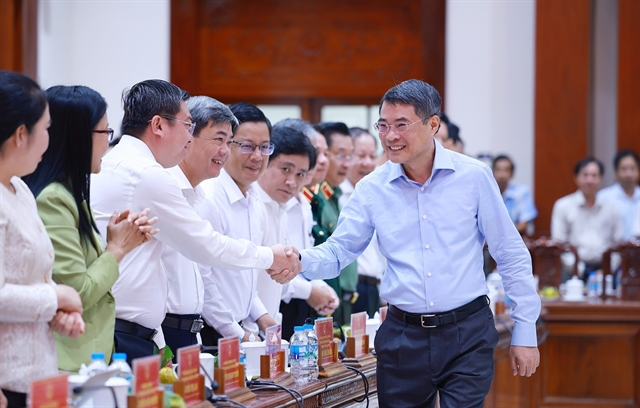
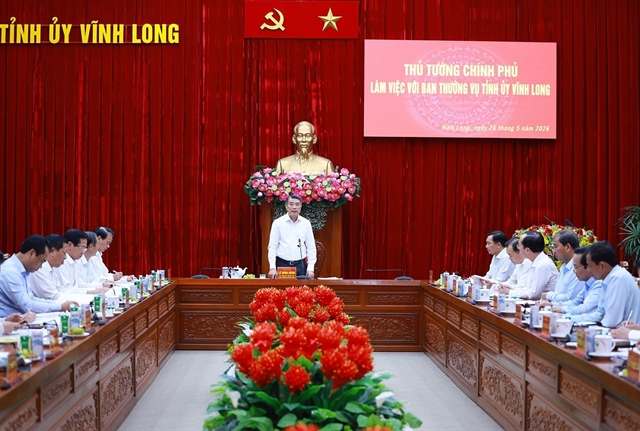
| Prime Minister Lê Minh Hưng held a working session with local authorities in Đồng Tháp Province on Wednesday. — VNA/VNS Photo |
ĐỒNG THÁP — Prime Minister Lê Minh Hưng on Wednesday urged the southern province of Đồng Tháp to develop regional logistics services, build major logistics centres and turn the province into a transport, warehousing and distribution hub connecting the Mekong Delta region with HCM City and export markets.
He was speaking during a working session with local authorities in Đồng Tháp Province on socio-economic development tasks and double-digit growth targets, as well as public investment disbursement and implementation of the two-tier administration system.
The PM suggested the province define a new growth model based on science and technology, innovation and digital transformation, as well as its potential, competitive advantages and available resources.
Đồng Tháp should also promote the development of modern, ecological agriculture associated with deep processing, brand building and serving the domestic market demand while boosting exports, he said.
It has also been tasked with developing the coastal area into a multi-sector marine economic centre that is resilient to climate change.
Hưng stressed the need to accelerate the development of the processing industry and transform industrial zones along the Tiền and Hậu rivers into centres for agricultural and seafood processing.
A report presented by local authorities at the meeting showed that the province’s gross regional domestic product (GRDP) grew 6.14 per cent in the first quarter of 2026, indicating that the economy maintained its recovery momentum and positive growth trend.
State budget revenue in the locality during the first five months of the year exceeded VNĐ12.2 trillion, fulfilling 51.5 per cent of the annual target and rising 107.8 per cent year on year.
Export turnover was estimated at around US$4 billion, up nearly 10 per cent from the same period last year.
The PM said that although the province’s economic growth in the first quarter of 2026 showed positive signs, it still fell short of the target.
Budget revenue remained low and unstable, while economic restructuring was slow, with agriculture still accounting for the largest share of the economy and generating limited added value.
GRDP per capita also remained below the national average.
He said slow public investment disbursement remains a major bottleneck for the province’s development, particularly for key centrally funded projects. Inter-regional transport infrastructure is not yet synchronised, limiting logistics development and the attraction of large investment projects.
The province also faces constraints in attracting major investors, while the processing industry and high-tech industries have yet to develop in line with their potential, he said.
Đồng Tháp also lacks leading enterprises in the processing industry and high-tech agriculture sectors, while its workforce remains insufficient to meet development requirements, he said.
Hưng highlighted the need to develop border trade and maximise the effectiveness of the province’s two international border gates and auxiliary border crossings.
He urged the promotion of eco-tourism, agricultural and rural tourism, with a particular focus on distinctive and branded local tourism products.
The PM also asked Đồng Tháp authorities to remove obstacles and bottlenecks, while accelerating the allocation and disbursement of public investment capital this year.
He said that the province should reallocate capital from projects with slow disbursement to those with strong disbursement capacity and additional funding needs.
It should also speed up site clearance for key national projects in the locality, including the expansion of the HCM City-Trung Lương-Mỹ Thuận Expressway and the Đồng Tâm-National Highway 1 interchange.
Regarding the implementation of the Politburo’s Resolution 57 on breakthroughs in science and technology development, innovation and digital transformation, the PM stressed the need to mobilise resources and prioritise workforce development in science and technology, innovation and digital transformation.
He also called for stronger vocational training linked to business demand, the attraction of scientific and technological talent, cooperation with major universities in the region and support for youth innovation and start-ups. — VNS
Politics & Law
 Politics & Law
 Politics & Law
 Politics & Law
 Politics & Law
 Politics & Law
 Politics & Law
 Politics & Law
 Politics & Law
 Politics & Law
 Politics & Law
 Politics & Law
 Politics & Law
 Politics & Law
 Politics & Law