 Politics & Law
Vietnamese Prime Minister meets Cambodian National Assembly President
1.
|
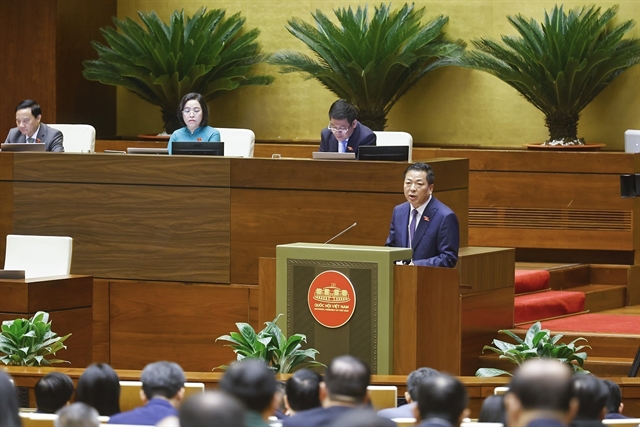
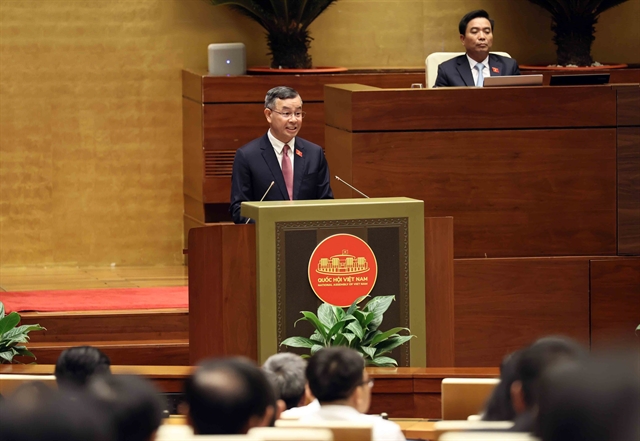
| Minister of Construction Trần Hồng Minh addresses and clarifies issues raised by National Assembly deputies at the socio-economic discussion on Monday afternoon. — VNA/VNS Photo Doãn Tấn |
HÀ NỘI — Synchronous infrastructure development, particularly in transport, is a key driver for achieving double-digit economic growth, Minister of Construction Trần Hồng Minh told the ongoing first session of the 16th National Assembly.
The direction is set out in Conclusion No. 18 of the 14th Party Central Committee, the minister said while addressing lawmakers’ concerns on transport infrastructure during a discussion on socio-economic development.
The construction sector is implementing coordinated measures across all transport sub-sectors to accelerate infrastructure development nationwide.
For road transport, 43 expressways are planned by 2050 with a total length of about 8,993km. Of this, 6,539km is scheduled for investment before 2030, with the remainder to be developed in the 2030–2050 period.
To date, about 3,345km of expressways have been opened to traffic, along with 458km of interchanges.
In terms of scale, 548km (16 per cent) are two-lane expressways; 1,559km (47 per cent) are four-lane limited expressways and 1,238km (37 per cent) are fully completed four- to six-lane expressways.
Of the total, the Ministry of Construction (formerly the Ministry of Transport) is responsible for about 2,561km (77 per cent), while 748km was developed by local authorities.
In terms of investment, 2,458km (74 per cent) has been funded through public investment while 860km (26 per cent) has been developed under public-private partnership (PPP) schemes.
An additional 1,252km is currently under transitional implementation and is expected to be completed by 2027, according to Minister Minh.
Of this, 153km is being carried out by the ministry while 1,099km is handled by localities and the Ministry of National Defence, including 611km funded by public investment and 641km under PPP.
By the end of 2025, expressway density nationwide is estimated at 2.23km per 100sq.km, though disparities remain significant between regions. The Mekong Delta records 4.43km per 100sq.km while 14 former border provinces in the north average only 0.58km per 100sq.km.
In the 2026–2030, the Government plans to mobilise resources to upgrade and expand about 1,721km of expressways, including upgrading two-lane and limited four-lane roads to six lanes in line with planning, requiring an estimated VNĐ802.86 trillion (US$30.5 billion) in investment.
The national highway network currently totals 24,376km. Under decentralisation efforts, from July 1, 2025, 17,520km has been transferred to local management, leaving the ministry responsible for 4,875km of mainly BOT (build-operate-transfer) roads, alongside several projects related to defence and security.
For coastal roads, 1,701km (around 60 per cent of the plan) has been completed while 340km across 10 provinces and cities is under construction. Localities have been urged to complete these sections by 2026.
Between 2026 and 2030, an additional 772km of coastal roads will be invested to complete the transport network, Minister Minh said.
|
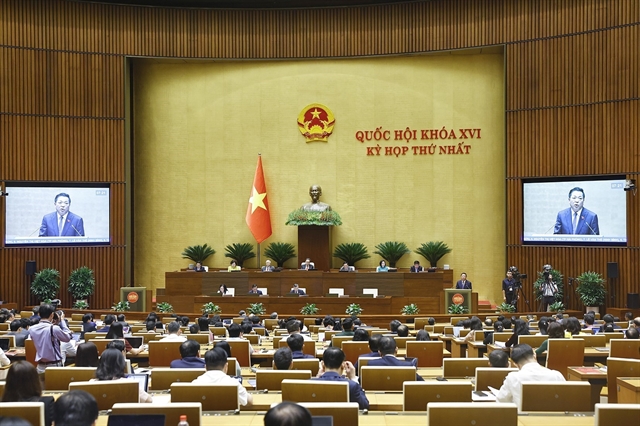
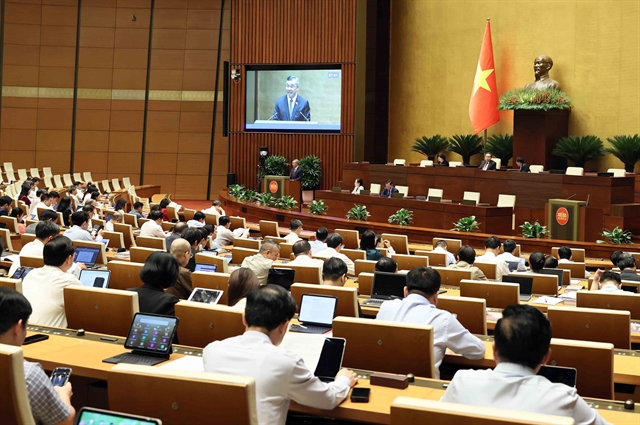
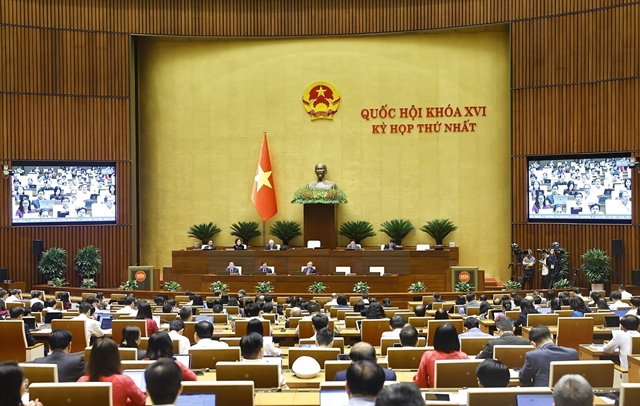
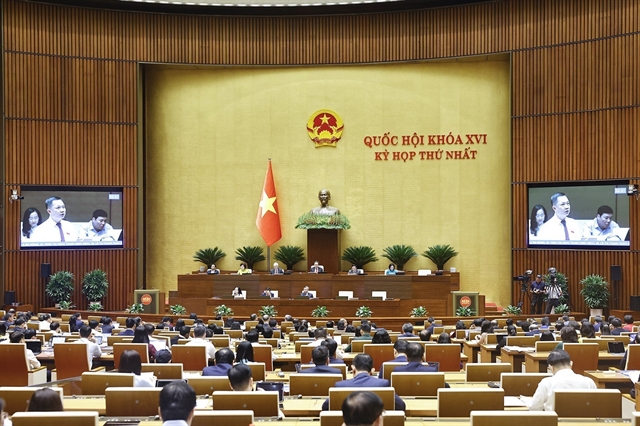
| National Assembly deputies attend the socio-economic discussion on Monday. — VNA/VNS Photo Doãn Tấn |
Railways and urban transit
In the railway sector, the planned network comprises 25 lines totalling 6,658km, including seven existing lines (2,510km) and 18 new lines (4,148km), forming the backbone of Việt Nam’s long-term transport expansion strategy.
The current national railway system largely uses the 1,000mm gauge, with the exception of the Hà Nội–Lạng Sơn line which uses the standard 1,435mm gauge.
Priority projects in the coming period include key routes such as Hà Nội–HCM City, Lào Cai–Hà Nội–Hải Phòng, Hà Nội–Lạng Sơn, Hải Phòng–Hạ Long–Móng Cái and HCM City–Cần Thơ–Cà Mau.
Regarding urban transport, three metro lines totalling about 41km have been completed, with two lines operational in the capital city in Hà Nội and one in HCM City.
In the next phase of development, Hà Nội plans to develop 18 metro lines (with total length of 1,052km) while HCM City will build 12 lines (around 1,172km), bringing the national total to 30 lines spanning approximately 2,224km with estimated investment needs of VNĐ743.9 trillion ($28.3 billion).
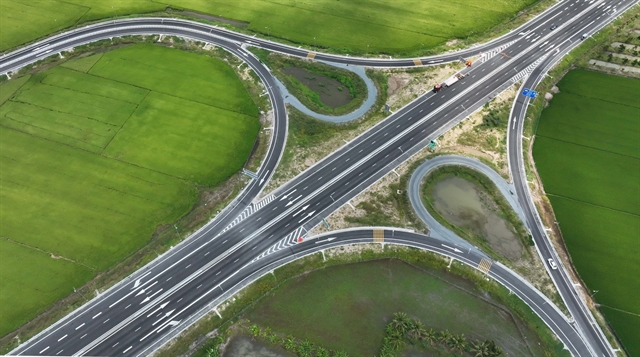
|
| An under-construction section of the Cần Thơ–Cà Mau Expressway project in southern Việt Nam. — VNA/VNS Photo |
Airports and seaports
The national plan targets 31 airports by 2030, including 15 international and 16 domestic, with a total capacity of around 294 million passengers per year. These figures are expected to increase to 34 airports and 533 million passengers annually by 2050.
Currently, Việt Nam operates 22 airports with a combined capacity of about 155 million passengers per year, 1.6 times higher than the previous period.
In terms of classification, among the planned 31 airports there will be six 4F airports (ultra-large hubs), one 4C airport (regional connectivity hub) and the remainder classified as 4E (major international hubs).
According to Minister Minh, the direction is to reduce the share of public investment, focusing instead on upgrades and maintenance while mobilising private capital, particularly through PPP models, for airport development.
Việt Nam also has 309 seaports with a combined quay length of about 107km, along with over 3,200km of maritime routes and 44 offshore oil and gas ports.
The maritime transport system has a capacity of around 955 million tonnes per year, up 1.3 times compared to 2020.
Inland waterway infrastructure has been improved, including upgrading 17 transport routes and increasing clearance of seven road bridges crossing key waterways and logistics corridors.
The country counts 310 inland waterway ports, including 202 cargo ports, 11 passenger ports and 97 specialised ports, along with 6,332 inland wharves and 2,562 ferry terminals.
During the 2026–2030 period, authorities will continue to promote the participation of the private sector in seaport investment while the construction ministry will focus on improving navigation channels and further decentralising inland port management to local authorities. — VNS
Politics & Law
 Politics & Law
 Politics & Law
 Politics & Law
 Politics & Law
 Politics & Law
 Politics & Law
 Politics & Law
 Politics & Law
 Politics & Law
 Politics & Law
 Politics & Law
 Politics & Law
 Politics & Law
 Politics & Law