 Politics & Law

Viên dives again to popularise swimming passion
1.
|
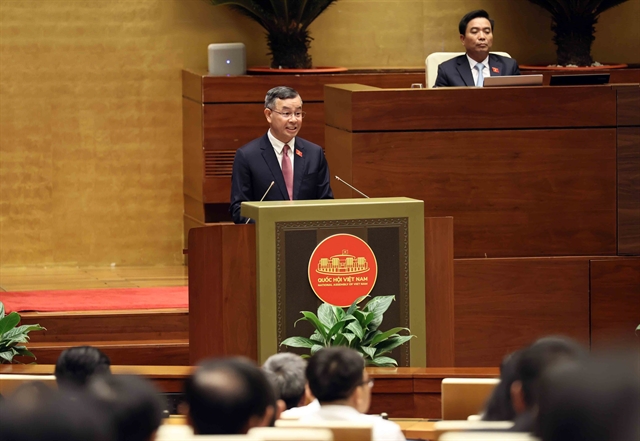
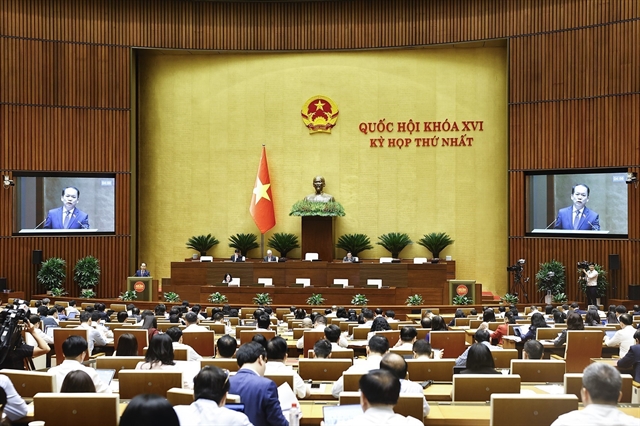
| Minister of Finance Ngô Văn Tuấn addressed the first session of the 16th National Assembly on April 21 discussing the five-year socio-economic development plan for 2026–2030, the implementation of thrift practice and anti-waste measures in 2025, and progress in achieving national gender equality targets. — VNA/VNS Photo |
HÀ NỘI — Lawmakers on Tuesday agreed that achieving double-digit growth this year will be extremely challenging but necessary if Việt Nam is to meet its goal of becoming a developed high-income country by 2045.
According to preliminary calculations, sustaining growth above 10 per cent would require the remaining quarters of the year to expand by around 10–11 per cent, they noted.
Continuing the agenda of the first session of the 16th National Assembly (NA), legislators discussed the five-year socio-economic development plan for 2026–2030, the implementation of thrift practice and anti-waste measures in 2025 and progress in achieving national gender equality targets.
Addressing the session, Minister of Finance Ngô Văn Tuấn said that over more than 40 years of Đổi mới (renewal), Việt Nam has recorded growth above 9 per cent in only two years and has never reached double-digit expansion.
Nevertheless, he stressed that the path has been chosen with strong consensus. The Government has set out 59 sectoral targets, 11 groups of tasks and solutions for the coming period and notably 92 specific tasks for 2026.
To realise high growth, Tuấn said coordinated action across the entire political system is required. The Ministry of Finance is advising the Government on a range of key measures.
These include reviewing and updating growth scenarios and assigning specific targets to ministries, sectors, localities and enterprises in line with evolving conditions. Fiscal and monetary policies will be closely coordinated to both ensure capital supply for the economy and maintain macroeconomic stability.
Fiscal policy in particular will focus on improving tax frameworks to ensure accurate, sufficient and timely collection while creating favourable conditions for businesses, especially small and medium-sized enterprises, which account for about 96 per cent of all firms and contribute over 50 per cent of GDP.
On public investment disbursement, Tuấn said tasks assigned by the Prime Minister are being implemented vigorously, with a nationwide conference on disbursement scheduled this week to help ensure targets for 2026 are met.
Another priority is addressing stalled projects, which he described as both a bottleneck and a major untapped resource for growth. Preliminary data show that around 200,000 hectares of land and approximately VNĐ3.3 quadrillion (US$130 billion) remain tied up in delayed projects, equivalent to roughly three times the planned public investment for 2026.
He noted that the NA’s continued focus on resolving such projects under Resolution No.170 is crucial to removing bottlenecks and unlocking resources for development.
In addition, the Ministry of Finance will prioritise reviewing institutional constraints. During this session, the Government is submitting amendments to four key tax laws, including the Law on Personal Income Tax, the Law on Corporate Income Tax, the Law on Value-Added Tax and the Law on Special Consumption Tax, to remove barriers and stimulate production and business activity.
On mobilising resources, Tuấn said total social investment will need to rise from about 33.1 per cent of GDP to higher levels in the coming period, while capital demand is projected to increase 2.2-fold. Central budget revenues are expected to grow 3.4 times and foreign direct investment inflows by about 1.7 times.
He agreed with NA deputies on the need to ensure efficiency in investment, noting that without improving the ICOR (Incremental Capital-Output Ratio), total social investment would have to reach as much as 70 per cent of GDP to sustain double-digit growth. The target, therefore, is to bring ICOR down to around 4–4.5.
However, he cautioned that this level remains high compared to other Asian economies during their rapid growth phases such as China (2.7), Japan (3.2) and South Korea (3).
To reduce ICOR, the ministry supports proposals to tighten project preparation, improve project selection, strengthen inspection and supervision, accelerate capital allocation and adopt rolling investment approaches.
Regarding capital markets, the minister noted that the economy still relies heavily on the banking sector, while long-term capital should increasingly come from capital markets, including equities and bonds. The stock market, he added, has the opportunity to be upgraded from frontier to emerging status. Meanwhile, the Government bond market mobilised about VNĐ800 trillion in 2025 and is targeting VNĐ900 trillion this year.
For sustainable development of capital markets, comprehensive reforms are needed across institutions, infrastructure and market participants, particularly the development of professional investment institutions to provide safer channels for retail investors alongside stronger supervision and capital recovery mechanisms.
During the session, NA deputies also offered various proposals to accelerate public investment disbursement and improve institutional frameworks.
Deputy Phan Duy Anh from Đà Nẵng warned that without breakthrough solutions to longstanding issues such as fragmented capital allocation, weak project preparation, slow site clearance and limited construction material supply, growth targets would be difficult to achieve. He called on the Government to outline a clear roadmap identifying specific factors contributing to ICOR reduction.
He also pointed out shortcomings in forecasting and budgeting, urging reforms to improve the accuracy of projections and align budgeting practices with international standards, including moving away from rigid revenue targets and adjusting expenditure based on actual revenue performance.
On public investment disbursement and fiscal discipline, Duy Anh noted uneven progress, with non-state capital disbursement reaching only 44.5 per cent of the plan. In the first quarter of 2026, overall disbursement stood at just 10.4 per cent of estimates.
He urged the Government to clarify causes for low disbursement rates in specific ministries, sectors and localities and to consider stricter sanctions for returning allocated capital due to subjective reasons.
Regarding financial discipline in science and technology spending, Duy Anh highlighted that VNĐ9.46 trillion earmarked for innovation and research had to be carried over to 2026 due to disbursement delays, indicating persistent bottlenecks and limited absorption capacity. He called for reforms to accelerate disbursement and create genuine breakthroughs for a new growth model.
Deputy Nguyễn Như So from Bắc Ninh Province proposed restructuring capital allocation mechanisms to ensure funds are channelled to the right sectors and growth drivers, particularly as productivity and technology have yet to fully take off and investment capital remains a key pillar of growth.
Responding to NA deputies’ concerns, Minister Tuấn reiterated that the Ministry of Finance will continue advising the Government on solutions to both ensure adequate capital supply for the economy and maintain macroeconomic stability. — VNS
Politics & Law
 Politics & Law
 Politics & Law
 Politics & Law
 Politics & Law
 Politics & Law
 Politics & Law
 Politics & Law
 Politics & Law
 Politics & Law
 Politics & Law
 Politics & Law
 Politics & Law
 Politics & Law
 Politics & Law