 Politics & Law
Vietnamese Prime Minister meets Cambodian National Assembly President
1.
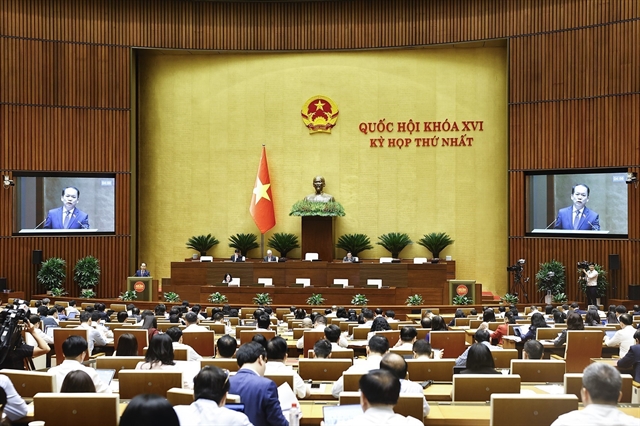 |
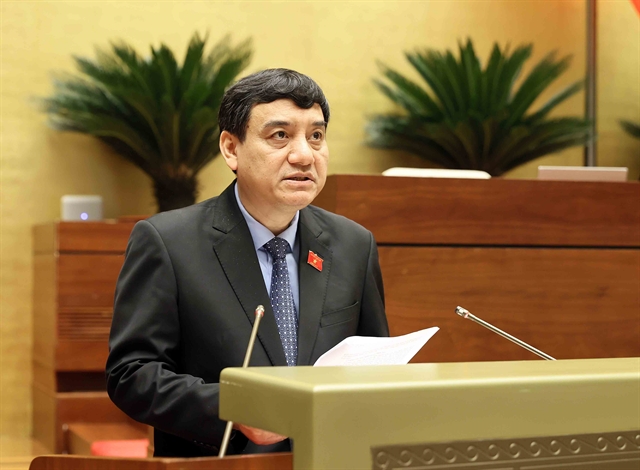
| Minister of Justice Hoàng Thanh Tùng speaks during the legislative session on Monday. — VNA/VNS Photo |
HÀ NỘI — National Assembly on Monday discussed a Government proposal to pilot a corps of public lawyers within State bodies, a move officials say would strengthen the government’s ability to handle increasingly complex litigation, contracts and international disputes.
The draft resolution would roll out the scheme at eight ministries and 10 provinces and cities from October 2026 through September 2028. Lawmakers are weighing how to define the role of these lawyers, who would straddle the line between civil servants and legal practitioners.
Minister of Justice Hoàng Thanh Tùng noted that the proposal reflects urgent needs driven by gaps in the state sector’s legal capacity, particularly as Việt Nam deepens its integration into the global economy.
Administrative lawsuits have surged in number and complexity in recent years, he said, while many government bodies struggle to prepare case files or represent themselves effectively in court.
At the same time, legal risks tied to large infrastructure projects, cross-border contracts and international arbitration have become more pronounced, placing new pressure on state agencies.
“Piloting the public lawyer scheme is necessary and urgent, based on political, legal and practical considerations,” he said.
Under the proposal, public lawyers would provide legal advice, represent state agencies in court and arbitration and handle complex complaints and disputes. Their remit would extend to domestic and international cases, though they would be barred from taking on clients outside the state sector.
Candidates would need to meet the criteria of both civil servants and licensed lawyers, including at least five years of relevant legal experience. The Government plans to draw personnel from existing state legal staff and recruit from the private sector.
The draft also envisages flexible deployment, allowing agencies to request secondment of public lawyers across ministries or provinces and cities depending on workload and case complexity.
The proposal outlines a hybrid system of rights and obligations. Public lawyers would retain professional independence in forming legal opinions and would be entitled to refuse unlawful instructions while still operating within the administrative hierarchy of their agencies.
They would be granted liability exemptions in certain cases provided they act in accordance with the law and without personal gain.
To attract experienced practitioners, the draft includes financial incentives such as salary supplements, case-based payments and exemptions from personal income tax on income derived from public lawyer duties. The State would also cover certain professional costs, including participation in legal associations.
But lawmakers have raised questions about whether the model can reconcile competing demands.
Trần Hoài Nam, an NA deputy from the southern province of Cà Mau, warned that the dual nature of the role, part civil servant, part legal advocate, could create tensions in practice.
While the draft requires public lawyers to act independently and uphold objective truth, it also subjects them to the authority of agency heads under civil service rules.
“There may be a certain misalignment,” he said, calling for clearer boundaries between administrative command and professional autonomy.
Nam also urged caution over provisions granting liability exemptions, arguing that protections should not shield poor performance or negligence.
Accountability, he said, must be tied not only to procedural compliance but also to professional competence, particularly given the potentially significant consequences of legal disputes involving the State.
Chairman of the NA’s Committee for Legal and Judicial Affairs Phan Chí Hiếu highlighted safeguards in the draft, including strict prohibitions on public lawyers providing services to private clients, disclosing confidential information without authorisation or abusing their position for personal gain.
The draft also sets out rules for granting and revoking practising certificates, he added. Those who do not meet the required standards, who hold judicial positions such as judges, procurators or investigators or who do not reside in Việt Nam would not be eligible.
“Certificates could be revoked for violations, when duties are no longer performed or when the pilot ends without further implementation,” he said.
The resolution would take effect from October 1, with the pilot running until September 30, 2028. — VNS
Politics & Law
 Politics & Law
 Politics & Law
 Politics & Law
 Politics & Law
 Politics & Law
 Politics & Law
 Politics & Law
 Politics & Law
 Politics & Law
 Politics & Law
 Politics & Law
 Politics & Law
 Politics & Law
 Politics & Law