 Politics & Law
Learning Việt Nam through food
1.
|
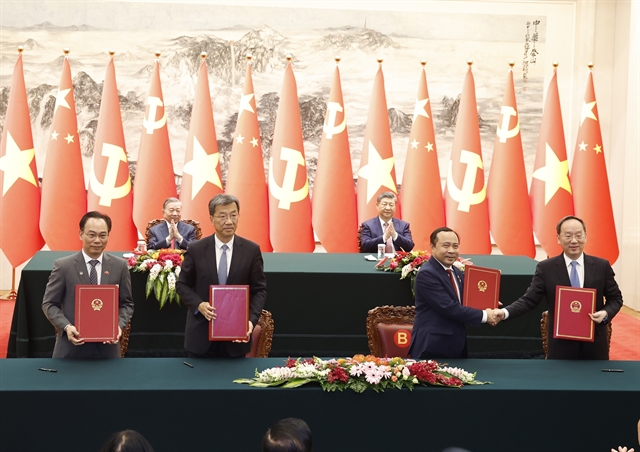
| General Secretary of the Communist Party of Việt Nam Central Committee and President of Việt Nam Tô Lâm (left, back) and his Chinese counterpart Xi Jinping witness signing of MoUs on vocational education and digital technology cooperation. — VNA/VNS Photo Thống Nhất |
BEIJING — The state visit to China by General Secretary of the Communist Party of Vietnam (CPV) Central Committee and State President Tô Lâm from April 14 to 17 yielded important outcomes, injecting fresh momentum into relations between the two Parties and countries in a new phase of development, said Professor Pan Jin’e, a senior researcher at the Academy of Marxism under the Chinese Academy of Social Sciences.
Talking to Vietnam News Agency correspondents in Beijing, Pan noted that the visit took place at a particularly meaningful juncture as China embarks on the first year of implementing its 15th Five-Year Plan, while Việt Nam is accelerating the implementation of the Resolution of the CPV’s 14th National Congress. In this context, high-level exchanges between the top leaders of the two Parties and States carry not only diplomatic significance but also profound strategic and historical values.
The trip, she said, underscored the special importance both sides attach to bilateral ties. That General Secretary Lâm, after assuming the State President position, chose China as his first overseas destination reflected a rare diplomatic arrangement and demonstrated the high priority given to the bilateral relationship. It reaffirmed the “both comradeship and fraternity” of Việt Nam – China ties, as well as the shared political determination to maintain and develop long-term, stable relations.
Pan emphasised both sides worked to align development strategies, laying a foundation for more comprehensive cooperation in the coming period.
A notable outcome, she added, was the continued elevation of the Comprehensive Strategic Cooperative Partnership between the two countries. Through high-level exchanges and signed documents, the two sides further strengthened political trust, enhanced discussions on socialist-oriented development theory and practice, and advanced the building of a Việt Nam – China community with a shared future.
Beyond bilateral dimensions, the visit also carried positive implications for the region and the world. Amid intensifying strategic competition among major powers, it sent a message of both countries’ commitment to their foreign policies of independence and self-reliance, and to prioritising stability and cooperation. Enhanced coordination within regional and international frameworks such as ASEAN, the Mekong – Lancang Cooperation, and the Asia-Pacific Economic Cooperation (APEC) is expected to contribute to peace, stability, and secure supply chains, according to the professor.
Assessing the trip's specific outcomes, she observed that bilateral relations were transitioning from a phase of consolidating political trust to one of deepening comprehensive strategic connectivity. This shift focused on stronger alignment of development strategies, expanded substantive cooperation, and improved quality of collaboration.
Infrastructure cooperation, particularly in railways, stood out as a key highlight. During the visit, the top Vietnamese leader experienced China’s high-speed rail system and explored its technology and operations. Both sides also advanced collaboration in railway connectivity, including by signing agreements on feasibility studies for the Lào Cai – Hà Nội – Hải Phòng line and human resources training. This, she said, reflected Việt Nam’s growing interest in accessing advanced infrastructure standards and expertise of China.
Economic, trade, and supply chain cooperation was also expanding in a more substantive and efficient direction. With bilateral trade reaching record levels, the focus was shifting from scale expansion to quality enhancement. The establishment of cooperation mechanisms on production and supply chains was seen as a crucial step towards deeper economic integration and the formation of stable and sustainable regional value chains, Pan opined.
She also highlighted progress in security and defence cooperation, particularly the establishment of the “3+3” strategic dialogue mechanism among foreign affairs, national defence, and public security ministries. This innovative framework was expected to help strengthen coordination in addressing both traditional and non-traditional security challenges.
The expert also underlined people-to-people exchanges, especially among the youth, adding that both countries' investment in younger generations means investment in the long-term future of bilateral relations.
She perceived that the visit had opened up new space for bilateral ties, elevating cooperation to a higher, more strategic and more comprehensive level.
With continued efforts to strengthen strategic connectivity and enhance the effectiveness of practical cooperation, Việt Nam – China relations were expected to develop in a stable and sustainable manner, contributing positively to peace, stability, and development in the region and the world. — VNA/VNS
Politics & Law
 Politics & Law
 Politics & Law
 Politics & Law
 Politics & Law
 Politics & Law
.jpg) Politics & Law
Politics & Law
 Politics & Law
 Politics & Law
 Politics & Law
 Politics & Law
 Politics & Law
 Politics & Law
 Politics & Law
 Politics & Law