 Politics & Law
Vietnamese Prime Minister meets Cambodian National Assembly President
1.
|
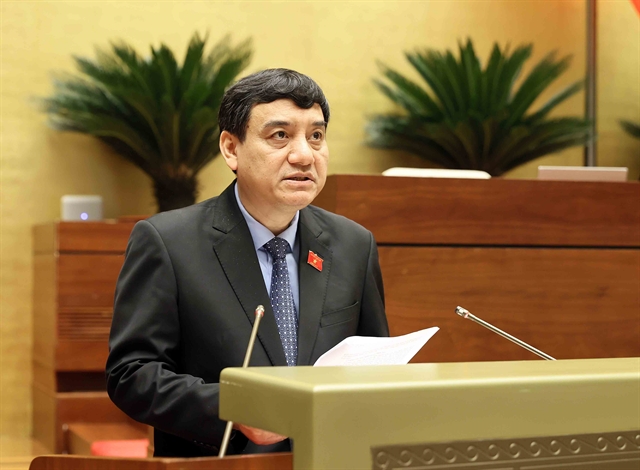
| Nguyễn Đắc Vinh, chairman of the National Assembly’s Committee for Culture and Society presents the verification report on the draft National Assembly resolution on the development of Vietnamese culture, in Hà Nội on Monday morning. — VNA/VNS Photo An Đăng |
HÀ NỘI — The National Assembly’s Committee for Culture and Society has endorsed the Politburo's proposal to designate November 24 each year as Việt Nam Culture Day, with employees entitled to a paid day off.
The announcement was made by the Committee Chairman Nguyễn Đắc Vinh on Monday morning in Hà Nội, as he presented the verification report on the draft National Assembly resolution on the development of Vietnamese culture during the first session of the 16th National Assembly.
Vinh expressed support for the issuance of the resolution, saying it is necessary to promptly institutionalise and implement Resolution No. 80-NQ/TW dated January 7, 2026, issued by the Politburo on the development of Vietnamese culture.
He said that the committee broadly agrees with the draft resolution’s title, scope of regulation and applicable subjects, as well as its 10 policy groups set out in Article 2 to Article 11.
However, it also urged the drafting body to take into account a number of additional considerations.
Beyond the proposed Việt Nam Culture Day, the committee called for further research to maximise the effectiveness of major national holidays and anniversaries associated with traditional cultural values, with a view to promoting cultural awareness and strengthening the preservation of national identity in society.
Regarding mechanisms to mobilise investment for cultural development, the committee supported efforts to unlock and attract funding, but recommended clarifying the scope and principles governing preferential policies to ensure a solid legal basis for effective implementation.
On investment incentives in the cultural sector, the committee agreed in principle, while suggesting that the concept of a “heritage urban model” be clearly defined, along with criteria for selecting pilot localities.
It also called for clearly defined principles on land-related incentives, fees and charges, and for an appropriate implementation roadmap to avoid fragmentation and ensure efficient use of resources.
The committee deemed it necessary to provide exemptions or reductions in land and property rental fees for State-owned publishers and documentary and scientific film production units.
However, it recommended a review to ensure compliance with land and public asset management laws, and to clarify eligibility criteria and the scope of such incentives.
On policies to nurture talent and develop specialised human resources in culture and sport, the committee broadly agreed but urged a careful review of beneficiary groups entitled to professional allowances and training and performance subsidies to ensure efficient resource allocation. It also called for clearer definitions of “traditional performing arts” and “classical performing arts”.
Regarding the commissioning and lump-sum funding of cultural creative activities using the State budget, the committee supported a pilot mechanism allowing lump-sum allocations for selected activities. However, it recommended specifying eligible tasks, methods for determining funding levels, evaluation criteria, and payment principles aligned with actual outputs, balancing strict budget management with the inherently risky and distinctive nature of cultural creation.
On the promotion and development of cultural industry products and markets, the committee supported several proposed policies. Nonetheless, it cautioned that provisions allowing reimbursement of eligible expenses incurred in Việt Nam by foreign organisations and individuals using Vietnamese settings, including post-production, accommodation and other lawful costs, were overly broad. It recommended tightening eligibility criteria, reimbursement levels and oversight mechanisms to ensure transparency, feasibility and effectiveness.
Concerning the proposed Culture and Arts Fund, the committee acknowledged that the initiative is grounded in Resolution No. 80-NQ/TW.
However, it noted that piloting such a fund under a public-private partnership and venture capital model would be a new and wide-ranging policy, directly affecting the management and use of State funds as well as the mobilisation of private resources, while current legislation remains incomplete in this area.
It therefore called for further assessment of governance structures, capital mobilisation mechanisms, State-private participation ratios, and risk-sharing principles to provide a sound basis for detailed Government regulations.
Proposals for cultural development
Earlier, Minister of Culture, Sports and Tourism Lâm Thị Phương Thanh proposed designating November 24 as Việt Nam Culture Day, with workers granted a paid day off.
She made the proposal while presenting the Government’s draft resolution on breakthrough mechanisms and policies for cultural development at the same session.
The draft resolution comprises 13 articles outlining 10 key policy groups to implement the Politburo’s Resolution No. 80.
Thanh added that the proposal forms part of a broader policy package, including a proposal that State spending on culture should account for at least 2 per cent of total annual budget expenditure, alongside efforts to mobilise social resources.
Other proposed measures include facilitating access to land and premises, offering tax and fee incentives to support the development of cultural and creative industry clusters, and assigning local communities to manage and operate grassroots cultural and sports facilities.
Investment incentives would include a reduced value-added tax rate of 5 per cent for film production, distribution as well as for exhibitions, sports and performing arts.
The draft also proposes full exemptions from import duties and customs fees for high-value artworks, national treasures and rare antiquities acquired abroad for non-profit exhibition in Việt Nam.
Additional policies focus on preserving the cultural heritage of ethnic groups, folk and traditional arts, and national treasures; supporting talent development through specialised training, flexible recruitment and enhanced allowances; and enabling career transitions for artists after retirement.
The draft further outlines mechanisms for State-commissioned cultural works, promotional activities to expand cultural markets internationally, and initiatives to promote Việt Nam’s image abroad through cultural weeks and themed exhibitions in leading museums worldwide.
Digital transformation is also prioritised, with plans to develop a national cultural database, invest in digital cultural infrastructure, digitise nationally recognised heritage assets, and establish cultural innovation centres.
Finally, the proposal includes a pilot scheme to establish Culture and Arts Funds at both central and local levels under a public-private partnership model. — VNS
Politics & Law
 Politics & Law
 Politics & Law
 Politics & Law
 Politics & Law
 Politics & Law
 Politics & Law
 Politics & Law
 Politics & Law
 Politics & Law
 Politics & Law
 Politics & Law
.jpg) Politics & Law
Politics & Law
 Politics & Law
 Politics & Law