 Politics & Law
Rural tourism needs to cash quantities over goods sold
1.
 |
| Minister of Home Affairs Đỗ Thanh Bình presents the Government’s proposal on the establishment of Đồng Nai City under central administration at the first session of the 16th National Assembly on Monday morning. — VNA/VNS Photo |
HÀ NỘI — The establishment of Đồng Nai as a centrally governed city is expected to generate fresh momentum for development, not only for the province itself but also for the southern region and the country as a whole.
Minister of Home Affairs Đỗ Thanh Bình made the remarks on Monday morning in Hà Nội while presenting, on behalf of the Prime Minister, the Government’s proposal on the establishment of Đồng Nai City under central administration at the first session of the 16th National Assembly.
Bình said that Đồng Nai serves as a key hub linking major development corridors and connecting the country’s largest economic centre, HCM City, with the Central Highlands, the south central coast and the Mekong Delta.
Coupled with increasingly synchronised and modern socio-economic infrastructure, particularly in transport, industry, services and logistics, and the rapidly progressing construction of Long Thành International Airport, the southern province of Đồng Nai has amassed the necessary conditions of a high-potential, multi-centre, multi-functional urban area with strong regional and national spillover effects.
He said that the establishment of Đồng Nai as a centrally governed city “is both necessary and well-founded, with sufficient political, legal and practical bases.”
The move represents a fundamental shift in development and governance models, aimed at transforming Đồng Nai Province into a major urban centre capable of sharing, linking and complementing the growth of HCM City.
It is expected to become a key national growth pole, a regional economic hub and international gateway as well as a model of dynamic, modern and civilised urban development, helping to shape a new spatial development framework for the southeastern region in line with conclusions of the Politburo.
Bình added that the proposed city would be established on the basis of the province’s current status, covering a natural area of over 12,700sq.km with a population of nearly 4.5 million.
Following its establishment, Đồng Nai City would retain its existing size and population, comprising 95 commune-level administrative units, including 33 wards and 62 communes. The city’s administrative headquarters would remain unchanged.
Regarding organisational arrangements, the plan largely maintains the existing structure of agencies and units within the provincial political system, while establishing new bodies in accordance with Party regulations, organisational charters and the law.
In terms of personnel, the current contingent of officials, civil servants and public employees would initially remain in place.
Đồng Nai has also developed a roadmap for restructuring and reallocating staff to ensure alignment with the urban governance model.
He also said the province now meets all five conditions stipulated under Clause 2, Article 8 of the Law on Organisation of Local Government No 72, as well as all seven criteria for city status set out in Article 4 of Resolution No 112.
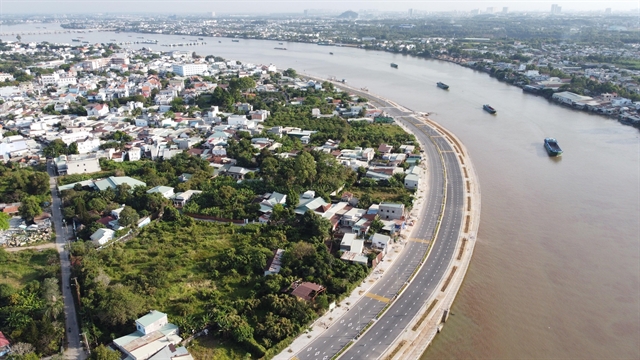 |
| The Đồng Nai River Corridor economic axis is expected to be a new growth pole for the province. — VNA/VNS Photo Sỹ Tuyên |
Toward a regional-scale urban centre
Presenting the verification report, Chairman of the National Assembly’s Committee for Legal and Judicial Affairs Phan Chí Hiếu said the committee supports the necessity of establishing Đồng Nai City on the basis of the province’s existing natural area and population, in line with the Government’s proposal.
He said the plan has already been reviewed and endorsed in principle by the Party Central Committee and the Politburo.
Based on the Government’s submission and the opinions of reviewing bodies, the committee recommended that the NA approve the resolution on the establishment of Đồng Nai City under central administration.
The committee also urged Đồng Nai’s Party Committee and authorities to direct relevant agencies to swiftly complete urban planning and develop clear roadmaps to address outstanding or marginally met urban classification criteria, thereby ensuring urban quality.
It stressed the importance of implementing projects to develop a synchronised, modern and well-connected urban system across the southeastern region, enabling Đồng Nai to emerge as a truly regional-scale urban centre that complements and supports neighbouring localities while fostering an integrated regional economic and urban space.
Additionally, the NA committee called for ensuring the fulfilment of local socio-economic development targets, maximising Đồng Nai’s advantages and strategic role, and ultimately improving residents’ quality of life while contributing effectively to regional and national development.
It further recommended that provincial authorities continue reviewing and efficiently handling redundant public offices and assets, while consolidating organisational structures and staffing in line with directives and regulations following the 2025 administrative reorganisation.
Finally, the NA committee agreed that the resolution should take effect from April 30 in line with the aspirations and determination of Đồng Nai’s authorities and to ensure consistency with the implementation timeline of a separate resolution on the establishment of 10 wards in the province, previously adopted by the National Assembly Standing Committee. — VNS
Politics & Law
 Politics & Law
 Politics & Law
 Politics & Law
 Politics & Law
 Politics & Law
 Politics & Law
 Politics & Law
 Politics & Law
 Politics & Law
 Politics & Law
 Politics & Law
 Politics & Law
.jpg) Politics & Law
Politics & Law
 Politics & Law