 Politics & Law
Việt Nam has five Halal certification bodies recognised by Malaysia
1.
.jpg) |
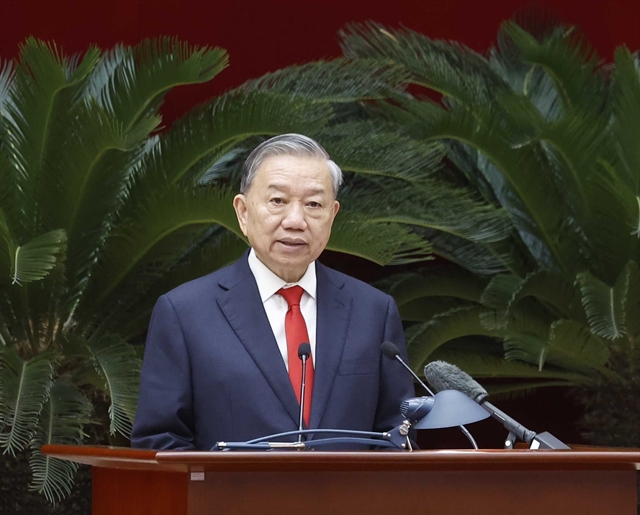
| Party General Secretary and State President Tô Lâm delivers his speech at a national conference in Hà Nội on Monday. — VNA/VNS Photo Thống Nhất |
HÀ NỘI — Each policy, each infrastructure project, and each flow of capital must aim to unlock people’s capacity and aspirations for development, turning potential opportunities into real growth and public confidence into a long-term driver of national and economic development.
Party General Secretary and State President Tô Lâm made the call on Monday morning in Hà Nội while attending and delivering keynote remarks at a national conference to study, disseminate and implement the Resolution of the second plenum of the 14th Party Central Committee.
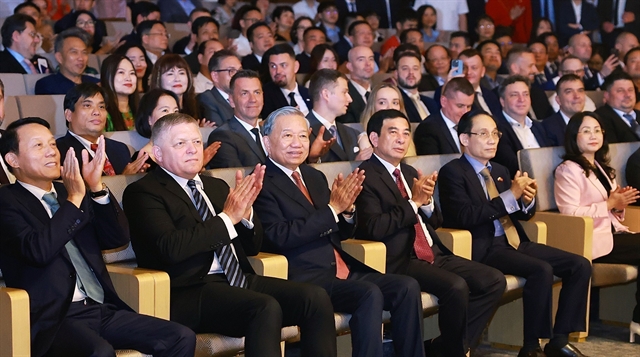
The conference was held in a hybrid format, with an in-person session at the Diên Hồng Hall of the National Assembly building and online connections to 36,323 locations across central agencies, provinces, ministries, military regions and units nationwide, drawing nearly 2.2 million participants.
The Party chief stressed the need to unleash productive forces and mobilise resources within the population, ensuring that every citizen, household, business household and enterprise becomes an active driver of growth.
Substantive growth must be generated both top-down and bottom-up, across every link of the economy, from individual households and small businesses to production facilities and large enterprises.
When domestic resources are unlocked and effectively connected with State resources, infrastructure, markets, technology, training, credit and development planning, the economy will gain a solid internal foundation for sustainable growth.
He called for the creation of a development environment in which millions of people can see genuine opportunities, where households and business entities are empowered to invest, expand and engage in legitimate, long-term economic activity.
At the same time, enterprises must be assured of a stable and transparent institutional framework, reasonable compliance costs, synchronised infrastructure and broad market access, conditions that will generate strong endogenous momentum, fostering innovation, entrepreneurship and sustainable development.
The Party chief also said: “Above all, it is essential to build trust and motivation across society.”
“When people and businesses have confidence, when the system functions smoothly and resources are effectively mobilised, the aspiration for development can be translated into tangible strength, helping to drive rapid and sustainable national growth in the years ahead.”
Uniform implementation
He further emphasised that the key task following the conference is to thoroughly grasp and resolutely implement its outcomes in a focused, coordinated and effective manner, creating clear and measurable changes across the political system and spreading momentum throughout society.
He stressed the need for a deep and comprehensive understanding that Party regulations constitute the institutional backbone ensuring the Party operates as a unified whole within the political system.
Party committees, organisations, officials and members at all levels must correctly understand, fully internalise and strictly implement the regulations as a direct political responsibility.
They are not allowed to interpret them differently, act differently or apply them in a way that benefits themselves personally, he said.
All regulations must be enforced consistently from top to bottom, alongside strict inspection and supervision, firm handling of violations and encouragement of innovative practices that comply with established rules.
The Party leader also called for a fundamental shift in development thinking, with more effective utilisation of all resources and capital to achieve sustainable growth.
“A high-performing and resilient economy cannot rely on a single source of resources, nor can it place the entire burden of development on the State,” he added.
The State, therefore, should transition from being a direct investor to a designer and enabler of a conducive environment, where all societal resources are mobilised and allocated according to market signals within a transparent and stable institutional framework.
“In this context, the roles of various capital sources must be redefined within a new development structure, where capital flows interact, reinforce and guide one another rather than operate in isolation,” he said.
State capital should be positioned as seed or catalytic capital, shaping development space and mitigating initial risks, thereby effectively attracting and activating non-State investment.
Corporate capital, including both private and foreign direct investment (FDI), should be channelled into high value-added production, innovation-driven projects and knowledge-based value chains.
External borrowing must be used selectively, aligned with absorption capacity and long-term debt sustainability, with priority given to key infrastructure projects and sectors with strong spillover effects.
Financial markets, including capital, credit and bond markets, must become genuine channels for medium- and long-term financing for the real economy, with a focus on directing capital into production, innovation and essential infrastructure, thereby improving the quality of growth, he said.
Tô Lâm also highlighted the importance of mobilising the people’s capital, describing it as a strategic breakthrough in the new phase.
“The resource encompasses not only financial capital but also the combined strength of knowledge, skills, labour, entrepreneurial spirit and the legitimate aspiration for prosperity among tens of millions of citizens,” he said.
When effectively activated, it can become a powerful endogenous driver, enhancing the economy’s resilience and self-reliance.
Responding to the directive, Politburo member, Secretary of the Party Central Committee and Head of the Central Commission for Communication and Mass Mobilisation Trịnh Văn Quyết said the guidance not only concretises the spirit of the 14th National Party Congress’s Resolution and the second plenum of the 14th Party Central Committee, but also serves as a guiding framework for Party committees and organisations at all levels to implement policies in a more coordinated, unified, effective and substantive manner.
At the conference, participants heard presentations on a range of topics, including regulations on implementing the Party Charter; resolutions on strengthening inspection and supervision, along with related rules on discipline; regulations on political and ideological work within the Party; a resolution on enhancing the Party’s leadership in anti-corruption, wastefulness and misconduct efforts in the new period; and conclusions of the second plenum regarding socio-economic development, public finance, public investment and public debt management for the 2026-30 period.
Following the conference, Party committees at all levels, organisations, agencies and units will continue to disseminate and thoroughly implement the Party Central Committee’s resolutions, regulations and conclusions in line with guidance from the Central Commission for Communication and Mass Mobilisation.
The process will be closely linked to the development of concrete action programmes and implementation plans tailored to the functions and responsibilities of each locality and institution, alongside strengthened inspection and supervision to ensure serious, coordinated, innovative and effective execution, with periodic reporting to the Politburo. — VNS
Politics & Law
 Politics & Law
 Politics & Law
 Politics & Law
 Politics & Law
 Politics & Law
 Politics & Law
 Politics & Law
 Politics & Law
 Politics & Law
 Politics & Law
 Politics & Law
 Politics & Law
 Politics & Law
 Politics & Law