 Politics & Law
Việt Nam, Belgium seek to deepen bilateral cooperation
1.
|
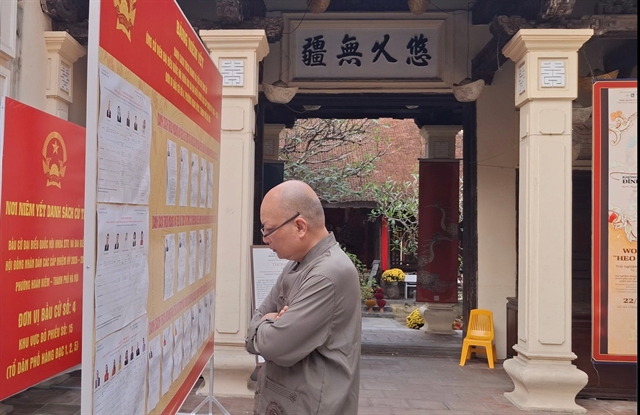
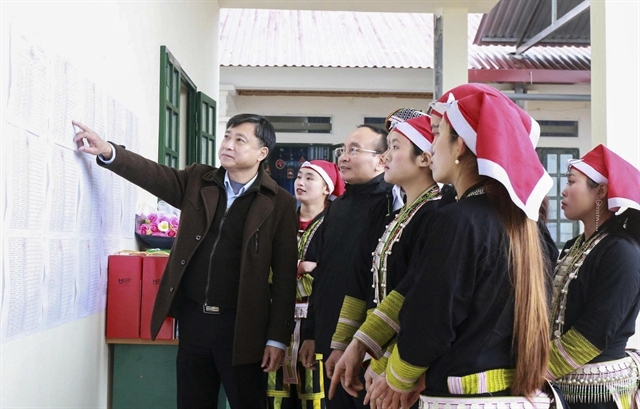
| A voter reads the list of voters and candidates for the National Assembly and local People’s Councils at Kim Ngân Communal House, Mar. 6. — Photo daibieunhandan.vn |
HÀ NỘI — In Hà Nội’s Old Quarter, the lead-up to the next general election is unfolding in places steeped in history, where voter lists now appear beside temple gates and centuries-old courtyards as residents prepare to cast their ballots.
Voter lists and candidate information for the upcoming election of deputies to the 16th National Assembly and local People’s Councils for the 2026–2031 term have been posted across Hoàn Kiếm Ward, not only in schools and government offices but also at some of the area’s best-known historical sites.
The notice boards now stand beside the courtyards and temple gates of centuries-old communal houses, where residents regularly gather for neighbourhood events and traditional rituals.
Hoàn Kiếm, one of the capital’s central wards, has set up 27 polling teams for the vote, including 25 serving residential areas and two for armed forces units.
Authorities have divided the ward into polling areas and designated locations where voters can check their names on the electoral rolls and review information about candidates.
Many of those locations are familiar community spaces.
One of them is Kim Ngân Communal House on Hàng Bạc Street, one of the largest and oldest communal houses in the Old Quarter.
The building once served as the meeting place of Thăng Long’s traditional silversmith guild, representing the craft community that helped build the reputation of the capital’s jewellery trade centuries ago.
For the coming election, the site has been designated as Polling Area 15.
In the early days of the year, residents often stop by the courtyard to burn incense and pray for good fortune. Now many linger a little longer, pausing at the notice boards to read through candidate biographies or check their names on the voter lists.
A few streets away, at Nam Hương Communal House on Hàng Trống Street, a similar board stands beside the temple entrance.
The shrine honours deities associated with the ancient city of Thăng Long and Lê Thái Tổ, the 15th-century ruler who restored Vietnamese independence after the Ming occupation of Việt Nam.
Residents have long visited the temple during festivals, the Lunar New Year and on the first and fifteenth days of the lunar month to offer incense.
In the weeks leading up to the election, some now stay to read about the candidates or confirm their voter registration.
Chử Bá Điệp, head of Polling Team 1 in Hoàn Kiếm Ward, said the changes to electoral boundaries this year have increased the number of voters assigned to each polling unit.
That has made the choice of venues especially important.
“These are places people already visit regularly. After coming to the temple or communal house, they can easily check the voter lists or learn about the candidates,” Điệp said.
Staff are stationed at the sites in three daily shifts to answer questions from residents and handle any corrections to the lists.
Alongside the traditional printed notices, many boards now include QR codes that allow people to scan and access detailed information online, a small example of how the election process is blending familiar public practices with digital tools.
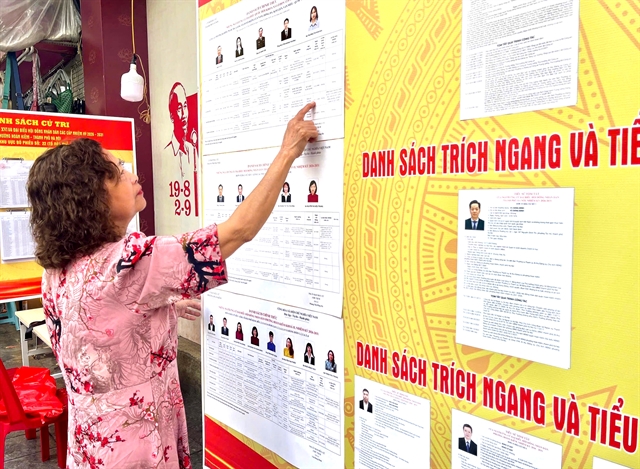
One of the most historically significant polling locations in the ward is at 48 Hàng Ngang Street, a national heritage site that has served as a voting location for many years.
|
| Voter Nguyễn Thu Hương of Hoàn Kiếm Ward at the national historical and cultural site at 48 Hàng Ngang Street, Mar. 6. — Photo daibieunhandan.vn |
The modest house holds a special place in modern Vietnamese history.
From August 25 to September 2, 1945, President Hồ Chí Minh and senior leaders of the revolutionary government stayed and worked there while preparing for the establishment of the new state.
It was in this house that President Hồ Chí Minh drafted the Declaration of Independence, proclaiming the birth of the Democratic Republic of Việt Nam.
Today the same building will again welcome voters.
Nguyễn Thu Hương, who lives nearby on Hàng Ngang Street, recently stopped by to review the lists.
“Every five years we come here to vote. Before election day we try to read about the candidates carefully so we can choose the people who will represent us,” she said.
In a ward where space is limited and history surrounds almost every corner, using cultural heritage sites as polling locations offers a practical solution.
But it also lends the process a quiet sense of continuity.
Buildings that once witnessed pivotal moments in the nation’s past now host one of its most ordinary civic routines, residents checking their names on a list, reading about candidates and preparing to cast their ballots. — VNS
Politics & Law
 Politics & Law
 Politics & Law
 Politics & Law
 Politics & Law
 Politics & Law
 Politics & Law
 Politics & Law
 Politics & Law
.jpg) Politics & Law
Politics & Law
 Politics & Law
 Politics & Law
 Politics & Law
 Politics & Law
 Politics & Law