 Politics & Law
Top Vietnamese leader begins official visits to EU, Belgium
1.
|
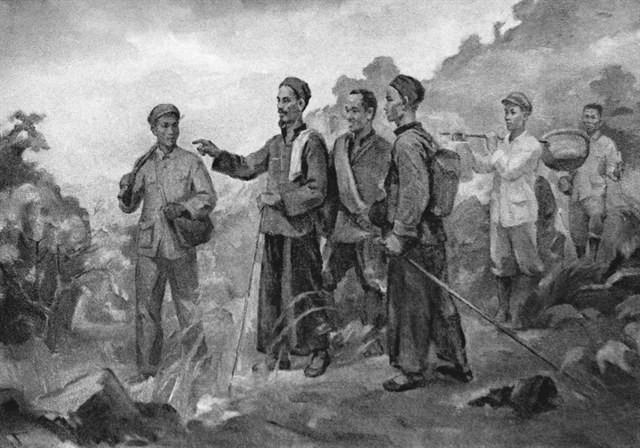
| A painting depicts President Hồ Chí Minh and his comrades returning to Việt Nam on January 28, 1941. — VNA/VNS Photo |
CAO BẰNG — The road into Pác Bó is wide and newly paved, its smooth surface lined with red flags bearing yellow stars.
For residents of Trường Hà Commune in the northern province of Cao Bằng, the decorations are more than ceremonial.
They are marking 85 years since President Hồ Chí Minh quietly crossed back into Việt Nam at this remote mountain outpost, setting in motion a revolution that would reshape the country’s history.
On January 28, 1941, President Hồ Chí Minh – then known as Nguyễn Ái Quốc – returned to the homeland after three decades abroad, entering through what is now known as Milestone 108, a border marker between Việt Nam and China.
He chose Pác Bó in Trường Hà as the headquarters of the Việt Bắc revolutionary base, a decision historians still regard as one of his most strategically astute. From this forested borderland, the early foundations of the Vietnamese revolution were laid.
Eight and a half decades later, the symbolic weight of Pác Bó remains undiminished, but the surrounding landscape has changed markedly.
Once a poor, isolated farming commune, Trường Hà has been reshaped by a blend of heritage tourism, small-scale commerce and targeted social programmes.
Nearly half of its households now earn income from tourism-related services, according to local officials. Families run souvenir stalls, provide transport for visitors, and offer homestays that cater to a steady stream of tourists drawn by history and scenery.
At a stall near the Lenin Stream, Lô Thị Hính arranges handwoven clothing, scarves and small handicrafts for sale.
She says visitors increasingly look for products with a clear local identity, particularly certified OCOP specialities – the 'One Commune, One Product' programme, a national initiative to promote rural brands.
“They want to take home something that really belongs to this place,” she said.
|
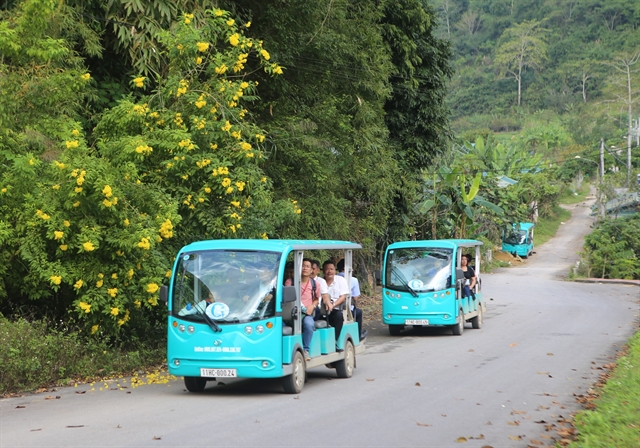
| Electric vehicles transport visitors at Pác Bó. — VNA/VNS Photo |
Tourism has also created work beyond retail. Residents drive electric shuttle vehicles, offer photography services and support site management – jobs that local leaders say have helped several families move out of poverty without leaving their home village.
Agriculture, too, has diversified.
Farmers have shifted away from subsistence crops to higher-value produce, including netted melons and red-fleshed dragon fruit.
One household now raises nearly 9,000 sturgeon a year across a series of concrete tanks, producing close to 10 tonnes annually and generating an income local officials estimate at around VNĐ1 billion (US$38,000).
Trade and services now account for about a quarter of Trường Hà’s economic output, a notable change for a commune once defined almost entirely by agriculture.
The nearby Sóc Giang border gate has added momentum to local trade and services. In 2025, trade passing through the crossing reached nearly $9.6 million, far exceeding official targets, according to local data.
|
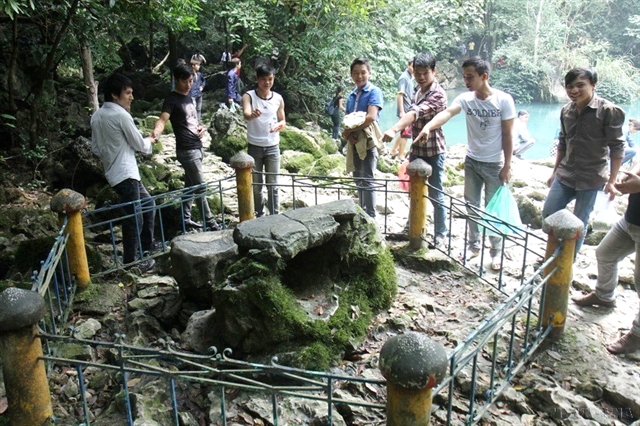
| Visitors view the stone table and benches where President Hồ Chí Minh once worked during his time in Pác Bó. — VNA/VNS Photo |
A visible push for social welfare has matched economic gains. Over the past year, the commune eliminated all remaining makeshift and dilapidated houses, replacing them with permanent, built-to-last homes for poor families.
For elderly residents like Đặng Văn Piao, 75, the change has been life-altering.
“My wife and I are old and no longer able to work. We used to live in a dilapidated house. Now we have a new home. We are very happy,” he said, standing in front of a newly built home completed just in time for Tết.
Local authorities say the goal for the next five years is to lift average annual income to around VNĐ40 million ($1,533) per person and reduce the poverty rate to 3 per cent, while maintaining border security and curbing smuggling.
“Eighty-five years ago, a revolutionary flame was lit here,” said Triệu Văn Thuận, Deputy Chairman of the People's Committee of Trường Hà.
“Today, that flame is about aspiration – building livelihoods, preserving culture, and developing this borderland sustainably.”
At Pác Bó, where mountains and streams once sheltered a returning revolutionary, the past still draws visitors in.
But it is the quieter transformation of daily life – homes rebuilt, businesses opened, young people finding work close to home – that now defines this historic corner of northern Việt Nam. — VNS
Politics & Law
 Politics & Law
 Politics & Law
 Politics & Law
 Politics & Law
 Politics & Law
 Politics & Law
 Politics & Law
 Politics & Law
 Politics & Law
 Politics & Law
 Politics & Law
 Politics & Law
 Politics & Law
 Politics & Law