 Politics & Law
Project lays foundation for digital greenhouse gas emissions data management
1.
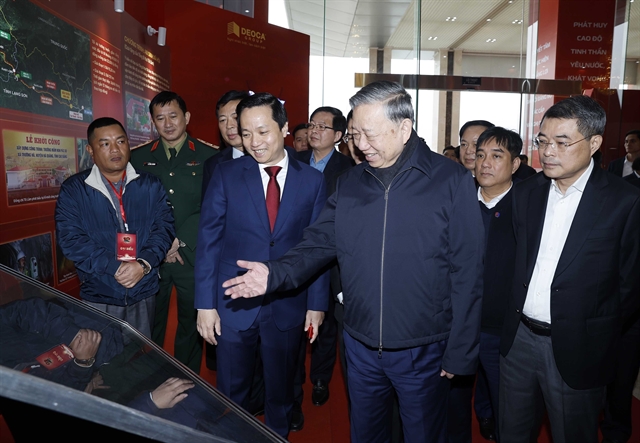 |
| Party General Secretary Tô Lâm (centre) and delegates visit a photo exhibition of the Cao Bằng Provincial Party Committee. — VNA/VNS Photo Thống Nhất |
CAO BẰNG — Cao Bằng will transform its unique advantages into genuine drivers of development, effectively fulfilling strategic tasks on national defence, security and foreign affairs while sustainably improving people's lives in a fundamental way.
Party General Secretary Tô Lâm made this statement while meeting with the Cao Bằng Provincial Party Committee on Wednesday.
The Party leader emphasised that Cao Bằng is a frontier of the Fatherland. It is also the cradle of the Vietnamese revolution, the place President Hồ Chí Minh chose as his first foothold upon returning to the country, where he led the revolution and made pivotal decisions for the nation's destiny.
From Cao Bằng, the path of the Vietnamese revolution was established, the Party's strategic resolve was forged, and the nation's aspiration for independence and self-reliance was ignited.
Today, Cao Bằng carries historical pride and bears great responsibility in maintaining border stability, strengthening national defence and security, and finding a suitable development path for a border province in the new era.
Lâm noted that Cao Bằng is a mountainous border province with a low starting point for development, harsh natural conditions and limited infrastructure, creating major challenges.
For this reason, the province cannot develop through a scattered approach, nor can it mechanically copy models from localities with more favourable conditions.
Every development decision must stem from those very specific conditions, turning difficulties into drivers, border location into a strategic advantage, and cultural and historical values into development resources.
Path to happiness
The Party chief said that the higher the goals, the more accurate the development thinking must be, adding that the more precise the breakthroughs, the stricter the public service discipline.
It is essential to internalise the 14th National Party Congress's requirements on enhancing organisational implementation capacity, public service discipline and accountability tied to results, he said.
The province is restructuring its development model towards effectiveness, productivity and happiness, decisively abandoning outdated thinking.
Cao Bằng has correctly identified a fundamental shift, “vigorously moving from a growth model mainly reliant on capital and labour to one centred on effectiveness, productivity, income and people's quality of life as the core measures of leadership capacity and development quality,” according to Lâm.
This is the right choice and must be institutionalised into a specific system of indicators linked to clear mechanisms for assignment, coordination and responsibility, the Party leader said.
He proposed making tourism a true spearhead economic sector, with tourism development based on a product mindset, destination mindset and service value chains.
The Party chief also confirmed that Cao Bằng has made a good choice in taking the happiness index as its central policy axis, linking growth with social security, health care, improved education and training quality, as well as essential services for remote and border areas.
According to Lâm, the province will concretise this idea into programmes with clear output standards and strict monitoring mechanisms, closely following the spirit of Central Committee resolutions on education, health care and culture.
For Cao Bằng, this is not merely social policy, but the foundation of political and social stability, of the “people's resolve posture”, and a direct component of national defence and security in the new context, he noted.
The Party leader added that this year, there must be strong improvements in the business environment, focusing on digital transformation and the application of science and technology.
Lâm proposed a focus on developing a workforce closely tied to the new growth model and the province's advantageous sectors.
Development cannot rely on wasteful programmes, he said, but must directly link to job outputs in prioritised fields like border logistics and trade, quality tourism and distinctive agriculture with processing, services and local digital governance capacity.
Building on existing training partnerships, the province must creatively apply an order-based training model tightly linked to occupational standards, businesses and the real needs of border gates, tourism destinations and public service systems.
The province must organise its streamlined government apparatus for effectiveness, build a cadre force commensurate with its stature and establish a creative, disciplined and effective administration, ensuring smooth operation of the two-tier local government model.
Officials must be close to the people and provide dedicated support. Every task must be assigned to specific roles, with clear duties, deadlines and full accountability. Emphasis must also be placed on efficiency in socio-economic development, the Party leader noted.
According to Lâm, the province must ensure national defence and security, foreign affairs and peaceful, stable, cooperative border management, as well as uphold national border sovereignty, political stability, social order and safety.
At the same time, border gate-related foreign affairs and trade must be organised as a controlled development space, open for growth but without lax management.
Trade promotion must be paired with elevated security, safety and discipline standards to combat smuggling and trade fraud, and cooperation must be strengthened while safeguarding national and ethnic interests.
Lâm said that Party building must be seen as the condition ensuring every breakthrough, reminding officials to maintain unity and consensus, strengthen inspection and supervision, combat corruption, waste and negativity and, most importantly, build a cadre force that can think, act and take responsibility for the common good.
This spirit must be concretised through mechanisms evaluating cadres by performance results and the degree of public satisfaction and trust, for public trust is the highest measure of leadership capacity, he said.— VNS
Politics & Law
 Politics & Law
 Politics & Law
 Politics & Law
 Politics & Law
 Politics & Law
 Politics & Law
 Politics & Law
 Politics & Law
 Politics & Law
 Politics & Law
 Politics & Law
 Politics & Law
 Politics & Law
 Politics & Law