 Politics & Law

Việt Nam, World Bank Group step up cooperation ahead of APEC 2027
1.
|
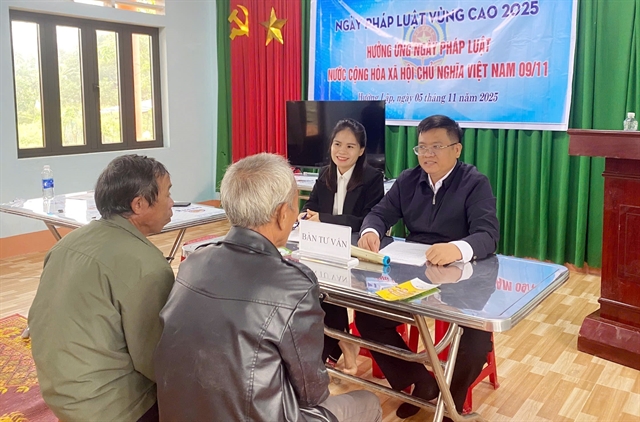
| Officers from Quảng Trị Provincial Legal Aid Centre No 2 provide legal aid to residents of Hướng Lập Commune. VNS/VNS Photo Tá Chuyên |
QUẢNG TRỊ — Legal aid in Quảng Trị Province has become a vital safety net for disadvantaged groups, particularly ethnic communities in remote areas, helping them access justice on an equal footing and strengthening trust in the law. However, strengthening resources, coordination mechanisms and outreach methods remains crucial to ensure that legal aid truly reaches every citizen.
At around 11am on June 4, 2022, 40-year-old Hồ Văn Dinh was driving a motorbike carrying 17-year-old Hồ Văn Vũ from Mò Ó Commune to Ba Lòng Commune. Dinh did not hold a driver’s licence and failed to observe a danger warning sign along a section of Provincial Road 588A known for its sharp curves.
When he saw a car with licence plate 74H-005.95 approaching from the opposite direction, Dinh braked suddenly, causing the motorbike to skid. As a result, Vũ was thrown onto the opposite lane, where he was struck by the car and suffered severe injuries.
He lost one-third of his left thigh and sustained skin damage on his right leg, with a total bodily injury rate of 66 per cent.
The police initiated criminal proceedings against Dinh for violating road traffic regulations. Prosecutors proposed a suspended sentence of 24 to 30 months.
Lê Thị Thùy Linh, a legal aid officer from Quảng Trị Provincial Legal Aid Centre No 2, defended Dinh, highlighting mitigating circumstances such as his sincere confession, voluntary compensation for the victim, the victim’s written request for leniency, good character, and the fact that he was the main breadwinner in a poor household.
Linh explained that Dinh, an ethnic man living in hardship, had limited legal awareness. At the trial, she appealed to the court’s compassion, asking for a suspended sentence so he could have a chance to make amends and continue supporting his family. She also filed a request for exemption from first-instance criminal court fees.
Her arguments were accepted. The court sentenced Dinh to 18 months in prison, suspended for 36 months and waived his criminal court fees.
Another case involving Hồ Văn Thon, an ethnic resident of Quảng Trị Province, further illustrates the vital role of legal aid in ensuring justice for vulnerable groups.
In mid-2024, Thon threw a rock at a moving truck, shattering its windshield and slightly injuring the driver. According to the valuation report, the property damage totalled more than VNĐ10.7 million (US$406). The victim suffered a 5 per cent bodily injury but chose not to pursue criminal charges.
For this act, Thon was initially fined VNĐ6.5 million ($246) for an administrative violation. However, on December 19, 2024, the People’s Court of Hướng Hóa District held a first-instance trial and sentenced him to six months in prison for deliberate destruction of property.
Thon appealed and filed a request with the provincial Legal Aid Centre No 2, seeking legal representation in hopes of receiving a suspended sentence.
Lê Thị Diệu Hương, the legal aid officer assigned to his case, said that upon reviewing the file, she recognised that Thon, a member of a poor ethnic minority household, qualified for free legal assistance. He was the family’s main breadwinner, raising two young children alone after his wife had left, with little understanding of legal matters.
Thanks to Hương’s defence, the appellate court reduced the sentence, granting Thon a six-month suspended term with a 12-month probation period and exempted him from appellate criminal court fees.

|
| Staff of Quảng Trị Provincial Legal Aid Centre No 2 discuss local cases in need of legal assistance. VNA/VNS Photo Tá Chuyên |
According to Nguyễn Lương Chính, Acting Deputy Director of Quảng Trị Provincial Legal Aid Centre No 2, the centre handles hundreds of cases each year, most of them involving poor households, ethnic minorities, people with meritorious service to the revolution, and children.
In addition, the centre has taken on complex civil disputes that have dragged on for years, involving land, administrative and inheritance issues. Thanks to legal aid, many citizens have come to understand their rights, received lawful protection and have been exonerated or had their penalties reduced.
“This is how the law reaches the people, so that justice does not remain only in books,” Chính said.
Judge Trần Trung Thành of the Quảng Trị People’s Court commended the presence of legal aid officers in court proceedings, noting that their participation helps defendants and plaintiffs better understand the law, prepare documents and evidence, and present well-founded arguments before the court.
“The thorough preparation made by legal aid officers ensures that proceedings are conducted smoothly and in accordance with due process,” Thành said.
“It also provides judges with a sound basis for delivering fair and objective verdicts.”
More access to legal aid
Despite significant progress, legal aid activities in Quảng Trị Province still face numerous challenges.
According to Chính, the greatest obstacles include language barriers, geographic isolation, and the hesitancy of local residents to seek assistance.
“To reach people in remote and mountainous areas, legal aid officers often have to travel hundreds of kilometres through winding mountain roads, sometimes just to provide counsel for a single case,” Chính said.
“Accessing case files or meeting with defendants for legal aid cannot be done in one trip. It usually requires multiple visits.”

|
| A shortage of legal aid officers in the province remains one of the main challenges for the sector. VNA/VNS Photo Tá Chuyên |
Many people are still unaware of their right to free legal assistance. Even those eligible often hesitate to contact legal authorities due to fear or unfamiliarity. Most beneficiaries of legal aid are ethnic minorities who may be illiterate or persons with disabilities who struggle to communicate. As a result, legal aid officers must rely on family members or witnesses to gather information, understand clients’ wishes and reconstruct case details.
Chính added that a shortage of legal aid officers was another problem. At the same time, the growing volume of complex and prolonged cases has placed increasing pressure on staff, requiring legal aid officers to possess in-depth expertise, strong problem-solving skills and more time to review case files.
“With a limited number of legal aid officers, we often have to work two or three times beyond our normal capacity,” he noted.
Expanding eligibility for legal aid is also an urgent need. Under current regulations, the elderly, persons with disabilities, and people living with HIV are entitled to legal aid only if they face financial hardship.
“Those who have just escaped poverty also need legal support,” he said. “These groups should be included in the next amendments to the Law on Legal Aid.”
Seeking solutions
Đào Thị Bình, Deputy Director of the provincial Department of Justice, said that to address geographic challenges and local conditions, the department has proposed that the provincial People’s Committee maintain two State Legal Aid Centres, including Centre No.1 (formerly based in Quảng Bình) and Centre No.2 (formerly in Quảng Trị), to better serve residents across the province.
Bình further noted that the province plans to broaden eligibility to include vulnerable groups such as single mothers, the elderly, and persons with disabilities in difficult circumstances. The Department of Justice will also focus on training legal aid officers in communication and counselling skills when working with disadvantaged people, aiming to enhance the quality of free legal services in the coming years.
In addition, the department has proposed that the Ministry of Justice review and amend relevant legal aid policies to ensure greater effectiveness and inclusivity. Bình said that key priorities ahead include strengthening digital infrastructure, modernising administrative procedures and innovating public outreach through diverse and creative communication methods.
“These efforts aim to integrate legal aid activities with the objectives of national target programmes,” she added, “ensuring that everyone entitled to legal aid can access it and that justice truly reaches every citizen.”
Nguyễn Ngọc Huy, Deputy Chief Judge of the provincial People’s Court for Region 7, acknowledged that while coordination between the courts and the legal aid centres has been effective, the rising number of cases demands more time for research and evidence collection.
“This underscores the urgent need for enhanced professional training, reasonable support policies, and stronger incentives to attract and retain qualified legal aid personnel,” Huy said.
He and other officials also emphasised the importance of digital transformation, applying information technology to manage case records, access legal documents, and provide remote consultations to ease workloads and improve service efficiency. — VNS
Politics & Law
 Politics & Law
 Politics & Law
 Politics & Law
 Politics & Law
 Politics & Law
 Politics & Law
 Politics & Law
 Politics & Law
 Politics & Law
 Politics & Law
 Politics & Law
 Politics & Law
 Politics & Law
 Politics & Law