 Opinion
Vietnamese Prime Minister meets Cambodian National Assembly President
1.
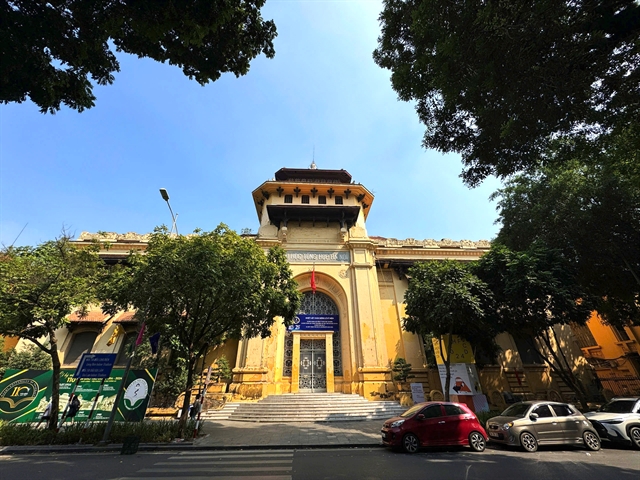 |
| The facade of the historic campus building at No 19 Lê Thánh Tông Street, Hà Nội. — VNA/VNS Photo An Thành Đạt |
HÀ NỘI — A proposal to convert a century-old campus at No.19 Lê Thánh Tông Street, Hà Nội, has sparked debate, with several experts arguing that a living space of academia should not be turned into a static exhibition.
The city authorities recently proposed establishing the Hồ Chí Minh Era University Museum at this location, which means departments and classes currently at the campus would have to be relocated.
The building dates back to 1906, when the Indochinese University (Université indochinoise) was established as the first higher education institution in Việt Nam and Indochina.
Following the signing of the 1954 Geneva Agreement and the liberation of northern Việt Nam, the facility became home to Hà Nội General University in 1956.
Today, it hosts the Faculty of Chemistry of Hà Nội University of Science under Vietnam National University, Hà Nội and Hà Nội University of Pharmacy.
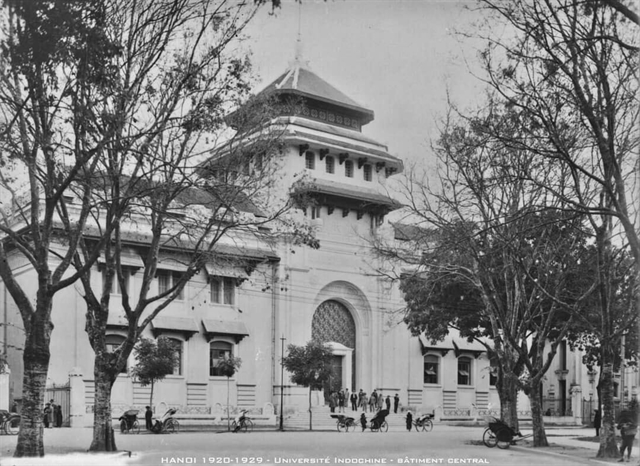 |
| The main building of the Indochinese University (Université indochinoise) in the 1920s. — Photo vnu.edu.vn |
Speaking to Vietnamnet.vn, Hà Nội-based architect Phạm Thanh Tùng said the site embodies legacy values that require careful consideration before any decision is made.
With more than a century of history, the building was home to the earliest institutions to train intellectual elites in the region and is itself a designated heritage structure, he said.
He also emphasised that the site could be considered a living museum that continues its function as an academic space.
“It is the students and those working there who create its value; they have been and continue to produce excellence in the field of medicine,” Tùng said.
“Those who study, research and teach here inherit an academic atmosphere built up over generations spanning more than a century. That is a precious educational foundation, offering both motivation and pride. It should be preserved as a living museum, not merely a place for viewing.”
The architect agreed that Hà Nội should establish a museum on the history of Vietnamese education, but at another location.
This facility could trace the transformation of higher education in Việt Nam, from the earliest universities such as the Indochina-era schools and dormitories to Hà Nội Polytechnic and other major institutions, reflecting achievements in the Hồ Chí Minh era and the training of new generations of talent.
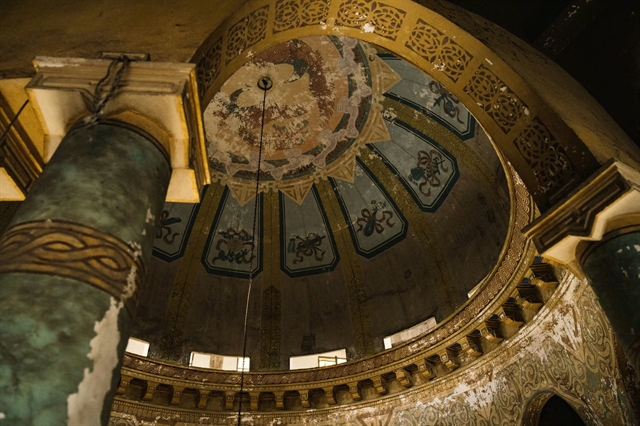 |
| The vaulted ceiling inside the building at No 19 Lê Thánh Tông Street, Hà Nội. — Photo courtesy of Hanoi Creative Design Festival |
From a planning perspective, architect Đào Ngọc Nghiêm, former director of Hà Nội’s Department of Planning and Architecture, said the policy of relocating universities out of the inner city dates back to a 1998 master plan. However, he stressed that relocation does not mean moving entire institutions.
“The policy is to relocate certain units, particularly those requiring large areas for teaching and research,” he said.
Many universities, Nghiêm noted, retain their original campuses as headquarters or primary sites to preserve institutional heritage. He believes the building at No.19 Lê Thánh Tông should continue some of its current functions.
Professor Nguyễn Hải Nam, rector of the Hà Nội University of Pharmacy, said a university is a constantly operating ecosystem rather than a static space.
He warned that converting the entire campus into a museum may preserve the physical structure but would disrupt the academic flow, turning a living space of knowledge into a static display.
Citing international practice, he noted that many leading universities maintain historic campuses in city centres while expanding elsewhere, with the original sites continuing to host academic activities.
Under the university’s proposal, the No 19 Lê Thánh Tông campus would continue to support postgraduate training, scientific research and academic activities, while undergraduate education would be relocated to a new campus in the suburban commune of Đan Phượng, covering more than four hectares. — VNS
Opinion
 Opinion
 Opinion
 Opinion
 Opinion
 Opinion
 Opinion
 Opinion
 Opinion
 Opinion
 Opinion
 Opinion
 Opinion
 Opinion
 Opinion