 Opinion
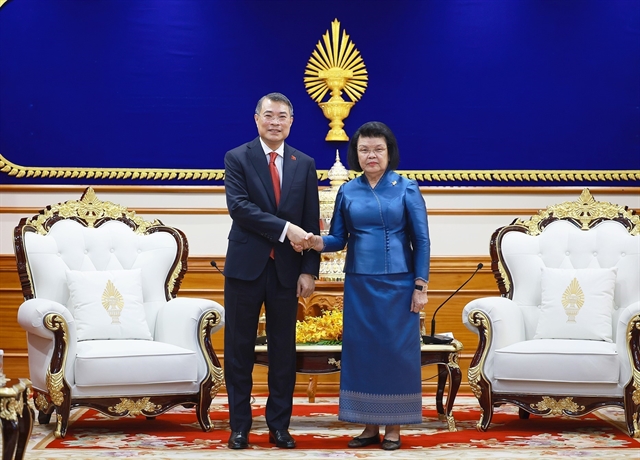
Vietnamese Prime Minister meets Cambodian National Assembly President
1.
.jpg) |
| Japanese Ambassador to Việt Nam Ito Naoki. Photo courtesy of the Japanese Embassy |
As Việt Nam enters a new phase of development following a year of strong economic performance, attention is turning to how reforms and international partnerships can sustain this momentum.
Speaking to Việt Nam News reporter Khánh Linh, Japanese Ambassador to Việt Nam Ito Naoki reflected on Việt Nam’s progress and outlined key priorities for Việt Nam–Japan cooperation in the years to come.
Looking back at 2025, how would you describe Việt Nam’s journey, and what developments in Việt Nam’s socio-economic landscape have impressed you most?
Reflecting on 2025, the most notable highlight is Việt Nam’s achievement of an economic growth rate of 8.02 per cent, the highest in Southeast Asia. This success is underpinned by rapid reforms under General Secretary of the Communist Party of Việt Nam (CPV) Tô Lâm.
The CPV's Politburo has adopted four strategic resolutions for breakthrough development, along with nine others to implement the CPV's 14th National Congress, laying foundations for double-digit growth and the goal of becoming a high-income nation by 2045.
We welcome the re-election of General Secretary Tô Lâm at the 14th National Party Congress. Under his leadership, the 'second act' of reform has begun, and we look forward to further progress, particularly in implementation. Japan fully supports this direction and believes improvements in the investment environment will create new opportunities for bilateral economic ties.
According to the General Statistics Office, Việt Nam’s exports in 2025 reached US$475 billion, a 17 per cent increase compared to the previous year, with strong performance in electronics and related sectors, resulting in a trade surplus of over $20 billion. FDI disbursement reached $27.6 billion, the highest in five years.
 |
| Delegates at a groundbreaking ceremony for the North Hanoi Smart City project in Vĩnh Thanh Commune, Hà Nội, on August 19, 2025. — VNA/VNS Photo Trần Việt |
In 2025, numerous strategic infrastructure projects broke ground or were completed, highlighted by the opening of the North-South Expressway’s main routes and the ongoing construction of the Long Thành International Airport.
Japan has also advanced projects, such as the groundbreaking of the North Hanoi Smart City by Sumitomo Corporation and BRG, the development of the Yen Xa Wastewater Treatment Plant through ODA, and the O Mon 4 Thermal Power Plant project involving Mitsubishi Heavy Industries.
Moving forward, Japan remains committed to contributing to Việt Nam's growth by leveraging our core strengths.
Việt Nam has continued to advance administrative reforms, digital transformation and efforts to improve its investment climate. From your conversations with Japanese businesses here, how has the Japanese business community in Việt Nam responded to these ongoing changes?
Trade and investment between Japan and Việt Nam continue to grow steadily. Japanese investment rose 19 per cent year-on-year to $3.1 billion, bringing the cumulative total to $79 billion.
In manufacturing, Toyota is investing approximately $400 million in hybrid vehicle production, while Thăng Long Industrial Park is investing about $100 million in Thanh Hóa Province. In retail, AEON MALL is investing around $500 million in Cần Thơ City and Đồng Nai Province.
Annual bilateral trade has reached nearly $50 billion. According to the Japan External Trade Organisation (JETRO), over 2,000 Japanese companies operate in Việt Nam, with about 70 per cent expecting profit and 60 per cent planning expansion. For the second consecutive year, Việt Nam ranked first in ASEAN in terms of Japanese companies’ eagerness for business expansion.
As Việt Nam achieves an unprecedented level of development, the acceleration of reforms and the further improvement of the investment environment will create greater opportunities for Japanese companies to expand their operations. I believe there remains significant room for Japanese businesses to contribute to Việt Nam’s growth by leveraging their core strengths.
In March and August 2025, and again on the 21st of this month, Prime Minister Phạm Minh Chính held three dialogues with Japanese companies, expressing strong expectations for the continued expansion of their trade and investment in Việt Nam.
Tangible results are already emerging. For instance, regulations concerning the renewal of business licences for manufacturers using machinery and equipment over 10 years old are being revised. Furthermore, the Economic Needs Test, which requires foreign retailers to undergo prior screening for each new store opening, has been amended based on requests from the Japanese side.
At the same time, several challenges remain. The issue of unpaid arrears to contractors involved in HCM City's Metro Line 1 has yet to be fully resolved and will require further attention. Regarding planned restrictions on petrol-powered motorcycles in Hà Nội, we hope that a clear roadmap will be established, along with an appropriate transition period.
I am confident that, once these outstanding issues are addressed and investment predictability is further strengthened, a more stable business environment will help unlock greater expansion of trade and investment between Japan and Việt Nam.
Japan has supported numerous grassroots grant assistance projects in disadvantaged communities across Việt Nam. With 759 projects worth around $70 million implemented to date, what has been the most meaningful impact of these initiatives?
Japan launched its Grant Assistance for Grassroots Human Security Projects (GGP) in Việt Nam in 1992. Over more than 30 years, around 760 projects worth over $70 million have been implemented.
Through GGP, Japan has supported the construction of schools, hospitals and water supply systems across Việt Nam, improving living conditions and reducing poverty, including in ethnic communities, contributing to Việt Nam’s Sustainable Development Goals.
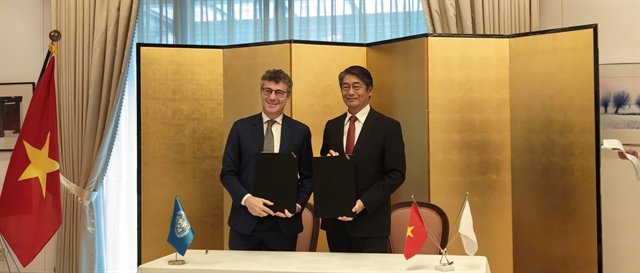 |
| Ito Naoki, Japanese Ambassador to Việt Nam and Jonathan Wallace Baker, UNESCO Representative to Việt Nam sign an agreement to implement a project on strengthening Việt Nam’s capacity for early warning, disaster risk reduction and safe learning environments. —VNS Photo Khánh Linh |
Furthermore, Japan has also supported disaster risk reduction. In response to increasing extreme weather, evacuation shelters have been built in three villages in Lào Cai Province, with additional support planned for Điện Biên and Lào Cai.
Most importantly, these initiatives have fostered mutual trust and understanding between the two peoples, strengthening bilateral relations. Japan remains committed to collaborating with Việt Nam to address community-based development challenges in the years to come.
What are your key expectations for bilateral cooperation, particularly in strategic areas such as high technology, energy transition and workforce development?
For over 30 years, Japan has fostered Việt Nam’s industrial development through technology transfer, contributing to the development of the Vietnamese manufacturing sector including small and medium-sized enterprises. These efforts are becoming increasingly important.
Key areas of cooperation include AI and innovation, semiconductors and digital and green transformation. These areas are positioned as new pillars of bilateral cooperation.
In semiconductors, Việt Nam aims to train 500 doctoral students by 2030, with Japan committed to hosting approximately 250 — half of the target — through international joint research programmes. Joint research projects have already begun, with further programmes planned. At Việt Nam-Japan University, over 100 students are enrolled in a semiconductor chip technology programme launched last October.
In agriculture, cooperation on decarbonisation and productivity is advancing through partnerships between Japanese start-ups and Vietnamese stakeholders.
By leveraging the financial resources and advanced technologies of both the Japanese public and private sectors, Japan remains committed to supporting Việt Nam’s workforce development and industrial growth.
As Việt Nam moves forward with its development vision centred on innovation and sustainability, which aspects of Japan’s experience do you believe could offer useful reference points?
Việt Nam has set policy targets under its National Green Growth Strategy and Resolution 57 on science, technology and innovation.
Japan remains committed to providing financial, technical assistance and cooperation in developing the institutional frameworks and environments necessary for these sectors to flourish.
 |
| A cultural performance during a Việt Nam–Japan exchange event in Đà Nẵng on March 20, 2025. — VNA/VNS Photo Văn Dũng |
Considering the recent situation in the Middle East, clean energy is becoming increasingly vital. Through the Asia Zero Emission Community, Japan has proposed 15 projects worth approximately $20 billion.
Japan has also decided to implement a programme loan of approximately $330 million to support climate and disaster resilience policies. These efforts contribute to Việt Nam’s new growth model and implementation of its commitments under the Paris Agreement.
Japan expects to see effective use of the green transformation and disaster-prevention technologies of Japanese companies, which possess significant strengths in promoting a decarbonised society and enhancing disaster resilience.
The Comprehensive Strategic Partnership between Việt Nam and Japan continues to deepen. What factors will ensure its continued growth?
As tensions increase in the Middle East, Japans looks forward to further progress in security cooperation to ensure the peace and stability of the region and the international community. We welcome Việt Nam’s policy of strategic self-reliance and its growing international role, including hosting CPTPP this year and APEC next year.
At the end of last year, Japan and Việt Nam held the first-ever Foreign and Defence Vice-Ministerial 2+2 meeting in Tokyo. Around the same time, Vietnamese Navy frigate Trần Hưng Đạo made its first port call to Japan in seven years.
In Việt Nam, Japan Maritime Self-Defence Force destroyer Onami visited Vũng Tàu in March, while the destroyer Asahi is scheduled to make a goodwill visit to Đà Nẵng in April. Japan fully supports Việt Nam in strengthening bilateral cooperation in diplomacy and security, and in playing an increasingly important role in promoting peace, stability and sustainable growth in the region and beyond.
The Comprehensive Strategic Partnership is a partnership “for Peace and Prosperity in Asia and the World". Japan will continue to promote a free and open Indo-Pacific as a key pillar of its foreign policy. In line with the ASEAN outlook on the Indo-Pacific, which emphasises peace, stability and inclusive cooperation, we look forward to working closely with Việt Nam as a vital partner toward the realisation of these goals.
People-to-people exchanges and cultural understanding also form a key foundation of our bilateral relationship. In 2025, 810,000 Japanese visited Việt Nam, while 680,000 Vietnamese travelled to Japan. We aim to raise this figure to over two million mutual visitors by 2030.
The number of Vietnamese residents in Japan has increased by more than 500,000 over the past decade. We will continue to improve conditions to ensure Japan remains an attractive destination for Vietnamese students and workers. With the goal of further expanding this community, we look forward to achieving even three million.
We are confident that these efforts will continue to strengthen cooperation between our two countries under the Comprehensive Strategic Partnership. — VNS
Opinion
 Opinion
 Opinion
 Opinion
 Opinion
 Opinion
 Opinion
 Opinion
 Opinion
 Opinion
 Opinion
 Opinion
 Opinion
 Opinion
 Opinion