 Opinion
Top leader’s visit to open new chapter in Việt Nam–Denmark relations
1.
 |
| Nguyễn Thị Xuân Thúy is an academic and a senior industrial policy expert. — Photo courtesy of Nguyễn Thị Xuân Thúy |
Nguyễn Thị Xuân Thúy, lecturer at the University of Economics and Business at Việt Nam National University, Hà Nội and senior industrial policy expert at the United Nations Industrial Development Organization (UNIDO) Việt Nam, speaks to Việt Nam News reporter Nhật Hồng about the country’s transition to green transport and insights from international experiences.
As an academic and a senior policy expert, how do you assess Việt Nam’s vision in the transition to green transport?
Việt Nam’s vision of a transition to green transport aligns with its net-zero goal, as we know the transport sector makes up a significant portion of total emissions. Green transport will not only help Việt Nam achieve its net-zero targets, but more importantly, elevate people’s quality of life, which is the most important and humane goal, in my opinion.
The country is taking steps in the right direction. For example, we have Decision 876/QĐ-TTg by the Prime Minister on transitioning to green energy and reducing carbon and methane emissions in the transport sector. Major cities like Hà Nội and HCM City have also introduced targets on reducing emissions in urban areas, along with measures including low-emissions zones, with very specific directions.
However, there is a certain gap between Việt Nam’s strategy and reality. The Ministry of Construction is considering several adjustments and supplements to Decision 876. Hà Nội is also looking into gathering more input on the feasibility of establishing low-emissions zones. I highly regard such directions, as well as the openness to policy feedback.
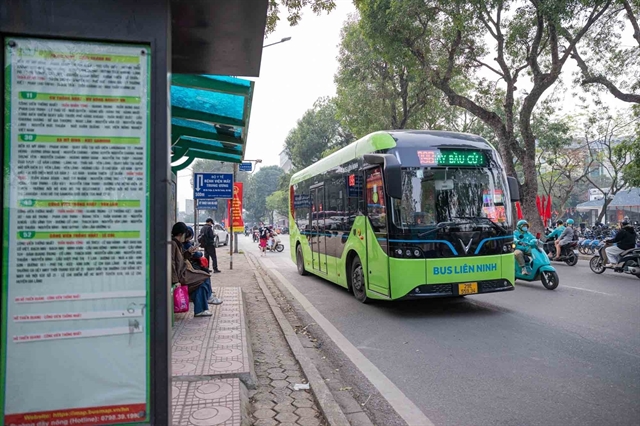 |
| An electric bus on a Hà Nội street. — VNA/VNS Photo Phạm Tuấn Anh |
What are some of the notable global examples of green transport that Việt Nam could learn from?
Regarding international experience in emissions reduction [in the transport sector], we can see that most countries pursue multiple objectives within their green transport strategies.
In countries without a domestic automotive industry, such as Singapore and Norway, policies tend to focus solely on transport goals, namely reducing vehicle emissions and easing congestion – these are urban transport management policies.
However, even though such countries don’t have a domestic automotive industry and rely heavily on imported vehicles, they still take into account consumers’ ability to adapt. As a result, they typically adopt long-term roadmaps of 20 to 30 years. Most began introducing policies in the 1990s or early 2000s, with targets set for 2030 or 2040.
Countries with developed automotive industries tend to be even more cautious. Their policies are more diverse and structurally complex, balancing transport management with maintaining domestic car manufacturing and enhancing the industry’s competitiveness.
In the case of Germany, Japan or the US, these countries have a strong domestic automotive sector, including supporting industries such as vehicle assembly and vehicle parts manufacturing. During the transition, their support policies are thus mainly directed at research institutes in collaboration with businesses to develop new technologies and innovative solutions.
Meanwhile, Thailand, a notable example closer to Việt Nam, pursued a strategy of attracting investment into electric vehicle (EV) manufacturing. The expectation was that foreign investors would integrate with existing domestic supplier networks.
However, while investors committed to increasing localisation rates, many failed to meet those targets in practice despite having benefitted from government incentives. This offers an important lesson for Việt Nam as it seeks to promote EV adoption and attract foreign investment in the sector.
In my opinion, the key takeaway is not just about choosing the right policy tools, but about designing policies that align with domestic context, infrastructure and other relevant conditions. Policies must be grounded in what is realistically achievable to be both effective and feasible.
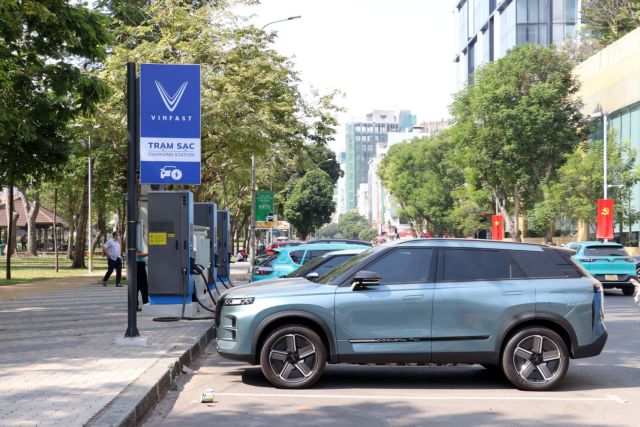 |
| An electric car at a charging station in HCM City. — VNA/VNS Photo Tiến Lực |
For example, in France, despite its status as a high-income country, policymakers differentiate support based on income levels. Lower income groups receive higher subsidies to help them access and transition to cleaner vehicles.
Similarly, in Norway, the support for switching to EVs is targeted at average income groups. Subsidies are typically capped at certain price thresholds, meaning government support applies only to vehicles below a specified value. Luxury EVs, by contrast, do not qualify for any subsidies.
The rationale is that higher-income individuals do not require support as their purchases are primarily for personal consumption rather than significant contributions to broader goals. As such, expensive vehicles are excluded from incentives.
This underscores that in policymaking, policies should first be inclusive, supporting all groups affected by the transition. Second, they must be sustainable and evidence-based.
Different countries can prioritise different targets. Some focus on private EVs, while others focus on public transport or motorbikes, depending on their specific conditions. Decisions must be made based on an assessment of a country’s actual circumstances to design effective policies.
In my view, the most important point is understanding who we are and what conditions we have. From there, we can determine the appropriate measures to drive the transition, which is the key lesson.
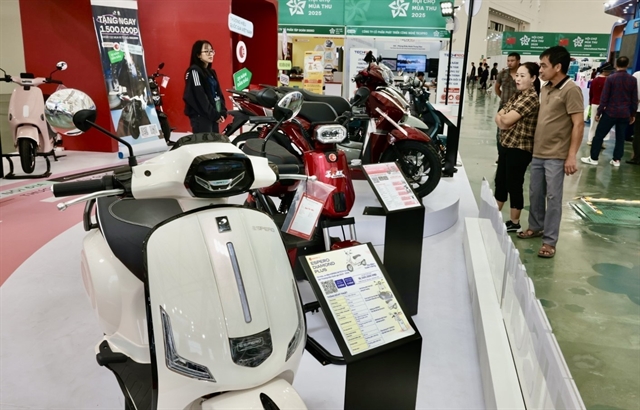 |
| Visitors view a display of electric bikes at the Autumn Fair 2025 at Việt Nam Exposition Centre in Hà Nội. — VNA/VNS Photo Trần Việt |
You noted that policy targets vary by country depending on context. What should be the priority targets for Vietnamese policymakers and enforcers to drive a more coordinated green transition?
It is difficult to give a definitive answer at this stage, as we still lack a comprehensive assessment of Việt Nam’s current situation.
What we can observe right now, for instance, is that the country has a far higher number of motorbikes than cars. This suggests that solutions targeting motorbikes may be more appropriate, or that both motorbikes and cars could be addressed simultaneously, but with different regulations and roadmaps for each type of vehicle.
More importantly, Việt Nam does not yet have a clear advantage in a specific technology. Given that, it may be worth keeping options open in order to identify and adopt the most suitable technologies. — VNS
Opinion
 Opinion
 Opinion
 Opinion
.jpeg) Opinion
Opinion
 Opinion
 Opinion
 Opinion
 Opinion
 Opinion
 Opinion
 Opinion
 Opinion
 Opinion
 Opinion