 Opinion

Vietnamese Prime Minister meets Cambodian National Assembly President
1.
 |
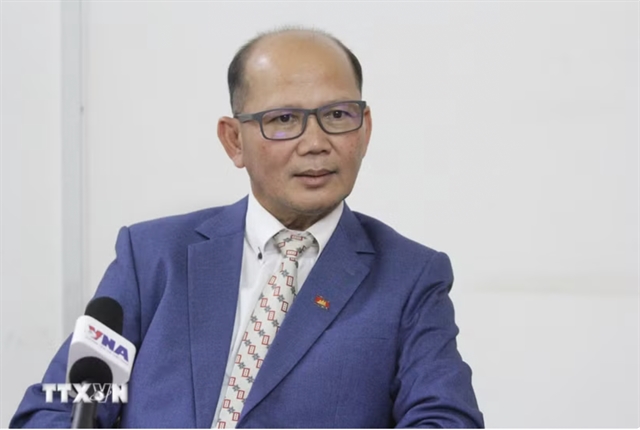
| Nguyễn Kim Hùng, Vice Chairman of the Việt Nam Association of Small and Medium Enterprises. Photo vietnamfinance.vn |
Resolution 79, issued on January 6, 2026, by the Politburo of the Communist Party of Việt Nam on State economic development, is expected to introduce a new approach in which the State sector does not develop in isolation but instead plays a leading and enabling role for other economic sectors.
In an interview with the Vietnam News Agency, Nguyễn Kim Hùng, Vice Chairman of the Việt Nam Association of Small and Medium Enterprises, shared his insights on the resolution’s potential impact.
How do you assess the effects of Resolution 79 on the private business community, particularly small- and medium-sized enterprises (SMEs)? What opportunities could it open up for private firms in accessing resources such as capital, land, technology and markets?
In my view, the most important spillover effect of Resolution 79 is that it introduces a new approach: the State sector should not develop in isolation but instead take on a leading role, paving the way for and supporting other economic sectors, including the private sector and SMEs.
For the SME community, this is highly significant. In reality, SMEs are not lacking in entrepreneurial spirit. Their biggest constraints lie in accessing key resources such as capital, production space, technology, data and market outlets. If Resolution 79 is effectively implemented, SMEs will have clearer opportunities across four main resource areas.
First, access to infrastructure and land. With improved transparency and digitalisation of land data, public assets, logistics systems and digital infrastructure, SMEs will have greater access to production sites, factories, transport and warehousing at more transparent costs.
Second, access to finance. By enhancing the efficiency of State credit institutions and promoting digital banking, data systems and modern financial instruments, SMEs can benefit more from supply chain finance, credit guarantees, digital lending and funding programmes linked to digital and green transitions.
Third, access to technology, which I consider a major highlight. State-owned enterprises take the lead in innovation, digital transformation and core technologies. As mechanisms for technology spillover are established, SMEs will have more opportunities to become technology partners, digital service providers or participants in innovation ecosystems.
Fourth, access to markets. If large State-owned enterprises truly act as anchors in building supply chains, production networks and major markets, SMEs will have greater opportunities to participate as subcontractors and suppliers, gradually upgrading their competitiveness.
International experience shows this is the right direction. South Korea, for example, has leveraged industrial policy and large enterprise networks to integrate SMEs into value chains, foster technological upgrading and enhance competitiveness. The Organisation for Economic Co-operation and Development identifies this as a key foundation for the sustainable development of South Korean SMEs.
For Việt Nam, the greatest opportunity from implementing Resolution 79 is not only direct support for SMEs but also the creation of a more transparent, fair and open resource ecosystem in which they can grow.
Based on practical observations, which sectors are expected to benefit most from Resolution 79 in the coming period?
From what we see in the SME community, five groups of sectors are likely to benefit most.
First, supporting industries, manufacturing, processing and logistics. As large State-owned enterprises in foundational sectors such as energy, transport, infrastructure, materials and telecommunications are upgraded and restructured, demand for procurement, auxiliary supply, operations, maintenance, logistics and technical services will rise, creating significant growth space for SMEs.
Second, digital technology, innovation and business management solutions. Resolution 79 places strong emphasis on innovation, digital transformation, R&D and mastery of core technologies. This opens major opportunities for SMEs in software, artificial intelligence (AI), data, cybersecurity and fintech.
Third, green sectors, including energy efficiency, circular economy and environmental technologies. As State enterprises lead the green transition and sustainable development, SMEs providing green equipment, materials and solutions will have greater opportunities.
Fourth, high-tech agriculture, deep processing, fisheries and the marine economy. These SMEs particularly need support in infrastructure, logistics and technology, so effective implementation of the resolution could generate strong spillover effects.
Fifth, business support services, including training, legal consulting, digital accounting, digital transformation, e-commerce, investment promotion and market linkage. Although indirect, these benefits are likely to materialise quickly.
Experiences from Thailand and Malaysia show that the most effective SME support programmes focus on firms capable of joining value chains, adopting technology and pursuing green growth. The Asian Development Bank also emphasises that successful SME policies must be linked to productivity, digital transformation and supply chain integration.
In the coming period, SMEs that invest in governance standardisation, technology and value chain connectivity will likely be the first to benefit from Resolution 79.
What specific implementation mechanisms are needed to ensure that policies under Resolution 79 reach individual enterprises, especially smaller ones?
To ensure that Resolution 79 truly reaches SMEs, its spirit must be translated into concrete action programmes with clearly defined tasks, responsible agencies, timelines and measurable outcomes. Where possible, these results should be linked to performance evaluation, ranking and even appointment considerations for leaders of State-owned enterprises.
At the same time, SMEs often lack the capacity to interpret policies on their own. Therefore, the role of business associations, research institutes, enterprise support centres, digital platforms and local advisory systems must be strengthened to bridge the gap between policy and practice.
A shared data platform and common digital tools are also essential. For SMEs to better access capital, land, markets, public procurement, training and innovation support, information must be transparent, easy to search, apply for and track.
Currently, SMEs most need capital, technology, markets and governance capacity. Policies should therefore be designed as integrated support packages, such as digital transformation packages, credit guarantee schemes, ESG (environmental, social and governance) support and programmes linking SMEs with larger enterprises.
Finally, it is crucial to reduce compliance costs, minimise overlapping inspections and shift decisively from pre-approval to post-audit mechanisms. For small businesses, these are essential conditions for policies to deliver real impact. — VNS
Opinion
 Opinion
 Opinion
 Opinion
 Opinion
 Opinion
 Opinion
 Opinion
 Opinion
 Opinion
 Opinion
 Opinion
 Opinion
 Opinion
 Opinion