 Opinion

ONYX Hospitality Group Invites Travellers to Discover Phuket and Penang Through Faith, Heritage and Relaxation
1.
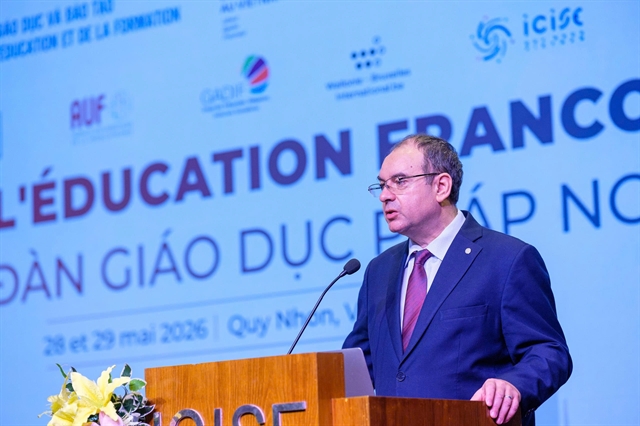 |
| Nicolas Mainetti, Regional Director of the Agence Universitaire de la Francophonie (AUF) for the Asia-Pacific region addresses the opening of the Francophone Education Forum on Thursday. |
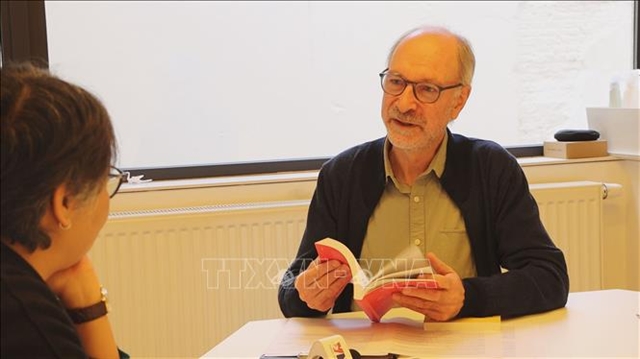
Through the seniority and strength of its experience, Việt Nam can serve as a source of inspiration for the whole region in promoting French, highlighted Nicolas Mainetti, Regional Director of the Agence Universitaire de la Francophonie (AUF) for the Asia-Pacific region in an interview with Việt Nam News reporter Nguyễn Khánh Chi on the sideline of the Francophone Education Forum hosted by the International Centre for Interdisciplinary Science and Education (ICISE) in Quy Nhơn, Gia Lai on May 28-29.
First of all, how do you assess the current status, position, and development prospects of the French language within the regional education system currently?
French holds a distinctive position in the Asia-Pacific region. It is not the most widely spoken language, but it is firmly rooted, alive, and oriented toward the future. In Việt Nam, Cambodia, Laos, and Vanuatu, where the AUF has national offices, French rests on solid structures, in particular bilingual programmes and centres of excellence such as LabelFrancEducation, awarded and managed by France, which recognises high-quality French bilingual programmes from secondary school onward.
What defines today's dynamic is a change of perspective. French is no longer seen as a simple legacy, but as a useful language, chosen for the concrete opportunities it opens. The Quy Nhơn forum, which has just concluded, reaffirmed this clearly: French is a language of employability, of mobility, of research, and of innovation. This, in my view, is where the strongest prospects for development lie. The challenge for the coming years is not only to maintain the teaching of French, but to connect it more closely to the needs of students and the labour market, and to strengthen teacher training, which remains the cornerstone of any lasting programme.
At the conference, many held that it is necessary to simultaneously promote cooperation initiatives to improve the quality of teaching and learning French in the region. In your view, how should Việt Nam, Cambodia, and Laos cooperate specifically to achieve this?
Cooperation between Việt Nam, Cambodia, and Laos is precisely one of the areas where the AUF, as a regional network, can add the most value. These three countries share a common history with the French language and have developed similar systems, in particular bilingual programmes. But each also has its own strengths and its own pace of development. The first concrete form of cooperation is therefore to share good practices among them. This is the role of the AUF, the world's largest network of French-speaking universities, with more than 1,000 member institutions in some 120 countries. In our region, it structures this cooperation among its 91 member institutions across 17 countries in Asia-Pacific, so that it goes beyond one-off initiatives and lasts over time.
Through the seniority and strength of its experience, Việt Nam can serve as a source of inspiration for the whole region, even though no model can be transferred identically from one country to another. Several concrete levers deserve to be strengthened. The first is initial and ongoing teacher training, the cornerstone of any lasting programme, where pooling resources and training trainers brings real economies of scale. The second is mobility, which allows students and teachers to move between institutions in the region. The third is the sharing of teaching and digital tools, including the use of artificial intelligence in the teaching of French, an area in which we already support our member institutions.
On this first lever, I strongly believe that an Asian component of the APPRENDRE programme would be very useful. This programme, implemented by the AUF with funding from the French Development Agency (AFD), has proven its effectiveness in many French-speaking countries in professionalising teacher training and strengthening education systems. Asia does not yet benefit from it, even though the needs there are real and clearly identified. A regional version of APPRENDRE, targeting Việt Nam, Cambodia, and Laos, would give this cooperation a lasting and structured framework, directly benefiting the quality of French teaching in our three countries.
This regional momentum carries particular significance this year. In November 2026, the 20th Summit of the Francophonie will be held in Phnom Penh, Cambodia. It will be only the second time the summit takes place in Asia, nearly thirty years after the founding Hanoi Summit of 1997. The reflections from the Quy Nhơn forum can usefully feed into this event.
According to the Francophone Education Forum organisers, French in Việt Nam is not only a foreign language but is increasingly affirmed as a language of knowledge, science, innovation, and international integration. Could you please share your personal opinion on this statement?
I fully share this analysis, and it matches exactly the mission of the AUF, which is to promote development through education and knowledge. French is not only a language of communication or culture: it is a language of science, present in research, in international organisations, and in the major academic networks of the world.
Việt Nam has built a strategic framework of remarkable ambition, based on three complementary resolutions of the Politburo. Resolution 57-NQ/TW of December 22, 2024, makes science, technology, innovation, and digital transformation drivers of national development. Resolution 59-NQ/TW places international integration at the heart of the country's strategy. And Resolution 71-NQ/TW of August 22, 2025, establishes education and training as a top national priority, with the goal of placing Việt Nam among the top twenty education systems in the world by 2045. Together, these three texts form a genuine strategic foundation.
It is precisely within this framework, defined by Việt Nam itself, that our role takes on its full meaning: to bring the engineering, the networks, and the expertise of scientific Francophonie in support of these national priorities. In practice, this means connecting Vietnamese researchers to international networks, improving the visibility of Vietnamese scientific publications, and supporting the development of skills among academic staff. To say that French is a language of knowledge and innovation is therefore not a slogan: it is a reality that we are building concretely, as partners, in the service of Việt Nam's own objectives.
Beyond the linguistic aspect, how does the French language help promote French culture in particular and strengthen cultural exchanges among countries in the Francophone community in Asia?
A language is never only a tool: it is a bridge between cultures. To learn French is to gain access to an imagination, a history, and ways of thinking and creating, but it is also, and this is essential, to enter a plural space that extends far beyond France. The Francophonie is a language shared by many cultures, on all five continents. In Asia, it connects Việt Nam, Cambodia, Laos, Vanuatu, and many other countries around a common language, while celebrating the richness of each national culture.
This is the very meaning of the Francophonie: a shared language, but many cultures. French allows a Vietnamese, Cambodian, or Laotian student to engage not only with someone from France, but also with someone from Quebec, Senegal, Belgium, or Switzerland, and with one another. It creates a community of exchange and movement, through student and teacher mobility programmes, scientific gatherings, cultural events, and alumni networks. This cultural dimension is inseparable from the academic one: it nurtures openness to the world, curiosity, and the ability to cooperate across borders, which are precisely the skills expected of the younger generations of Asia-Pacific. VNS
Opinion
.jpg) Opinion
Opinion
 Opinion
 Opinion
 Opinion
.jpg) Opinion
Opinion
 Opinion
 Opinion
 Opinion
 Opinion
 Opinion
 Opinion
.jpg) Opinion
Opinion
 Opinion
.jpg) Opinion
Opinion
.jpg)