 Opinion
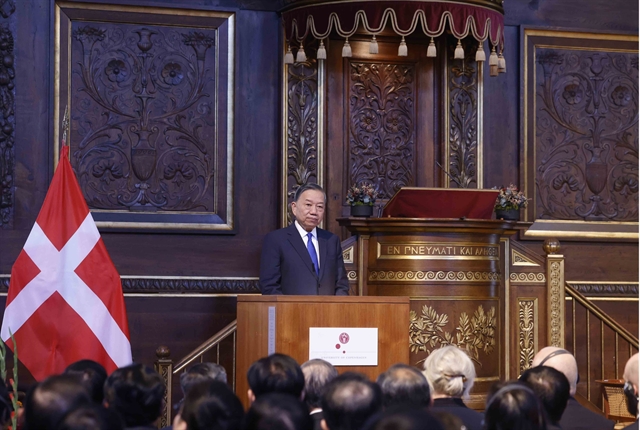
Top Vietnamese leader highlights new horizon for Việt Nam–Denmark cooperation
1.
 |
| Minister of Education and Training Nguyễn Kim Sơn. — VNA/VNS Photo |
Minister of Education and Training Nguyễn Kim Sơn spoke to the Vietnam News Agency about the outcomes of implementing the Resolution of the 13th National Party Congress in the education and training sector, while outlining the sector’s proactive and decisive steps to roll out strategic tasks from the pivotal year onwards, seizing opportunities to achieve a breakthrough in education and training development.
Could you outline the key achievements of the education and training sector during the 13th National Party Congress term, a period marked by highly unusual circumstances?
The five-year period of implementing the Resolution of the 13th National Party Congress was indeed a special phase for education and training. It coincided with the continued, vigorous rollout of fundamental and comprehensive education reform in line with Resolution No.29-NQ/TW of November 4, 2013, together with other major guidelines and orientations set by the Party Central Committee.
Under the leadership of the Party, the National Assembly and the Government, and thanks to the efforts of teachers, education managers and learners, alongside the strong support and consensus of the public and parents, the education and training sector has achieved significant results. Many elements of Resolution No.29-NQ/TW have been effectively implemented, yielding tangible outcomes over the past five years.
First and foremost, in terms of expanding learning opportunities, the scale of the national education system has continued to grow at all levels, from early childhood and general education to vocational, higher and postgraduate education. The total number of learners across the system has now exceeded 24.5 million, not including those engaged in further education and lifelong learning.
Alongside this expansion, the sector has made strong efforts to ensure and broaden access to learning conditions. Universal education has been completed for five-year-old children, as well as at primary and secondary levels; the literacy rate has surpassed 99.5 per cent, placing Việt Nam among the world’s leading countries in this regard. These are major milestones the sector has worked hard to achieve.
The proportion of trained workers holding qualifications or certificates has reached nearly 30 per cent, essentially meeting the target set by the 13th National Party Congress. By December 2025, the country also recorded around 225 university students per 10,000 people, broadly fulfilling the five-year goal. Overall, the education sector has largely met the targets on access to education set out in the Congress Resolution.
Over the past five years, reform of general education has been identified as a key priority. The sector has completed the rollout of the 2018 General Education Programme from Grade 1 through Grade 12, in line with the approved roadmap. The shift from a knowledge-heavy model to one focused on holistic learner development, emphasising qualities, competencies and skills, has largely been realised. Reforms in teaching methods, assessment and evaluation, as well as the organisation of the national high school graduation examination, have also delivered important results. Oversight missions by the National Assembly and relevant agencies have confirmed that the core objectives of general education reform have been achieved.
These outcomes are reflected in both mass education quality and elite education. For many consecutive years, Việt Nam has ranked among the world’s top 10 countries at international Olympiads in mathematics, physics, chemistry, biology and informatics. In 2025, all Vietnamese teams competing at regional and international Olympiads placed within the global top 10 by number of gold medals, with particularly strong performances in mathematics and chemistry. These achievements underscore the sector’s comprehensive education results during the continued implementation of Resolution No.29-NQ/TW and the Resolution of the 13th Party Congress.
In higher education and vocational education, the past five years have seen the robust implementation of autonomy policies and the mobilisation of social resources, generating positive outcomes. The ministry has advised the Government on launching major initiatives to develop human resources for high-tech sectors such as semiconductors, artificial intelligence (AI) and Industry 4.0 technologies. The higher education network has continued to expand in scale, while improving training quality, particularly in high-quality human resources and key technological and engineering fields. In 2025 alone, hundreds of new programmes in technology and engineering were introduced. By December 2025, students enrolled in STEM-related fields accounted for over 33 per cent of total enrolments, a critical ratio for meeting future development needs.
Both public and non-public universities have made clear improvements in quality indicators, with several Vietnamese institutions now featured in international rankings, including the world and Asia’s top 1,000, and even the top 500.
Vocational education has become increasingly aligned with enterprise and labour market needs. Facilities and teaching conditions have gradually improved, and some institutions have joined regional and global training networks. Training quality and vocational skills, particularly for technical and skilled workers in technology-related fields, have steadily risen.
In terms of infrastructure, education facilities from early childhood to higher education have continued to receive investment and gradual upgrades. While improvements have not always matched expectations, the proportion of solidly built schools has increased markedly, from just over 75 per cent at the start of the term to nearly 90 per cent in some areas by December 2025, reflecting the combined efforts of the State, society and the public.
Looking back, it is impossible to overlook the sector’s response to the severe impacts of COVID-19, especially between 2020 and 2022, when many schools were closed for extended periods. Guided by the principle of 'suspending school attendance but not learning,' the sector swiftly shifted to online teaching on a system-wide scale, mitigating the pandemic’s negative effects. This experience also gave a strong boost to digital transformation, accelerating the development of e-learning platforms, digital and open educational resources and online training models.
Digital transformation has since become a major highlight. From 2022, the national student database enabled fully online registration for high school graduation exams and university admissions, improving transparency, efficiency and convenience. Databases covering schools, learners and teachers have been built, while the lifelong learning record system, comprising digital transcripts and digital diplomas, has begun linking with the National Public Service Portal, simplifying administrative procedures. Universities have also stepped up the use of AI in teaching, management and smart campus development.
Another important hallmark has been the focus on developing the teaching workforce, the sector’s foundational and decisive factor. Teacher numbers, structure and quality have all improved. The Party and Government have added substantial staffing quotas to ensure that 'where there are students, there are teachers and schools,' particularly in early childhood and primary education. New incentive and welfare policies have strengthened teachers’ attachment to the profession. Notably, entry scores for teacher training programmes have recently ranked among the highest, signalling a welcome rise in input quality. By 2025, more than 33 per cent of university lecturers held doctoral degrees, reflecting steady progress in academic staff development.
Overall, the objectives and targets set out in the Resolution of the 13th Party Congress and the five-year socio-economic development plan for education and training have largely been achieved, with some completed ahead of schedule.
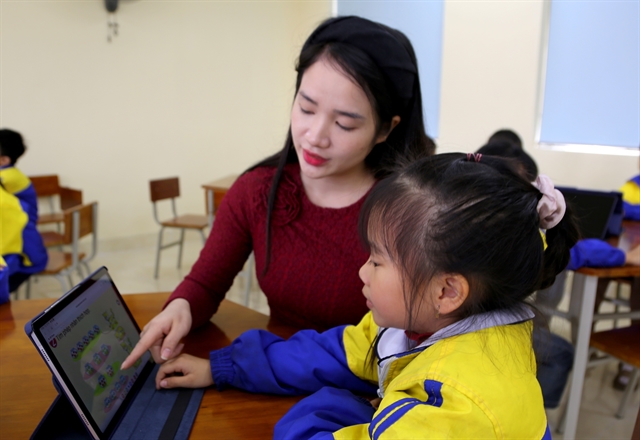 |
| A teacher in An Đồng School, Hải Phòng City, instructs her student on using the tablet for classes. — VNA/VNS Photo |
Among these achievements, how would you assess the education sector’s performance in 2025, the pivotal year between two Party Congress terms?
Education and training have made significant progress, yet the country is entering a new development phase with higher demands on growth speed and quality. With the goal of becoming a developed, high-income country by 2045, and placing Việt Nam’s education system among the world’s top 20, education development must now proceed at a new, higher level in scale, intensity and ambition.
Against this backdrop, the Politburo issued Resolution No.71-NQ/TW in August 2025, setting out the objective of a breakthrough in education and training development through modernisation and quality enhancement, aimed at comprehensive human resource development and high-quality human resources. The resolution provides strategic direction and has been incorporated into draft documents for the 14th Party Congress.
Importantly, the sector did not wait until after the Congress. In 2025 itself, many programmes and tasks were launched early. The ministry advised the Government and submitted to the National Assembly four major draft laws: the Law on Teachers; amendments to the Law on Education; a revised Law on Higher Education; and a revised Law on Vocational Education. It also proposed key National Assembly resolutions on universal early childhood education for children aged three to five; tuition fee exemptions and support; the National Target Programme on education modernisation for 2026–35; and special breakthrough policies for education development.
With these legal and policy foundations in place, 2025 stands as a truly pivotal year, closing one five-year cycle while opening a new phase of reform and sustainable development.
What key tasks and solutions should be prioritised in the next term to realise the strategic breakthrough envisaged in Resolution No.71-NQ/TW and the Resolution of the 14th National Party Congress?
The foremost task is renewing thinking and awareness about education and training, an essential starting point for all subsequent reforms. This includes a renewed understanding of education’s role and mission; the State’s leading responsibility; the core position of public education; effective mobilisation and use of resources; education autonomy; and strengthened Party leadership within educational institutions, especially universities and vocational schools.
Mobilising resources, particularly finance and infrastructure, is another priority. The National Target Programme on education modernisation for 2026–35 will focus on upgrading facilities at all levels, with an emphasis on higher education and selected vocational institutions. Increased public investment and higher spending on education and research are expected to reshape the system and elevate institutional quality and standing.
A central task will be training high-quality human resources in key technological and engineering fields, while boosting research, technology transfer and university–industry cooperation. In early childhood education, a new programme will be rolled out alongside universal provision for children aged three to five. In general education, reforms will deepen, with greater emphasis on holistic development and skills, and a gradual move towards English as a second language in schools.
Digital transformation will continue apace, alongside the controlled, safe and effective application of AI in education. At the same time, ensuring equity in access, particularly for students in disadvantaged, ethnic minority, border and island areas, will remain a core commitment. The construction of 248 schools in border communes is under way, with the first 100 set to open in 2026, marking an important step towards narrowing educational gaps and ensuring fairness nationwide. — VNS
Opinion
 Opinion
 Opinion
 Opinion
 Opinion
 Opinion
 Opinion
 Opinion
 Opinion
 Opinion
 Opinion
 Opinion
 Opinion
 Opinion
 Opinion