 Opinion
Customs moves toward data-driven digital management
1.
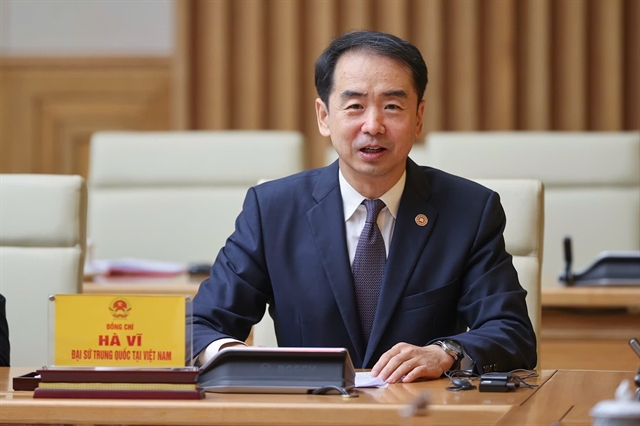 |
| He Wei, Chinese Ambassador to Việt Nam. — VNA/VNS Photo |
HÀ NỘI — Chinese Ambassador to Việt Nam, He Wei, has praised Việt Nam’s outstanding socio-economic achievements during the tenure of the 13th National Party Congress and voiced his belief that the success of the 14th Congress will herald a new development phase, creating a strong impetus for the country’s development in the time ahead.
Commenting on Việt Nam’s socio-economic performance, he told the Vietnam News Agency that over the past five years, under the leadership of the Central Committee of the Communist Party of Việt Nam (CPV), the development goals set forth by the 13th National Party Congress have been seriously and comprehensively implemented, focusing on the three strategic breakthroughs in institutions, human resources and infrastructure.
Việt Nam has achieved many important results, meeting the expectations of the Party and the people.
He highlighted remarkable improvements in quantity, quality, and mindset, elaborating that in terms of quantity, Việt Nam's economy has grown from US$346 billion to $514 billion over the past five years, ranking 32nd globally. Average GDP growth has reached 6.3 per cent per annum and exceeded 8 per cent in 2025 – among the highest in Asia.
Meanwhile, GDP per capita has surpassed $5,000, officially placing Việt Nam in the group of upper-middle-income countries.
Against the backdrop of global supply and production chain restructuring, these results clearly demonstrate the strong resilience and recovery capacity of the Vietnamese economy, the ambassador said.
In terms of quality, more than 3,000km of expressways have been built and opened to traffic in five years, while the 500kV North-South power transmission line has had its main circuits completed, and the scale of the national power system has emerged in second place in ASEAN.
Many important strategic projects, such as Long Thành International Airport, have been accelerated and gradually become operational, helping improve people's life quality, ensure social security and narrow the development gap among regions.
Việt Nam has also been increasingly integrating into global value chains with 17 free trade agreements in effect, covering more than 60 countries and territories that account for approximately 90 per cent of global GDP, according to He.
Mentioning mindset improvement, which was described as a key factor, the ambassador said the CPV Central Committee has focused on removing institutional bottlenecks. For the first time, it has undertaken an intensive reform of the Party and State apparatus, and reorganised provincial-level administrative units, thereby enhancing the effectiveness and efficiency of national governance.
With a long-term vision, Việt Nam has issued many important resolutions on innovation, digital transformation, legal perfection, and the building of a rule-of-law socialist state, creating a solid foundation for entering a new stage of development, he noted.
When asked about the significance of the 14th National Party Congress of the CPV, the Chinese diplomat said the congress holds special importance as it takes place at a crucial point of time when the Vietnamese Party and people are striving towards the goals set for the 100th founding anniversary of the Party in 2030.
Domestically, Việt Nam is in a critical transitional phase, inheriting the achievements of 40 years of Đổi mới (Renewal) and opening up a new path of development. The country’s national strength and international prestige have continuously been enhanced; people's life quality improved significantly; the rule-of-law socialist state increasingly perfected; and administrative reform and the corruption fight achieved many remarkable results.
However, Việt Nam is also facing challenges such as the risk of falling into the middle-income trap, population ageing, and the need to press on with institutional improvement.
Internationally, he added, the world is entering a period of profound upheaval; protectionism is on the rise; the international order encounters unprecedented challenges; and the Fourth Industrial Revolution is strongly impacting the global economy.
In this context, Việt Nam is presented with both rare opportunities and intertwined complex challenges.
Given this, the 14th National Party Congress is significant for reviewing 40 years of Đổi mới, formulating major directions and policies for the next five years and subsequent periods, and ushering in a new era of national development.
As comrades and brothers, China believes that the 14th National Party Congress will be that of solidarity and success, and the Vietnamese people, under the leadership of the Party Central Committee, will successfully achieve national development goals and confidently advance to a new era of development – one of peace, independence, democracy, prosperity, civilisation and happiness, He remarked.
Sharing his view on Việt Nam’s development prospects following the 14th National Party Congress, the ambassador said Việt Nam sees the Congress as the starting point of a new era of national development, perceiving that the 'era of the nation’s rise' is a crucial political point formulated by the CPV Central Committee, led by General Secretary Tô Lâm, on the basis of the goals set for the Party’s and the country’s centenaries in 2030 and 2045, of which the top priority is to realise the target of becoming a developing, upper-middle-income country with modern industry by 2030.
He emphasised China’s belief that under the unyielding leadership of the CPV Central Committee, the next five years will be a period of comprehensive development and strong breakthroughs for Việt Nam, especially in its national governance capacity, overall strength, and influence and stature in the international arena.
The ambassador affirmed China’s continued support for Việt Nam to remain steadfast in the socialist path that suits Việt Nam’s conditions and realities, expressing confidence that the success of the 14th National Party Congress will create new and powerful momentum for national development in the new period. — VNA/VNS
Opinion
.jpg) Opinion
Opinion
 Opinion
 Opinion
 Opinion
 Opinion
 Opinion
 Opinion
 Opinion
 Opinion
 Opinion
 Opinion
 Opinion
 Opinion
 Opinion




