 Life & Style

NA President tours revolutionary sites in China’s Shaanxi
1.
|
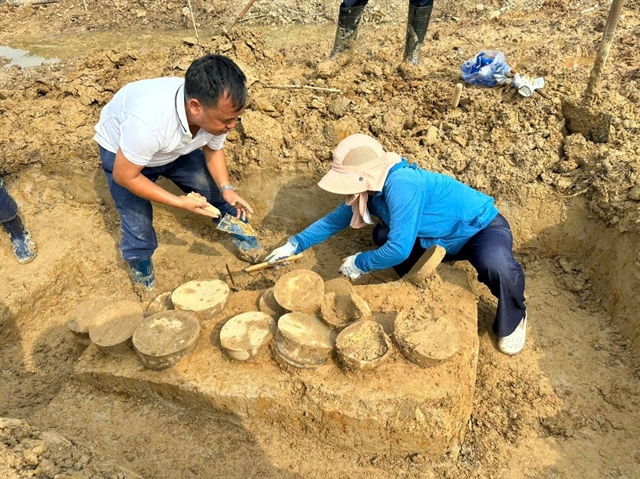
| Ceramic jars discovered at the construction site in Ninh Bình Province. — Photo courtesy of Ninh Bình Provincial Museum |
NINH BÌNH — A family in Hoa Lư Ward in the northern province of Ninh Bình unearthed several ceramic jars about 30cm below the soil line, while constructing a foundation for a house on October 11.
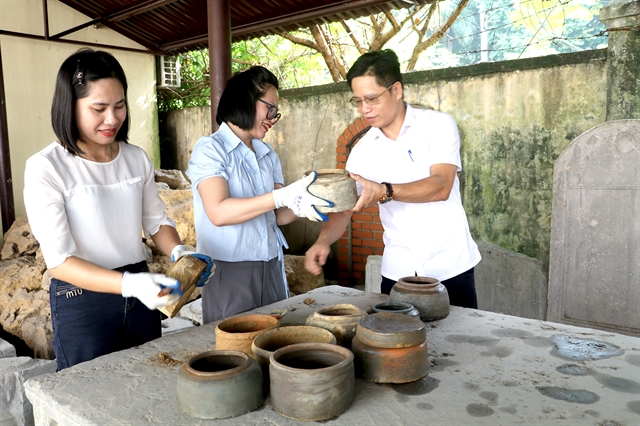
Recognising the value of the finds, the family promptly notified local authorities and relevant agencies. Following instructions from the province's Department of Culture and Sports, the Ninh Bình Provincial Museum sent specialists to inspect the site, document the findings and receive the artefacts handed over by the family in accordance with regulations.
The collection comprised six ceramic jars and several broken ceramic fragments.
|
| Specialists from Ninh Bình Provincial Museum polish and assess the artefacts. — VNA/VNS Photo Hải Yến |
Preliminary surveys and research into the artefacts unearthed at the area found that the ceramic jars were arranged in two east–west rows across an area measuring 2.2 metres long and around 0.5 metres wide.
The ceramic jars were stacked in three staggered layers and arranged in two ways. In the first arrangement, most jars were placed upside down, with their mouths facing downwards, and stacked on top of one another. In the second, some jars were placed mouth-to-mouth and stacked together.
An expanded survey of the surrounding area by provincial museum officials found no additional artefacts or architectural remains. The ceramic jars contained only soil, with no other artefacts found inside them.
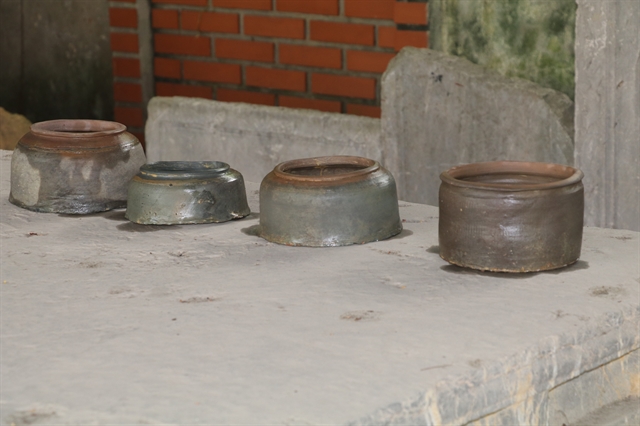
The finds comprise two types of ceramic jars: those with straight sides and those with curved shoulders. Some feature incised lines and a comb-pattern decoration on their bodies. They are made of fine-grained stoneware fired at high temperatures.
Measurements of the jars range from 14–20cm in diameter at the mouth, 19–21cm at the base and 7–11cm in height.
According to residents, the area was once Đồng Hà farmland. The surrounding sandy mounds were used to grow crops such as maize, peanuts and beans, and were also home to several family graves belonging to the Trần and Nguyễn clans.
Local authorities reclaimed the land and cleared the site to make way for a resettlement area in 2010. The sandy mounds were then excavated to a depth of about one metre to level the ground, turning the area into low-lying fields. Some graves were also relocated by local residents in recent years.
A preliminary assessment by the Ninh Bình Provincial Museum found that the ceramic jars were household items dating from the Trần Dynasty (13th–14th centuries). Their deliberate arrangement suggests they may have been buried or stored intentionally.
|
| A preliminary assessment found that the ceramic jars were household items dating from the Trần Dynasty (13th–14th centuries). — VNA/VNS Photo Hải Yến |
The artefacts were found above a layer of natural soil, with no archaeological remains or evidence of structures detected. No further artefacts have been found in the surrounding area, and there is insufficient evidence to warrant an emergency archaeological excavation.
Several historical sites associated with the Trần Dynasty and its people are located near the discovery site, including A Nậu Pagoda, which worships King Trần Thái Tông and Princess Trần Thị Ngọc Một, and Đức Thánh Cả Temple, also known as Đô Thiên Temple, dedicated to Đô Thiên, a Trần Dynasty general.
Vũ Thanh Lịch, deputy director of the Ninh Bình Province Department of Culture and Sports, said the department has proposed the provincial People’s Committee to allow residents to continue building their homes in the area to ensure the timely completion of essential infrastructure while safeguarding cultural heritage.
The department has assigned the provincial museum to closely monitor construction work and prepare to coordinate responses in accordance with the Law on Cultural Heritage if further antiquities are discovered.
It has also proposed an appropriate commendation for the family for protecting the artefacts and promptly handing them over to the State. VNS
Life & Style
 Life & Style
 Life & Style
 Life & Style
 Life & Style
 Life & Style
 Life & Style
 Life & Style
 Life & Style
 Life & Style
 Life & Style
 Life & Style
 Life & Style
 Life & Style
 Life & Style