 Life & Style
Sun PhuQuoc Airways to launch daily Hà Nội–Shanghai route this month
1.
|
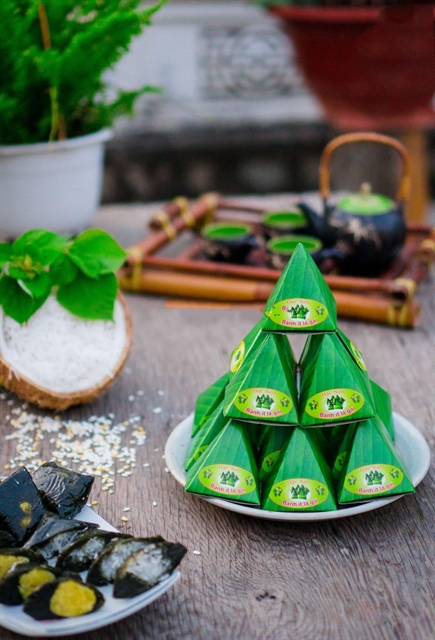
| LOVE AT FIRST BITE: 'Bánh ít lá gai' is a traditional Vietnamese pyramid-shaped sticky rice cake and a signature speciality of Gia Lai Province. Photo vinpearl.com |
Thanh Hà
GIA LAI — Bánh ít lá gai (ramie leaf cake) failed to catch my attention at first when displayed alongside other traditional treats at Gia Lai Days in Hà Nội. However, after taking a bite, I realised I had nearly missed out on one of the nation's finest traditional delicacies.
I was urged to try the little cake by a woman I later learned was a vice chairwoman of the Gia Lai Provincial People's Committee. She said it was a famous speciality from the former Bình Định Province, which is now part of Gia Lai Province.
She assured me that while the cake's appearance might not catch anyone's eye, its taste would surely change their minds, and it certainly did. It was so delicious that I took several pieces home to enjoy throughout the day. Whenever friends or family visited Gia Lai, I would always ask them to buy me some of these cakes as a gift.
A royal legend
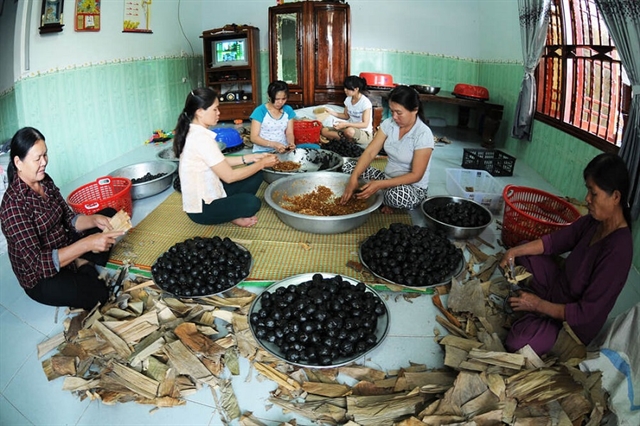
"According to an ancient tale, the youngest daughter of King Hùng VI created this cake to offer to her father during the New Year festival. The cake was a unique combination of the wrapping style of bánh chưng and the ingredients of bánh dày. The name bánh ít was given by the people to the cake made by the youngest princess," local cake maker Bùi Thị Xuân told Việt Nam News.
|
| ROYAL ORIGINS: Many families in Gia Lai produce 'bánh ít' every day, as it is one of the most popular specialities of the region. Photo thuonghieucongluan.com.vn |
"There is also another explanation related to the custom of newlywed couples. The bride would make this cake as a 'modest gift' to show filial piety to her parents and ancestors. The cake comes in many variations – wrapped or unwrapped, square, round or flat, white, green or black, and filled with coconut or mung beans. The bride would make a little of each type, giving rise to the name 'little cake'."
The pyramid-shaped bánh ít is made from sticky rice, ramie leaves, sugar, green or black beans and coconut.
The ramie leaves are boiled and then ground in a stone mortar until their green colour turns black. The leaves give the cake its distinctive flavour.
The sticky rice is ground into flour. The sugar is dissolved in water and then boiled down to make syrup. The rice flour, ground leaves and syrup are then mixed to form a dough.
Meanwhile, the beans are soaked in water for hours and then whipped before steaming. The cooked beans are then mashed and shaped into small balls for the filling. A small amount of ginger is added for warmth and aroma.
|
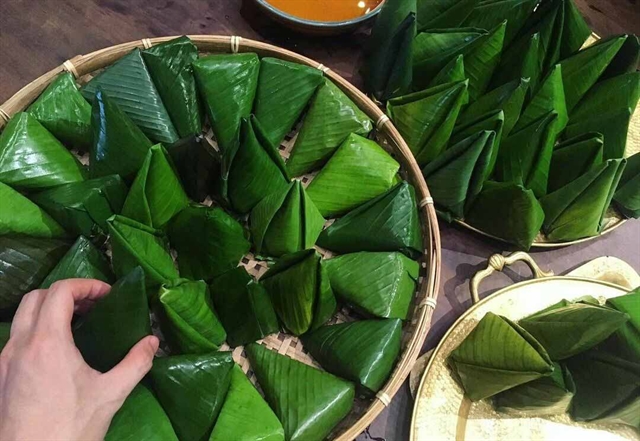
| A LITTLE BIT OF EVERYTHING: The cake is made from different ingredients before being wrapped in banana leaves and steamed. Photo vinpearl.com |
The banana leaves are usually briefly passed over a flame or dipped in hot water to soften them, making it easier to wrap the cakes into small, conical shapes that resemble the Chăm towers – a renowned cultural symbol of the former Bình Định Province. The wrapped cakes are then steamed in a pot.
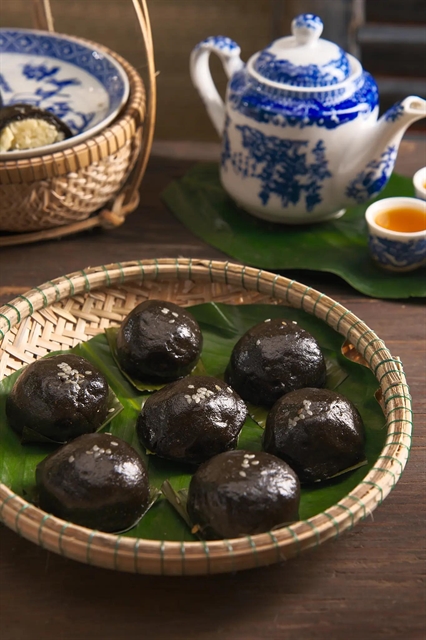
The cake has a distinctive dark outer layer, a chewy texture and a fragrant, mildly sweet flavour that make it instantly recognisable among Việt Nam’s traditional cakes.
It is often enjoyed with tea, whose mild bitterness helps balance the sweetness of the cake.
|
| SWEET DECEPTION: 'Bánh ít lá gai' goes perfectly with a cup of tea. Photo theoriginallife.vn |
A taste to remember
"When I took a bite, I was truly surprised by the delicate sweetness, the chewy and supple outer layer, and the rich and flavourful filling. It’s an unusual treat, yet one that’s surprisingly addictive," said Haruto Tanaka, who was accompanying me at the Gia Lai Days event.
The Japanese visitor immediately searched online and happily told me that he could even buy 'bánh ít' in his home country, as the cake was already being exported to Japan, one of its many overseas markets.
Asked about the popularity of bánh ít, Thủy, who has run a shop for more than 20 years, said, "Bánh ít is not only a familiar delicacy but also an indispensable treat at traditional celebrations, including Tết (Lunar New Year), and is often served to guests as a gesture of hospitality.
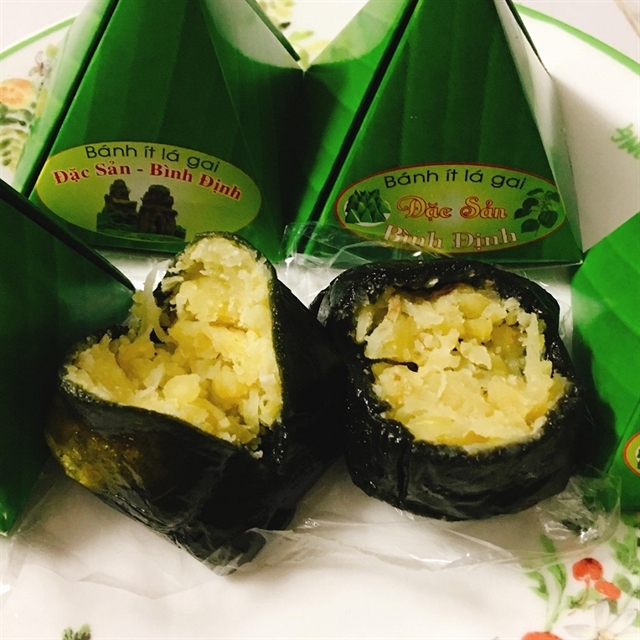
|
| CULTURAL SYMBOL: Banana leaves are used to wrap the cakes into small, conical shapes reminiscent of the Chăm towers, an iconic symbol of the former Bình Định Province. — Photo vinpearl.com |
"In death anniversary ceremonies, it is acceptable to have no fish or meat, but there must be bánh ít. In marriage rituals, a tray of the cake is presented by the bride’s family to the groom's family to show the skilfulness of the bride."
Bánh ít can be easily found in local markets and shops, especially in the former Bình Định Province, at an affordable price, typically ranging from VNĐ4,000 to 5,000 per piece, depending on size and filling.
"I receive many tourists every day. They come to taste bánh ít and often end up buying several cakes because it is a must-try delicacy and an ideal gift to bring home, embodying the authentic flavour and cultural essence of our region," Thủy added. — VNS
Life & Style
 Life & Style
 Life & Style
 Life & Style
 Life & Style
 Life & Style
 Life & Style
 Life & Style
 Life & Style
 Life & Style
 Life & Style
 Life & Style
 Life & Style
 Life & Style
 Life & Style