 Life & Style

NA President meets leaders of international audit organisations
1.
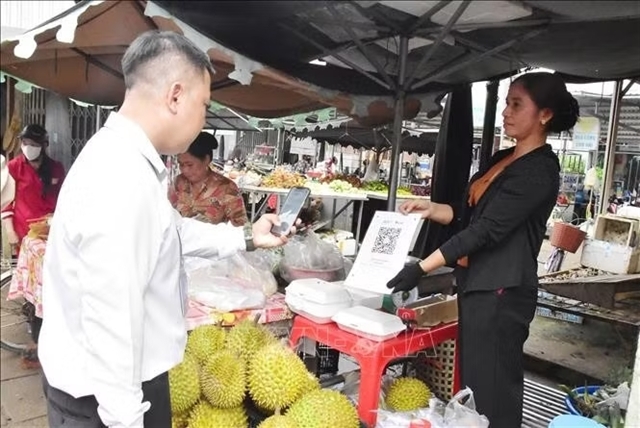
|
| Customers shop and pay by scanning QR codes at Long Hiệp Market. — VNA/VNS Photo |
VĨNH LONG — Traditional markets in rural areas of Vĩnh Long Province are embracing digital payments as the locality moves to translate the Politburo's Resolution 57-NQ/TW on science, technology, innovation and national digital transformation into practical measures at the local level.
The '4.0 Market' model, which promotes cashless payments, is being introduced at traditional markets, particularly in remote areas and communities with large Khmer populations.
In Long Hiệp Commune, a remote locality where Khmer people account for 80.6 per cent of the population, the model has been launched at Long Hiệp and Tha La markets.
Each vendor is supported in opening a bank account and creating a personal QR code displayed at their stall. Customers can scan the code with a smartphone to make payments, while vendors can confirm transactions without handling cash or preparing change.
The commune plans to install 93 QR code boards equipped with automatic transaction notification speakers at the two markets. Connected via 4G or Wi-Fi, the devices will allow vendors to hear payment notifications without checking their phones after each transaction.
The model is also expected to cover market-related payments, including stall rentals, electricity, water and parking fees, helping bring digital technology into both transactions and market management.
Community digital technology teams, youth union members and other volunteers are providing hands-on assistance to vendors and residents in opening payment accounts, installing banking and e-wallet applications and using QR codes.
Viettel Vĩnh Long has so far supported the '4.0 Market' model at 13 markets and plans to add 14 more in September, with a target of supporting five to 10 additional markets each month.
As of September 10, 35 communes and wards across Vĩnh Long had drawn up plans to introduce '4.0 Markets' and cashless payments at 49 markets, with estimated funding of VNĐ754.7 million (US$29,000).
The provincial Department of Industry and Trade requires each participating market to implement at least four digital transformation components, including cashless payments, connectivity and direct support for residents. — VNS
Life & Style
 Life & Style
 Life & Style
 Life & Style
 Life & Style
 Life & Style
 Life & Style
 Life & Style
 Life & Style
 Life & Style
 Life & Style
 Life & Style
 Life & Style
 Life & Style
 Life & Style