 Life & Style

NA President meets leaders of international audit organisations
1.
|
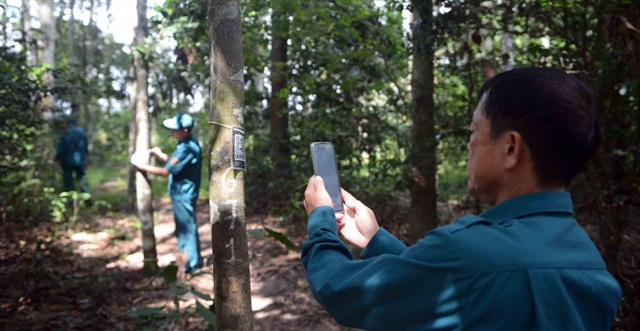
| Patrol staff use mobile phones to scan QR codes to trace the origin of trees and identify the plot, sub-zone and location they are patrolling. — VNA/VNS Photo |
HCM CITY — Digital technology is being used to improve the management and conservation of plant genetic resources at the HCM City Botanical Garden, where thousands of plants are being recorded and monitored as part of a growing 'living collection' of Việt Nam’s plant diversity.
The 40ha garden in Nhuận Đức Commune currently maintains 10,454 individual plants belonging to 672 species representing the southeast, central highlands, central and northern regions. The collection includes 40 rare species listed in the Việt Nam Red Data Book and five species classified as endangered, precious and rare and prioritised for protection.
Each plant species is being given an electronic record using QGIS software and QR codes. The database contains scientific and Vietnamese names, family, origin, morphological characteristics, uses, planting location, time of arrival, growth conditions and images.
The digital system is not only designed to provide information to visitors. For garden staff, data on growth, flowering, fruiting, pests, diseases and plant quality can be regularly updated, helping detect abnormalities and support timely care, disease control and propagation.
Information related to genetic conservation, including the origin of plant materials, mother plants, propagation materials and seed-collection periods, is also stored. This allows staff to monitor flowering and fruiting, collect seeds and reduce the risk of losing valuable genetic resources.
Phan Thị Mỹ Dung, director of the garden, said data was an important foundation for gene conservation. Digital records allow information on individual species and plants to be stored over the long term, updated regularly and retrieved quickly, reducing reliance on paper records and individual experience.
The garden began establishing systematic plant records and new labels in 2020, introduced QR codes for some species in 2022, and developed a digital map and database for forest management in 2023.
The garden plans to expand by about 139.29ha and increase its collection to 1,200-1,500 species, supporting research, environmental education and long-term conservation of Việt Nam’s plant genetic resources. — VNS
Life & Style
 Life & Style
 Life & Style
 Life & Style
 Life & Style
 Life & Style
 Life & Style
 Life & Style
 Life & Style
 Life & Style
 Life & Style
 Life & Style
 Life & Style
 Life & Style
 Life & Style