 Life & Style
84 individuals investigated for transnational online frauds
1.
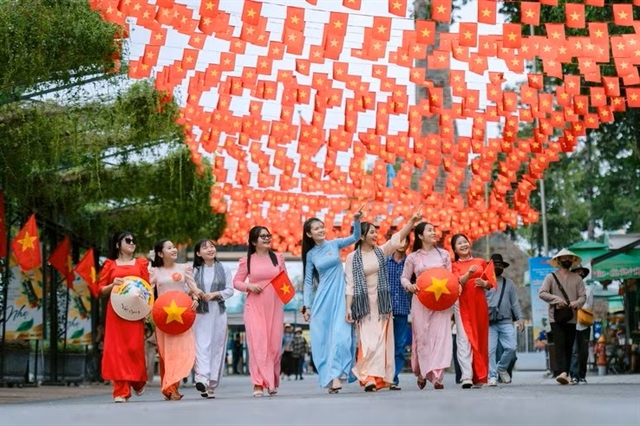 |
| Streets adorned with national flags to celebrate Việt Nam's National Day on September 2. —VNA/VNS Photo |
HÀ NỘI — August and September offer a particularly evocative time to explore Việt Nam, as the red-and-gold colours of National Day on September 2 fill the streets. From HCM City, travellers can extend their journey through the Củ Chi Tunnels to Tây Ninh and Bà Đen Mountain, where history, culture and nature converge.
In the days surrounding National Day, the red flag with its five-pointed golden star appears across city streets, outside homes and on public buildings. For Vietnamese people, it is one of the most significant occasions of the year. For international visitors, it also offers a rare opportunity to observe, more vividly than usual, the connection between history, national pride and everyday life in contemporary Việt Nam.
For those exploring southern Việt Nam at this time of year, a journey from HCM City to the Củ Chi Tunnels, Tây Ninh and Bà Đen Mountain offers a particularly compelling route. The trip can begin amid the flag-lined streets of HCM City, continue into a chapter of history preserved beneath the ground at Củ Chi, and then lead onward to Tây Ninh, where an entirely different facet of Việt Nam's cultural landscape unfolds.
From flag-lined streets to tunnels beneath the ground
Located northwest of HCM City, the Củ Chi Tunnels are among southern Việt Nam's best-known historical landmarks. Today, the tunnel system is preserved across two sites, Bến Đình and Bến Dược, remnants of an underground network that once stretched for more than 200 kilometres.
For international visitors, Củ Chi is more than a place to hear stories of war. Here, travellers can enter preserved sections of the tunnels to gain a sense of how people once moved and lived underground, watch documentary footage and explore surviving traces of a defining period in Việt Nam's history. Official tours at Bến Đình also introduce visitors to documentary screenings, exhibition spaces and artefacts connected to the local guerrilla warfare experience.
For those seeking a deeper historical perspective, Bến Dược is also home to the Bến Dược Martyrs’ Memorial Temple. As part of a journey onward to Tây Ninh later the same day or the following morning, Củ Chi serves as a natural transition point. From stories of war and years spent beneath the ground, the road gradually leaves the urban landscape behind, passing through increasingly open outskirts before heading towards one of the most distinctive mountains in southern Việt Nam.
From Củ Chi to Tây Ninh
As the journey continues towards Tây Ninh, its character begins to shift. If Củ Chi takes visitors back to the years of war through its underground tunnel system, Tây Ninh reveals another facet of Việt Nam, where landscapes, spirituality and local cultural life come together in a single journey.
One of the most prominent stops is Sun World Bà Đen Mountain, a tourism complex on Bà Đen Mountain, located around 100 kilometres from HCM City. Rising 986 metres above sea level, the mountain is known as the “Roof of Southern Việt Nam”. Late August and early September are also an especially atmospheric time to visit, as the cloud-hunting season coincides with the Vu Lan Festival and a series of cultural activities marking National Day.
From the underground tunnels of Củ Chi, travelers can continue their journey upwards aboard the cable cars of Sun World Bà Đen Mountain, watching the Tây Ninh plains gradually recede below and, at times, seeing the summit enveloped in layers of cloud.
For international visitors, this connection creates a remarkably complete journey through southern Việt Nam: from a landmark that offers insight into the country’s modern history to a destination where nature, spirituality and enduring cultural traditions remain woven into everyday life. During the Vu Lan season in particular, experiences such as pinning a flower to one’s lapel or releasing lanterns on the mountain offer a direct encounter with an aspect of East Asian cultural heritage, rather than one experienced solely from the outside.
A flower pinned to the lapel during Vu Lan
Just over a week before the National Day holiday, on August 22, the summit of Bà Đen Mountain will take on a distinctive atmosphere with a special Vu Lan programme. Rooted in Buddhism, Vu Lan has long been an integral part of Vietnamese culture. It is a time to honour parents and grandparents, remember loved ones who have passed away, and express gratitude towards those who gave us life.
The most recognisable symbol of Vu Lan is the rose pinned to one’s clothing: a red rose for those whose parents are still living, and a white rose in remembrance of those who have passed away. For international visitors, this simple ritual offers an immediate way to understand one of Vu Lan’s most universal messages: family, gratitude and remembrance.
According to the planned programme, from the afternoon of August 22, visitors can receive a flower to wear, collect a lantern, take part in Vu Lan rituals and listen to Dharma talks centred on maternal love and filial devotion. As night falls, small lanterns are gradually lit across the mountaintop, each carrying a personal prayer or expression of gratitude for parents and loved ones.
For a visitor witnessing Vu Lan for the first time, it may not be necessary to understand every ritual to appreciate the moment. The sight of thousands of people gathered amid the mountains and sky, holding small illuminated lanterns as darkness gradually descends, offers an intimate glimpse into a very different dimension of Vietnamese cultural life.
A market where a leaf can “buy” your food
If Vu Lan brings visitors closer to the spiritual life of Việt Nam, another distinctive experience awaits at Sun World Bà Đen Mountain just before National Day: Chợ Lá, or the Leaf Market. Held on August 30 and 31, this unique market uses leaves in place of money. Visitors simply receive a leaf, choose a dish and exchange the leaf at the stalls.
For international travellers, it is a particularly accessible cultural experience. No extensive knowledge of local customs or language is required; the concept of the market can be understood almost immediately upon arrival. Behind its simple format lies a long-standing spirit of sharing associated with Chợ Lá in Tây Ninh.
Visitors can also sample local treats such as bo bo, boiled sweet potatoes and cassava, or tàu phớ, alongside traditional folk games. Following the Củ Chi stop, these humble foods offer another way to experience local culture through everyday life, transforming stories of the past into experiences that can be seen, touched and tasted.
A different portrait of southern Việt Nam at 986 metres
While experiences such as Vu Lan and Chợ Lá take place on specific dates, Sun World Bà Đen Mountain offers plenty to discover throughout the year. From the cable car cabins, the Tây Ninh plains stretch out below, and when clouds gather, the summit can appear to float in a vast sea of mist.”
Set against this natural landscape is a Buddhist architectural and artistic complex featuring the 72-metre-tall Tây Bổ Đà Sơn Bodhisattva statue and the 36-metre-tall Maitreya Buddha, crafted from thousands of natural sandstone blocks. During August and September, visitors can also explore The Sound of the World: The Ceramic Sutra, an exhibition featuring more than 400 ceramic sculptures inspired by Buddhist themes.
For international visitors, Sun World Bà Đen Mountain is therefore more than a viewpoint or pilgrimage destination. It is a place to ride a cable car, seek out the clouds, explore Buddhist art and architecture, and take part in distinctive local traditions, from wearing a Vu Lan rose to exchanging a leaf for food at Chợ Lá.
The Vu Lan programme, featuring the rose-pinning ritual and lantern offering, takes place on August 22, while Chợ Lá will be held on August 30 and 31. Combined with a visit to the Củ Chi Tunnels, the HCM City–Củ Chi–Bà Đen Mountain route offers international travelers a richly varied journey through southern Việt Nam, moving from the country’s modern history to its landscapes, spiritual traditions and distinctive cultural experiences in Tây Ninh. — VNA/VNS
Life & Style
 Life & Style
 Life & Style
 Life & Style
 Life & Style
 Life & Style
 Life & Style
 Life & Style
 Life & Style
 Life & Style
 Life & Style
.jpg) Life & Style
Life & Style
 Life & Style
 Life & Style
 Life & Style