 Life & Style

Visit Vietnam app to showcase AI-powered platform at ITB Asia 2026
1.
|
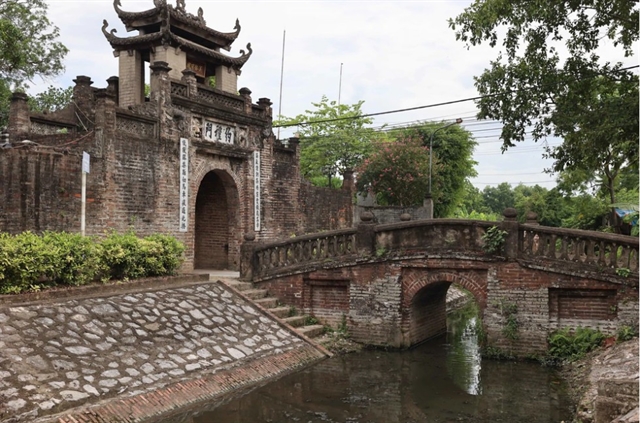
| The architecture of an ancient gate in Hà Nội's Ước Lễ Village has remained intact after hundreds of years. — Photos thethaovanhoa.vn |
HÀ NỘI — Urbanisation and global integration are driving significant changes in Việt Nam, but alongside the imperative for modernisation, a question arises: how to ensure people's living spaces do not become increasingly uniform, thereby losing their 'connection' to the history, culture, or unique identity of each locality?
Experts recently debated the above issue at a workshop held in Hà Nội focusing on how to undertake 'planning for the urban and rural areas, associated with the Vietnamese cultural identity in the new era'.
Analyses presented at the workshop offered fresh perspectives on identifying the values that have shaped the ways Vietnamese people organise their living spaces over generations, ranging from their relationship with nature and community structures to their capacity to assimilate and transform external influences. At the same time, they also open insights into how these values can be further leveraged in contemporary planning and architecture.
Dr Nguyễn Quang, former director of UN-Habitat Việt Nam, took famous cities like Paris, Kyoto, and Barcelona as examples, adding: "The common point among these cities lies not in possessing the tallest or most modern structures, but in the ability to preserve and promote their unique identities throughout their development process."
|
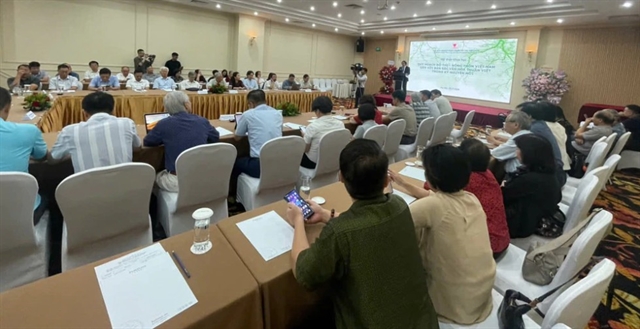
| Experts discussed at the recent workshop in Hà Nội focusing on how to undertake 'planning for the urban and rural areas, associated with the Vietnamese cultural identity in the new era'." |
According to Quang, it is a particular concern in the global context that the trend of 'homogenisation of development spaces' is becoming a common challenge, as numerous new urban and residential areas are built following similar models, failing to reflect the historical, cultural, and natural features of each locality.
"Indeed, despite notable achievements, Việt Nam has also been affected by this trend," he said.
When architecture and urban planning lack a connection to local conditions, not only are distinctive formal characteristics lost, but elements such as urban memory, the continuity of cultural space, and the relationship between the community and a specific place also risk fading away.
Many experts agreed with Dr Quang’s assessment from the perspectives of architecture and urban planning. A notable reason was analysed: during the course of development, many localities tend to look to, or even replicate, planning and architectural models popular elsewhere in the world, without fully accounting for their own specific natural conditions, history, culture, and social structures.
Therefore, preserving and promoting cultural identity must become a key component of new urban and rural development planning in Việt Nam as the country enters a new era of growth, they said.
However, a further question was raised: How should identity or the concept of being 'authentically Vietnamese' be understood?
According to experts, the nation's history reveals that Vietnamese identity resulted from a continuous process of cultural exchange, acculturation, and creativity spanning centuries.
The essence of Vietnamese identity does not reject external values, but is rather about the ability to adopt, select, and transform suitable elements into relevant values that bear a unique Vietnamese imprint.
Dr Trương Văn Quảng, deputy secretary-general of the Việt Nam Urban Planning and Development Association, emphasised that the purely Vietnamese urban-rural planning model is not an isolated model, but rather one that 'Vietnamises' global best quintessence and 'globalises' Vietnamese values.
According to Dr Quảng, core values shaping the Vietnamese identity in urban planning and architecture do not emerge by chance but have been nurtured by the country's natural conditions, history, and settlement structure.
Wet-rice civilisation, river and maritime systems, and resilient village networks – combined with diverse topography, climate, and regional cultures – have fostered unique principles and ways that the Vietnamese people have organised their living spaces over the centuries.
As the expert analysed, the principle of natural adaptation must be the first concern. With its long coastline, dense river network, and vast deltas, Việt Nam's development history has always been intertwined with the process of adapting to, harnessing, and coexisting with water.
Water should be viewed as a foundational element in the spatial organisation of development, rather than merely a landscape feature, he said.
This approach necessitates a shift in mindset from 'conquering nature' toward 'adapting to and living in harmony' with it, particularly in the context that the impacts of climate change are increasingly evident on coastal and riverside urban areas and delta regions.
Dr Quảng also mentioned another principle of community formed from the village structure as a place to preserve indigenous knowledge, cultural values and ways of organising life for many generations.
Along with that, differences in terrain, climate, history and culture among regions require planning to respect cultural characteristics of each locality, instead of applying a uniform development model on them.
Dr Quang said: "Preserving identity cannot stop at merely safeguarding structures but must aim to protect the entire 'living cultural ecosystem' that has been shaped and nurtured over generations." — VNS
Life & Style
 Life & Style
 Life & Style
 Life & Style
 Life & Style
 Life & Style
 Life & Style
 Life & Style
 Life & Style
 Life & Style
 Life & Style
 Life & Style
 Life & Style
 Life & Style
 Life & Style