 Life & Style
French experts share digital administrative experience with Vietnamese public servants
1.
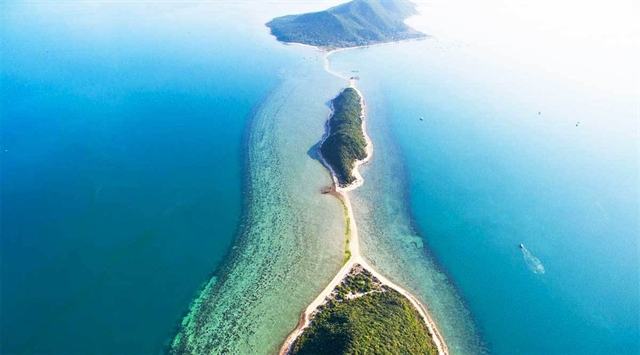 |
| Vân Phong is the largest bay in Khánh Hòa in the South Central coast region, holding great potential for the development of eco-tourism and the marine economy. Photo mia.vn |
HÀ NỘI — The South Central coast is a distinctive maritime cultural landscape, encompassing a rich array of tangible and intangible values.
Amid rapid urbanisation and the pressures of mass tourism, however, many traditional cultural practices and forms of folk knowledge are at risk of disappearing.
The Việt Nam National Institution of Culture, Arts, Sports and Tourism (VICAST) gathered delegates and experts in a recent seminar to raise their voices in protecting and promoting the value of maritime cultural heritage in conjunction with tourism development in the South Central Coast region in Hà Nội.
Associate Professor Dr Phạm Lan Oanh, VICAST deputy director, said the South Central Coast constituted a unique maritime cultural landscape, a convergence point for enduring cultural strata spanning the Sa Huỳnh, Champa, and Đại Việt (Great Việt) civilisations.
Through a long history of settlement, trade, and cultural exchange, the region developed a rich heritage, ranging from temple-towers, trading ports, communal houses and shrines dedicated to the Whale Deity to fishing villages, alongside whale-worshiping festivals, maritime knowledge, cuisine, and customs integral to the lives of coastal inhabitants.
These cultural values not only reflect the identity of coastal communities but also contribute to preserving cultural heritage while affirming historical significance and sovereignty over the seas and islands.
"The region's tangible and intangible cultural heritage not only bears witness to how humans have adapted to and interacted with the sea but also serves as a vital cultural resource for the sustainable development of the marine economy and high-quality tourism," she said
"As Việt Nam accelerates the development of its marine economy, cultural industries and high-quality tourism, maritime cultural heritage is increasingly recognised not merely as something to be preserved, but as a vital resource for development.
"This necessitates a new approach to protecting and promoting heritage values, one that ensures harmony between conservation and development; economic interests and the preservation of cultural identity; the application of science and technology and respect for indigenous knowledge; and state management and the community's legitimate rights to participation and benefit-sharing.
"Heritage protection is truly effective only when embedded in a governance mechanism that connects various stakeholders, allowing heritage to become an endogenous resource for sustainable development."
 |
| VICAST deputy director Hoàng Thị Bình speaks at the conference. |
According to Dr Hoàng Thị Bình, VICAST deputy director, despite its numerous advantages, the development of maritime cultural heritage for tourism in the region continued to face significant challenges.
Key issues included fragmented development approaches that have hindered the transformation of heritage assets into distinctive tourism products; the risk that commercialisation may undermine their value and authenticity; limited participation by local communities; and shortcomings in management mechanisms and inter-agency coordination.
According to experts, to promote the regional cultural heritage values, it is necessary to identify the distinctive characteristics of each locality to select appropriate forms of utilisation, while avoiding duplication and the commercialisation of the heritage.
Coastal communities should be considered as the custodians of their heritage, participating in the whole process of development and management and benefiting from tourism activities.
Furthermore, tourism products need greater investment in their cultural depth, with a stronger focus on stories of history, local people and the lives of coastal communities; and application of digital technology.
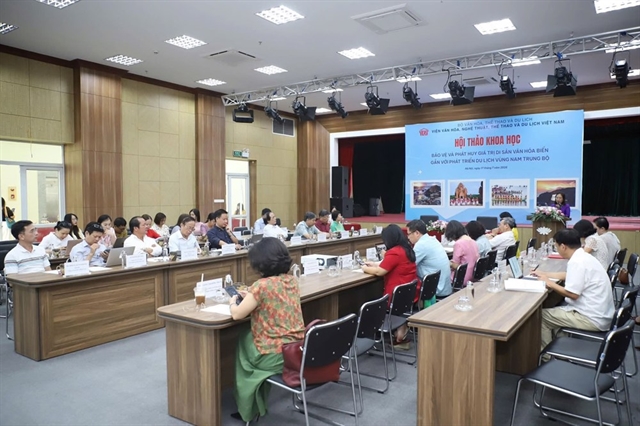 |
| Delarates take part in the seminar. |
Localities also needed to improve their zonal linkages, connect tourism routes and destinations; share data and coordinate conservation activities while ensuring tourism development and environmental protection and supporting communities in preserving traditional cultural values.
Emphasising the need to regard maritime cultural heritage as a cornerstone of tourism development, Dr Nguyễn Anh Tuấn, director of the Institute for Tourism Economics, said that tourism development must strike a balance between heritage conservation, community livelihood creation, and the enhancement of visitor experiences.
At the same time, there was a need to shift from a mindset of developing individual destinations to creating interconnected maritime heritage spaces.
In particular, heritage tourism development should be linked with the green and creative economies to expand value chains, increase community benefits, and foster sustainable development.
Speakers also discussed other issues such as the relationship between heritage conservation and tourism development and suggested tourism models that could be effectively applied in the region: fishing village community tourism; ecotourism in association with marine culture; heritage education and marine environment tourism and coastal culinary tourism. VNS
Life & Style
 Life & Style
 Life & Style
 Life & Style
 Life & Style
 Life & Style
 Life & Style
 Life & Style
 Life & Style
 Life & Style
 Life & Style
 Life & Style
.jpg) Life & Style
Life & Style
 Life & Style
 Life & Style