 Life & Style

Vietnamese Prime Minister meets Cambodian National Assembly President
1.
|
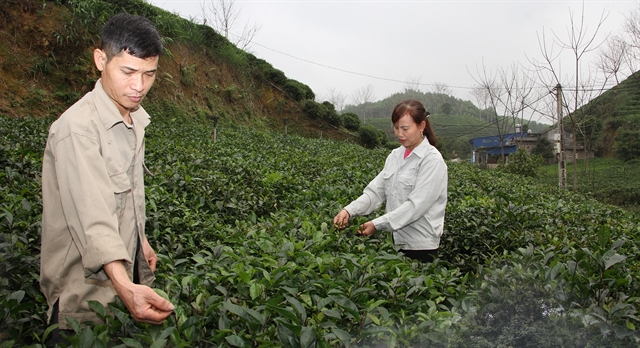
| Trương Thị Hoa of Thái Ninh Tea Cooperative in Vô Tranh Commune and her husband take care of their purple tea plants. — Photo courtesy of Hằng Hải-Linh Lan |
Thanh Hà
THÁI NGUYÊN — Have you ever heard of purple tea plants? If you have, you must be a true tea expert. Otherwise, you are probably an amateur like me – surprised by the name and immediately reaching for Google to learn more about the plant.
I consider myself lucky to have recently travelled to Thái Nguyên, the kingdom of Vietnamese tea, where I had the chance to see, touch, taste and drink tea made from these remarkable bushes – a variety as special as its name.
In Thái Nguyên, I met with Trương Thị Hoa of Thái Ninh Tea Cooperative in Vô Tranh Commune, the birthplace of the province's purple tea production. She was pleased to introduce a curious and excited newcomer to the plants, which produce drinks that are not as well known as their green and black siblings, but are somehow much better in flavour and health benefits.
This plant, one of two variants of the midlands tea cultivar, is characterised by small, thin, elongated leaves and buds that are purple or ripe plum in colour. They are pale purple on the upper surface, which shifts to green as they mature, and deep purple on the underside and stems.
Purple tea grows reliably and adapts well to the nutrient-poor soils of the Thái Nguyên hills, as well as to harsh, dry weather and pest pressures.
|
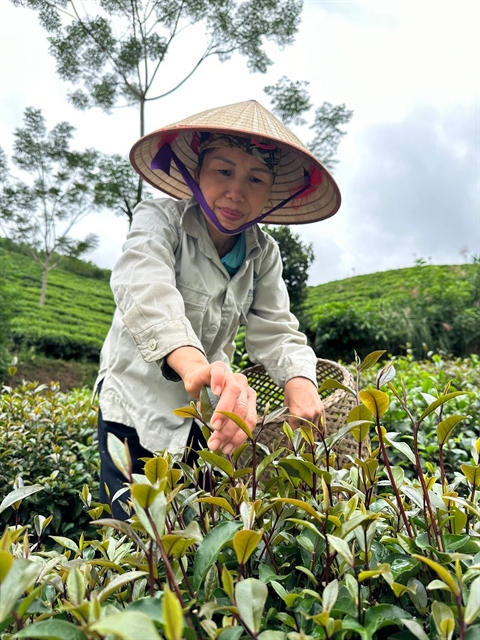
| Trương Thị Hoa picks tea buds in the early morning to ensure the best quality of her products. — Photo courtesy of Thái Ninh Tea |
"It was my father-in-law Phạm Văn Dung who was the first one to pay real attention to the plants, and he spent his whole life growing and popularising it among the community," Hoa told me.
"The plants have been available on our land for centuries, but local farmers didn't really care about them. Then my father-in-law learned about its distinctive features through a training course at Thái Nguyên University more than a decade ago. He realised that the true value of the purple tea plant had not yet been fully tapped. That was how the idea of a dedicated purple tea-growing region took shape in his mind," she said.
"To date, my family owns a 2ha hillside area to grow purple tea. The products from the plants are still not widely known, but I believe that they will take off in the near future."
Hoa said that the tea is hand-picked in the early morning to ensure its quality. Properly steeped leaves produce beautiful, clear tea with a rich, full body and a delicious flavour.
The tea is at its best from the second steep, offering a slightly astringent and bitter taste followed by a gradually emerging sweetness rarely found in other teas. Yet it remains rich and flavourful even through the sixth or seventh steep.
.jpg)
|
| Purple tea offers a distinctive taste. — Photo courtesy of Thái Ninh Tea |
The liquid boasts a unique golden-reddish hue; the stronger the brew, the deeper the colour becomes, even shifting toward purple.
Because her tea is inherently robust in flavour and further enhanced by its purely organic cultivation and artisanal processing, it boasts a wonderfully aromatic and delicious taste.
When I compared it with a cup of regular green tea, the purple tea had a much darker colour with a distinct hue. Upon tasting, there was an initial slight bitterness and mild astringency, followed by a gradual sweetness that lingers in the throat for a long time.
Beyond its pleasant aroma and delicious taste, purple tea is recognised as a medicinal plant, offering numerous health benefits related to protecting the body from stress and helping to keep it hydrated without a caffeine overload.
.jpg)
|
| A purple tea bud compared to regular green tea. — Photo courtesy of Thái Ninh Tea |
Dr Dương Trung Dũng, dean of the Faculty of Agronomy at the College of Agriculture and Forestry of Thái Nguyên University, said that purple tea is highly beneficial for maintaining physical health.
"When analysing the chemical composition, we found that the catechin content in purple tea is significantly higher than in green tea," he said.
Catechin is a natural antioxidant that is believed to have multiple health benefits due to its vasodilation and anti-inflammatory effects, with some limited evidence that it may help reduce the risk of developing certain types of cancer.
Meanwhile, when Hoa looked at me, a chubby woman, she told me that drinking purple tea would help me lose weight.
 (1).jpg)
|
| Purple tea (on the left) compared to typical green tea. — Photo courtesy of Thái Ninh Tea |
"Consuming purple tea supports the immune system and aids in weight loss. Drinking purple tea suppresses appetite," she said. "It boosts the body's metabolic rate, enabling it to burn fat at a significantly faster pace."
She added that like its green counterpart, purple tea can be used as an ingredient in cooking and baking.
.jpg)
|
| Peanut candy made with purple tea leaves. — Photos courtesy of Thái Ninh Tea |
"We produce peanut candy and peanut-filled candy rolls, which are two traditional sweets in Việt Nam. Matcha powder made from the leaves can also be enjoyed as a tea or added to smoothies, baked goods and other foods."
Hoa kindly invited me back for another visit later this year.
"This mid-Autumn Festival, please come back to my home town," she said. "I would be happy to serve you my special drink and moon cakes made from purple tea leaves." — VNS
Life & Style
 Life & Style
 Life & Style
 Life & Style
 Life & Style
 Life & Style
 Life & Style
 Life & Style
 Life & Style
 Life & Style
 Life & Style
 Life & Style
 Life & Style
 Life & Style
 Life & Style