 Life & Style

Vietnamese crime gang busted in Scotland
1.
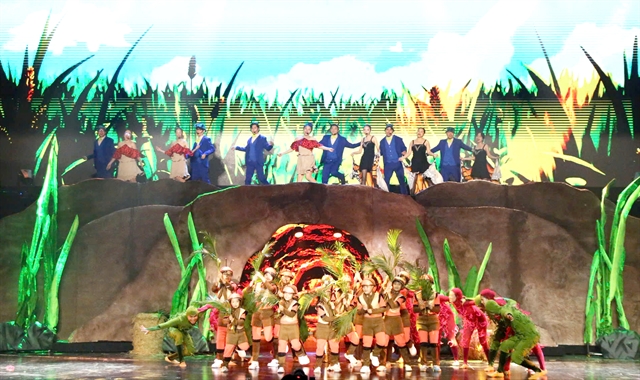 |
| The Cricket's Side Story: A Story Beneath the Grass combines various art forms including circus, singing, dance and visual arts. Photos thethaovanhoa.vn |
HÀ NỘI — After inspiring countless adaptations over the years, one of Việt Nam's much-loved children's books, Dế Mèn Phiêu Lưu Ký (Adventures of a Cricket), is returning to the stage in a new production.
Entitled Dế Mèn Ngoại truyện - Câu Chuyện Dưới Tán Cỏ (The Cricket's Side Story: A Story Beneath the Grass), the production does not just recreate the original work but expands the story from the point of view of an adult cricket looking back on his youth.
This method has been used to resonate with issues facing today's young people, such as identity, responsibility, love for nature and the journey of self-discovery.
The production premiered recently at Hòa Bình Theatre in Hòa Hưng Ward, HCM City, attracting an audience of 2,000 people. It combines various art forms, including circus, singing, dance and visual arts.
Acrobatic performances, balancing acts and aerial displays are used as metaphors for growing up, courage and the ability to rise again after failure.
Music, dance, choral performance, visual arts and modern stage technology further enrich the multisensory experience, appealing to audiences of all ages.
One of the highlights is singer Thanh Duy's performance in the role of the cricket.
"It's been a long time since I've felt this excited and eager about a project," said Thanh Duy.
"From the very first meetings with the production team, I could already feel the positive energy, creativity, and love that everyone has poured into this project.
"I believe that when a childhood story is retold with such wholehearted dedication, it will touch not only young audiences but also those who have grown up."
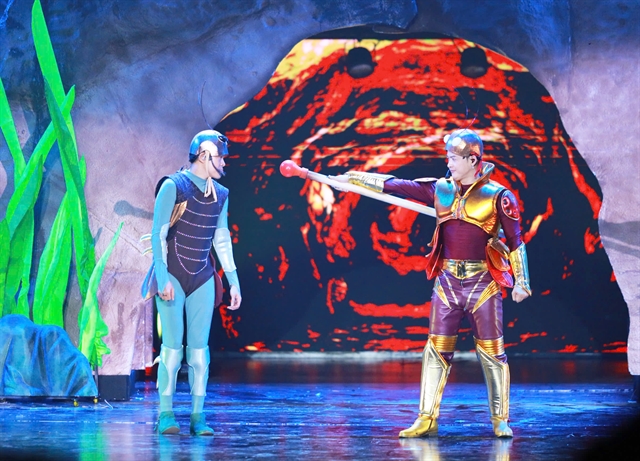 |
| Thanh Duy (right) as Dế Mèn in the production. |
The music is composed by musician Việt Anh and ranges from pop music and symphonic works to film and stage scores.
Việt Anh builds the music as a 'character' that accompanies and drives the emotional development of the entire story.
The project also has an advisory board comprising of experts in music, dance, circus and the performing arts, including journalist Dr Võ Danh Hải.
"Through the world beneath the grass, we hope to convey to young people messages about love for nature, love for family, compassion and faith in kindness," Hải said.
According to creative director KiKi Trần, expanding the world of the cricket is intended to build a stronger bridge connecting the classical story with today's audiences.
"There are projects that, from the moment I begin working on them, I know I'm touching something greater than a single performance. Dế Mèn Ngoại Truyện is one such project," said Trần.
"I understand that an entertainment production with lasting vitality is defined not only by its staging techniques or the scale of its investment, but by whether it can answer the question: what story are we telling, and to whom does that story belong.
"Việt Nam is at an important stage in shaping a genuine cultural industry – one where culture is not only preserved as heritage but also invested in, produced and operated as a creative economy.
"Many countries in the region have already moved ahead in this direction, so we need to accelerate through quality, innovation and appeal."
More than just a stage production, the creative team hopes that Dế Mèn Ngoại Truyện will become a signature cultural product of HCM City.
Many major cities around the world have successfully developed performances closely associated with their local identity, making them tourist attractions alongside architectural landmarks and scenic sites, according to Trần.
From his experience collaborating with partners from South Korea, Japan and other Asian countries, he has observed that these countries not only export artists or works, but also an entire professional performing arts ecosystem.
These are long-running productions built around local stories but produced to international standards to serve both domestic audiences and international visitors.
According to Trần, this is the intellectual property development model adopted by many advanced entertainment industries.
"A story does not exist for just one performance but continues to expand into multiple activities, generating long-term economic and cultural value," Trần said.
As the government identifies the cultural industry as a creative economic sector, the need for products that both embody Vietnamese identity and can operate under market mechanisms has become increasingly urgent. — VNS
Life & Style
 Life & Style
 Life & Style
 Life & Style
 Life & Style
 Life & Style
 Life & Style
 Life & Style
 Life & Style
 Life & Style
 Life & Style
 Life & Style
 Life & Style
 Life & Style
 Life & Style