 Life & Style

Việt Nam, Switzerland seek to deepen parliamentary cooperation
1.
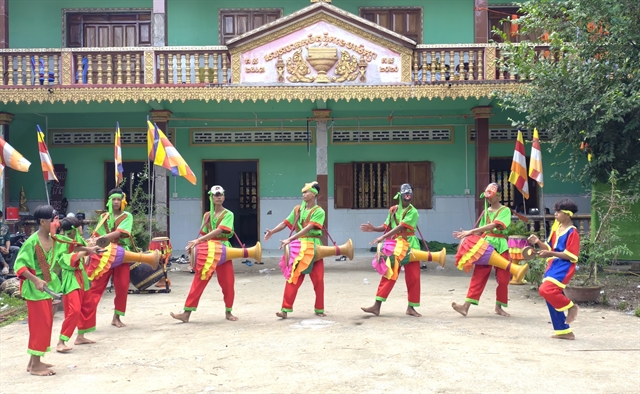 |
| A performance of the chhay-dăm drum dance, a unique Khmer folk dance accompanied by drumming, at the Snay Đon Kum Pagoda in Ô Lâm Commune of An Giang Province. — VNA/VNS Photo Thanh Sang |
AN GIANG — The Cửu Long (Mekong) Delta province of An Giang has launched several key initiatives to protect, preserve and promote the traditional arts of the Khmer ethnic community.
The Khmer accounts for 8 per cent of the province’s population. The community is preserving a very diverse array of arts forms, such as dì kê, a subgenre of dù kê musical theatre; folk dances of rô băm, rom vong, chhay-dăm drum; ngũ âm (five tones) or Pinpeat, the traditional musical ensemble that performs ceremonial music at temples; and the Chol Chnam Thmay, Ok Om Bok and Sen Dolta festivals.
The art forms hold not only artistic value but also folklore, knowledge, customs, and traditions, reflecting the history and spiritual life of the Khmer across generations.
Lê Văn Phước, Vice Chairman of the provincial People’s Committee, said the province’s project on preserving and protecting the traditional artistic value of the Khmer by 2030 is focused on digitising Khmer folk art, offering training and passing on traditional arts to succeeding generations, organising the Khmer art festival and exhibitions, and developing Khmer cultural spaces in the community.
An Giang will establish a steering committee to oversee the project and create and assign designated plans for each locality.
The province will conduct a comprehensive survey of traditional art forms, including dance, musical instruments, theatre, stage clothes and festivals, and organise scientific conferences to build a digital database of Khmer art to serve research, management and education.
Under the project, training the succeeding generation is a top priority for preserving Khmer arts.
The province will recruit artisans to develop a training curriculum, maintain classes for young people, and help to open more art clubs to promote the arts.
The work emphasises the important role of artisans in sustainably preserving and promoting traditional Khmer arts.
According to the An Giang Department of Ethnic and Religious Affairs, the number of artisans is decreasing. They are mostly elderly people facing declining health and economic difficulties; in contrast, young people show less interest in traditional arts.
The localities with large Khmer communities, such as Tri Tôn, Tịnh Biên, Giang Thành, Hòn Đất, Định Hòa, Gò Quao and Vĩnh Thuận, have only five to ten artisans each. Most of them are 55 years old or older, and many are over 70.
Many of them are still devoted to passing on the arts to younger generations and preserving traditional musical instruments and stage attire. They are opening classes and practising the arts and rituals at Khmer pagodas.
In addition, An Giang will strengthen the practice and promotion of Khmer arts in the community, at festivals, and in tourism as a crucial solution to preserve and promote traditional art values.
The province will also build experiential tourism products associated with Khmer culture, such as visiting Khmer pagodas, enjoying dì kê or ngũ âm, learning folk dances, and exploring Khmer cultural life and festivals.
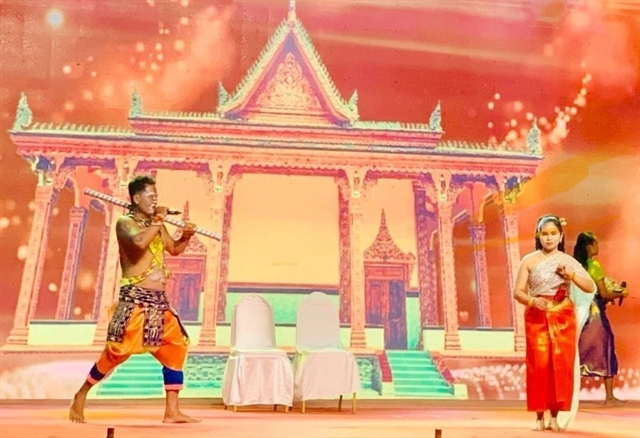 |
| Dì kê of the Khmer community in Ô Lâm Commune is recognised as a national intangible cultural heritage. — VNA/VNS Photo Thanh Sang |
By 2030, An Giang strives to complete an inventory dossier of Khmer art forms, produce documentary films and a map of Khmer culture and arts, organise five to seven training classes each year, establish at least two Khmer art clubs, and hold a Khmer traditional arts festival every two years.
The Khmer community in An Giang owns five national intangible cultural heritages, including the Bảy Núi Ox Race Festival, the knowledge and techniques of writing on palm leaves, the craft of making palm sugar, and the two traditional performing arts forms of dì kê and chhay-dăm drum dance, reflecting the cultural depth of the Khmer community in the South.
Among them is dì kê, a subgenre of dù kê, of the Khmer community in Ô Lâm Commune, which was recognised as a national intangible cultural heritage by the Ministry of Culture, Sports and Tourism in 2023.
Dù kê was created by the Khmer in the early 1920s. In the art, artists in traditional Khmer costumes perform plays based on the religions, traditional customs and culture of the Khmer, poetry based on Indian epics such as the Ramayana and the Mahabharata, and even today’s social issues.
The chhay-dăm drum dance is a unique folk dance accompanied by drumming.
The performers play the chhay-dăm drums (made from the hollow tree trunk of an old areca tree) with their hands, elbows, or heels. The dance of the Khmer community in An Giang was recognised as a national intangible cultural heritage in 2025. — VNS
Life & Style
 Life & Style
 Life & Style
 Life & Style
 Life & Style
 Life & Style
 Life & Style
 Life & Style
 Life & Style
 Life & Style
 Life & Style
 Life & Style
 Life & Style
 Life & Style
 Life & Style