 Life & Style

Data centre market faces energy challenges
1.
|
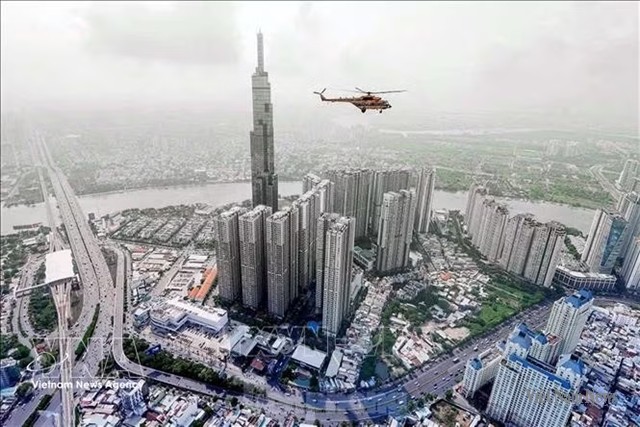
| A bird's-eye view of HCM City Photo VNA/VNS |
HCM CITY — HCM City has evolved into Việt Nam’s leading economic and cultural hub, driven not only by economic growth and global integration but also by the formation of an open, diverse urban identity rooted in cultural convergence.
Cultural values shape city's identity
Experts say the city’s reform spirit has been sustained by deeply rooted cultural values rather than institutional changes alone. The defining characteristics of Sài Gòn – HCM City residents – dynamism, openness, pragmatism, innovation, and compassion – have underpinned successive waves of reform, from the early đổi mới (renewal) experiments to recent special development mechanisms.
Researchers from the Hồ Chí Minh City Cadre Academy argue that these values, forged through more than three centuries of migration and cultural exchange among Vietnamese, Chinese, Khmer and Chăm communities, have become the city's key internal strength.
Four enduring traits – creativity, openness, pragmatism, and compassion – have consistently shaped its approach to governance and institutional innovation.
They identify three major phases over the past five decades: the pioneering reforms in the early 1980s that contributed to the 1986 đổi mới policy, the pilot implementation of special mechanisms, and the current push for breakthrough reforms under recent Party resolutions and the proposed Special Urban Law.
Cultural diversity as engine of development
Over the past half-century, HCM City has become a space where multiple cultural traditions converge and evolve, reinforcing its reputation as a centre of innovation and international integration.
Following the merger with the former Bình Dương and Bà Rịa – Vũng Tàu provinces, the expanded city now covers more than 6,772 sq.km with a population of over 14 million, creating a broader cultural landscape alongside its enlarged economic space.
According to experts, the new metropolis encompasses three distinctive cultural sub-regions: the historic Sài Gòn core, characterised by commerce and innovation; Bình Dương, known for its traditional craft villages, industry and migrant workforce; and Bà Rịa – Vũng Tàu – Côn Đảo, defined by maritime culture, port and energy industries, and revolutionary heritage. Together, these layers enhance the city's resilience, attractiveness and cultural competitiveness.
Scholars note that these cultural sub-regions collectively shape the city's identity while enriching its multicultural character.
Dr. Lê Thị Linh Trang of the Hồ Chí Minh City Cadre Academy said the three cultural sub-regions are closely interconnected and have collectively shaped HCM City's identity over the past 50 years. From its historic urban core and industrial – craft areas to its coastal and island communities rich in historical heritage, the city has emerged as an open, diverse and culturally dynamic urban space with a strong capacity for renewal.
Residents say the expanded city presents diverse landscapes ranging from agricultural and eco-tourism areas to industrial zones, logistics hubs, coastal urban centres and protected natural environments, each contributing its own distinctive character.
Looking towards its long-term vision of becoming a global megacity, experts view these cultural assets as a vital source of endogenous development. Shared historical memory strengthens social cohesion, particularly among migrants, while diverse cultural traditions enrich the city's cuisine, commerce, crafts, tourism and creative industries.
They add that, with modern investment and management, cultural heritage – from Chợ Lớn's commercial streets and Bình Dương's craft villages to coastal communities, Côn Đảo's historical sites and migrant culinary traditions – can become a powerful driver of cultural industries, tourism and sustainable urban development. — VNA/VNS
Life & Style
 Life & Style
 Life & Style
 Life & Style
 Life & Style
 Life & Style
 Life & Style
 Life & Style
 Life & Style
 Life & Style
 Life & Style
 Life & Style
 Life & Style
 Life & Style
 Life & Style