 Life & Style

Việt Nam News reporters win global journalism prize about child drowning
1.
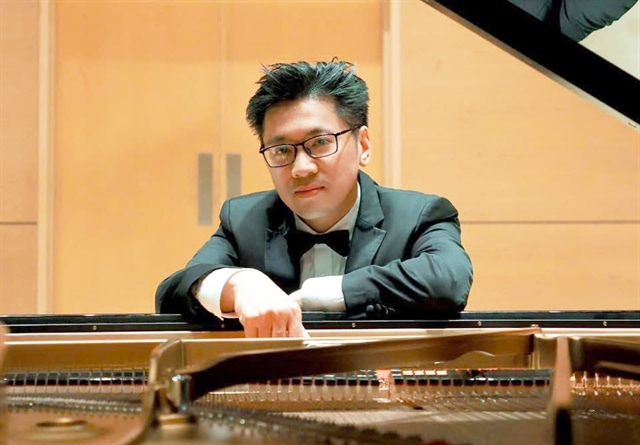 |
| Award-winning pianist Lưu Hồng Quang. Photo hanoimoi.com |
Pianist Lưu Hồng Quang recently returned to the stage of the Việt Nam National Academy of Music (VNAM), where his musical journey began, for a solo recital marking the institution’s 70th anniversary. Now pursuing doctoral studies in New Zealand, the internationally acclaimed artist spoke about music, perseverance and inspiring younger generations to embrace classical music
This marks the second time you have performed Franz Liszt's 12 Transcendental Etudes in Việt Nam. Did you enjoy your performance?
For me, every return to Việt Nam for a performance is very special. This time, I once again play Liszt’s 12 Transcendental Etudes, which I previously performed in 2022 and later recorded on an CD album released by Ratte.
It is an enormous challenge for any pianist. The work stands as one of the most extraordinary achievements in piano history. Each piece represents its own musical universe, ranging from the beauty of nature and legends to memories and the depths of the human soul. This time, I sought to explore the sharp beauty of sound through deeper layers of meaning and artistry.
Although I have performed the cycle many times in different places, I was deeply moved during the concert in Hà Nội on May 8. Perhaps it was because I was performing in my homeland, which made the emotions resonate more profoundly.
As I played the final chords, I reflected on the turbulent journey our nation has endured. It strengthened my desire to contribute to my country through music.
Is that the reason you always make time to perform in Việt Nam each year?
I have always lived by the principle of remembering my roots. Việt Nam nurtured me from the very first days of my path. VNAM was where I received my foundational training, where my teachers guided me and where my serious passion for music was formed.
I have always sincerely wished to bring classical music at the highest artistic level to audiences at home. As long as there is someone who is truly moved by the music, I feel that what I do is meaningful.
Every time I return, I feel even more deeply the sacred meaning of the word homeland. After long journeys abroad, Việt Nam is always the place that gives me renewed energy, greater resilience, compassion and the aspiration to continue striving forward.
How did music come into your life and what has that journey meant to you?
I was born into a family with an artistic tradition, so my parents encouraged me to study piano from an early age. The learning environment was quite strict but also filled with love and support. In truth, talent is not always immediately visible in childhood.
What matters more is whether one’s love for music is strong enough. For me, that love has grown over the years. The more I studied and experienced, the more I realised that music is not simply a profession but a way of life.
This path is filled with challenges. There were periods of loneliness, pressure and great sacrifice. I have devoted most of my life to the piano, practising through moments of happiness, sadness, hope and even exhaustion.
But when you give so much of yourself to music, it also gives back many precious things. What makes me happiest is music’s ability to connect people. A beautiful concert is when both the artist and the audience enter a space where only emotion and listening remain.
You have won many prestigious international awards. How have competitions influenced your career and artistic thinking?
When I was younger, competitions were extremely important experiences for me. They taught me many things, from stage confidence to handling pressure. But the further I have gone, the more I realise that competing is not about winning at all costs.
Competitions are like stations along an artistic journey. How far one can go depends on ambition, discipline and the process of self-improvement. Sometimes judges are not only looking at current results but also recognising an artist’s future potential. For me, every competition has been an honest mirror, showing where I stand in comparison with the rest of the world.
Later, through pursuing my doctoral studies in New Zealand on a full scholarship, I have come to understand even more clearly that music has no limits. Researching the music of Franz Liszt helped me realise that behind the brilliance and virtuosity of his works lies profound humanity and a remarkable character. That discovery inspired me to delve even deeper into both research and performance.
How do you view the development and training of classical music for young Vietnamese generations today?
I believe music education in Việt Nam has strong academic foundations. Many young students today are being trained in a highly systematic way. However, to become a true artist, technical proficiency alone is not enough. Young musicians also need to develop independent thinking and a personal artistic voice. Art cannot stop at simply playing the correct notes. What matters is understanding what one wants to express through music.
I think today’s younger generation has opportunities to connect with the world. What is essential is maintaining perseverance, discipline and a genuine love for art.
I always hope that the programmes I bring back to Việt Nam can inspire young people who love music so they can believe that Vietnamese artists are fully capable of reaching the world stage through talent, courage and serious dedication. — VNS
Life & Style
 Life & Style
 Life & Style
 Life & Style
 Life & Style
 Life & Style
 Life & Style
 Life & Style
 Life & Style
 Life & Style
 Life & Style
 Life & Style
 Life & Style
 Life & Style
 Life & Style