 Life & Style
Hà Nội adorned in red ahead of Liberation Day
1.
|
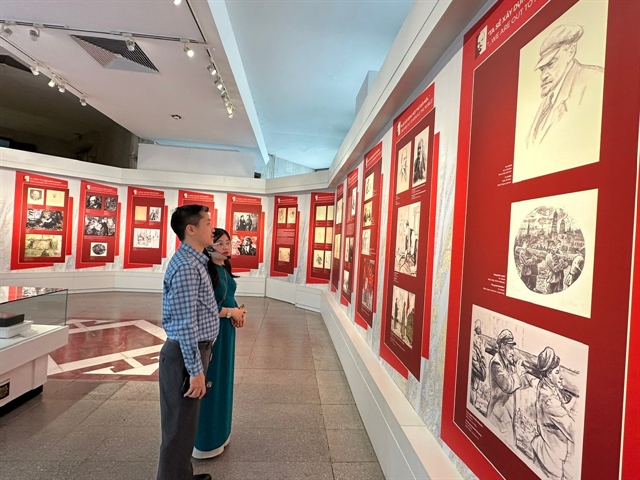
| A visitor is introduced about the 156 Lenin Images – From the Collection of the V.I. Lenin Memorial Site in Ulyanovsk exhibition. — Photo hanoimoi.vn |
HÀ NỘI — Stories about Vladimir Lenin are being brought to the public's attention through an exhibition at the Hồ Chí Minh Museum in Hà Nội, offering visitors a visual journey through his life and legacy.
Entitled 156 hình tượng Lênin – Từ Bộ Sưu Tập Của Khu Lưu Niệm V.I. Lênin ở Ulyanovsk (156 Lenin Images – From the Collection of the V.I. Lenin Memorial Site in Ulyanovsk), the exhibition is one of a series of activities marking the 156th anniversary of Lenin’s birth (April 22, 1870–2026), the 76th anniversary of diplomatic relations between Việt Nam and Russia (1950–2026) and the year of cross-cultural cooperation in science and education between the two countries, which will see various activities and events organised in both nations.
The exhibition also aims to help Vietnamese people, especially younger generations, and international visitors better understand Lenin, a revolutionary political theorist and the founder of the Soviet Union, widely regarded as one of the most significant and influential political thinkers of the 20th century, as well as the long-standing friendship between the two countries.
Speaking at the opening ceremony on April 22, Dr Vũ Mạnh Hà, director of the Hồ Chí Minh Museum, said: "Soviet art on the theme of Lenin (Leniniana) is an artistic epic about the leader of the working people, built over many decades to create a heroic, romantic image of a great revolutionary, a historical figure of world stature.
“The collective achievement of artists from many generations with different styles, techniques, and nationalities has laid a solid foundation for the Leniniana theme. Through this exhibition, the public can admire the diversity in the depth of personality of the image of V.I. Lenin, the leader of the socialist revolution in Soviet art.”
|
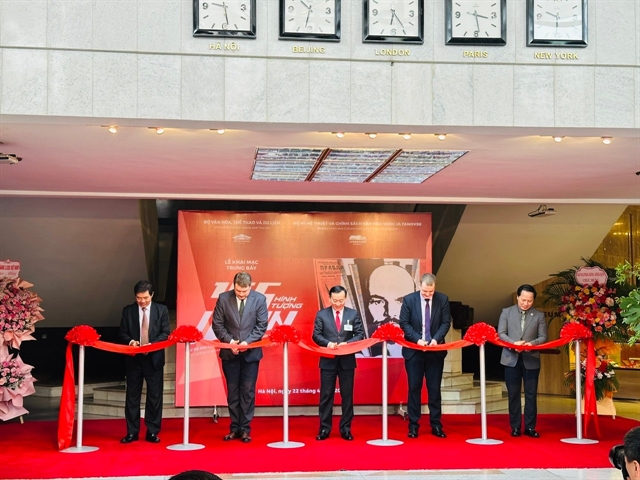
| Delegates cut the ribbon to officially open the exhibition. — Photo vov.vn |
He noted that many surviving portraits of Lenin were produced during his lifetime, including works created directly from life by prominent contemporary artists. Lenin typically agreed to sit for these portraits provided it did not interfere with his ongoing work.
Following his death, the theme of Lenin in art entered a new stage. The focus shifted from simply portraying the late head of state to crafting a heroic, romanticised image of a monumental revolutionary figure of global significance. Across all artistic forms, including graphic art, efforts intensified to depict Lenin as a revolutionary, a leader, a thinker and a close ally of workers and peasants.
Along with portraiture, works of art reflecting all stages of Lenin's revolutionary path were also created, depicting scenes of him giving public speeches, holding meetings or meeting with working people.
.jpg)
|
| A bronze statue of Lenin. — Photo vov.vn |
The exhibition is divided into nine areas, telling stories about different paths of his life from his childhood in Simbirsk, revolutionary participation, being the great leader, time with children to his legacy.
In addition, there are a number of typical artefacts and documents that demonstrate the strong solidarity, profound friendship and warm feelings of the Party, Government and People of the Soviet Union towards President Hồ Chí Minh and the Vietnamese people.
.jpg)
|
| A relief sculpture of Lenin presented to President Hồ Chí Minh by the Soviet Union's National Assembly delegation in November 1962. — Photo vov.vn |
The exhibition will run until November at No 19 Ngọc Hà Street, Ba Đình Ward.
Also on this occasion, the managers of the Hồ Chí Minh Museum and the Memorial Museum V.I. Lenin in Ulyanovsk signed a Cooperation Agreement.
The two sides would join hands in various activities such as scientific research projects, technology applications and cultural activities in general within the museum field, exhibitions for visitors and cultural heritage education, organising and participating in joint conferences and scientific seminars. — VNS
Life & Style
 Life & Style
 Life & Style
 Life & Style
 Life & Style
 Life & Style
 Life & Style
 Life & Style
 Life & Style
 Life & Style
 Life & Style
 Life & Style
 Life & Style
 Life & Style
 Life & Style



