 Life & Style

AIMCONNECT 2026 Held in Singapore, Bringing Global Automotive Leaders Together to Explore the Future of AI, Trust and Connected Mobility
1.
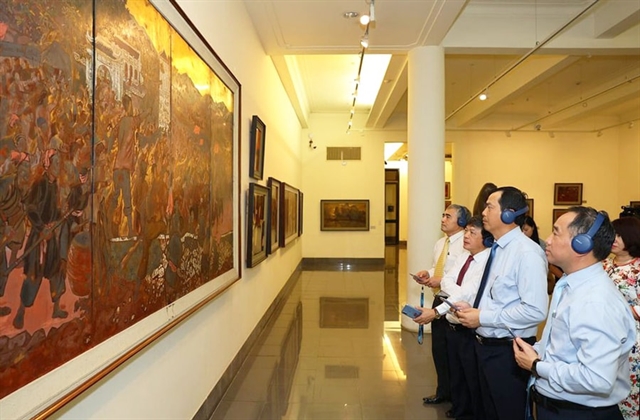 |
| Visitors experience the iMuseum VFA multimedia audio guide application at the Vietnam National Fine Arts Museum. — Photo courtesy of the museum |
HÀ NỘI — From interactive screens to virtual reality experiences, museums in Hà Nội are increasingly adopting digital tools to revitalise exhibitions and bring cultural heritage closer to the public.
The growing integration of technology into museum displays reflects Việt Nam’s broader push for digital transformation, in line with Resolution No. 57-NQ/TW, which promotes advances in science, technology, innovation and national digitalisation.
Bringing heritage to life through technology
The Hà Nội Museum officially reopened last month, unveiling a permanent thematic exhibition space after years of research and preparation.
Designed as an open exhibition environment, the new displays integrate artefacts, images, archival materials and multimedia presentation systems. Interactive screens allow visitors to explore information and gain deeper insights into the history, culture and everyday life of Thăng Long–Hà Nội across different periods.
A dedicated digital experience area featuring newly produced 3D films has also been introduced.
According to museum director Nguyễn Tiến Đà, combining original artefacts with modern technology is becoming an important trend for museums.
“The use of technology helps increase visitor interaction and attract more people to museums, contributing to the development of cultural industries in the capital,” he said.
The integration of technology has become an urgent task for many museums across Hà Nội as they seek to modernise their operations and improve visitor engagement.
The Vietnam Museum of Ethnology has been actively implementing digital transformation in management as well as in exhibition, educational and visitor activities.
Several exhibition areas have incorporated digital technology, including the use of Virtual Reality (VR) systems to recreate three-dimensional environments that help preserve and promote cultural heritage values. Visitors can also download mobile applications and scan QR codes to access stories behind artefacts and explore exhibitions in greater depth.
Meanwhile, the Vietnam National Museum of History has also been accelerating the digitalisation of artefacts and applying new technologies in its displays.
According to deputy director Nguyễn Thị Thu Hoan, many exhibition areas have been equipped with automatic audio guide systems available in multiple languages, allowing visitors to access information more easily.
Some digital experience programmes also enable visitors to explore artefacts in the form of 3D models, helping them better understand the structure and historical value of ancient objects.
At the Vietnam National Fine Arts Museum, digital transformation efforts began as early as 2017.
Museum director Nguyễn Anh Minh said technological applications such as cinemagraph and 3D mapping used in themed exhibitions like Mùa Xuân Đất Nước (Spring of the Nation) in 2023, Đất Nước Tôi (My Country) in 2023 and Xuân Hà Nội (Hà Nội Spring) in 2024 have helped attract significantly more visitors.
“Visitor numbers have increased by more than 300 per cent compared to five years ago,” Minh said.
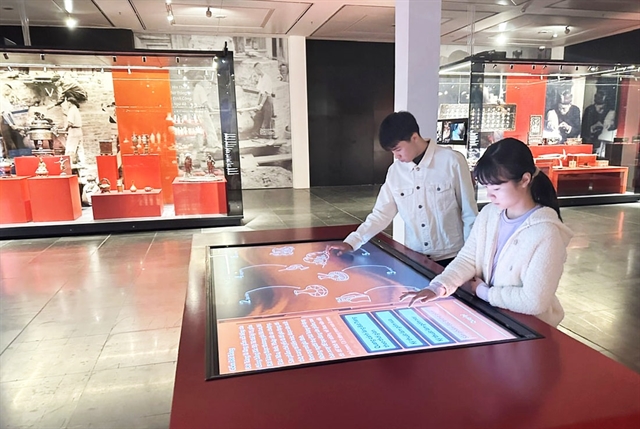 |
| Visitors use digital technology to access information at the Hà Nội Museum. — Photo Hoàng Lân |
Toward smart museums
The use of technology in museum exhibitions is transforming the way museums connect with the public, shifting from traditional static displays to interactive experiences.
According to Dr Phạm Quốc Quân, former director of the Vietnam National Museum of History, the digitalisation of artefacts and the development of digital databases allow museums to expand their reach beyond physical exhibition spaces.
Through online platforms, audiences from anywhere in the world can visit virtual museums, explore collections and learn about a country’s history and culture.
Beyond improving visitor experiences, technological innovation in museums also plays a significant role in promoting cultural industries.
Art researcher Dr Trần Hậu Yên Thế noted that technology-based exhibition products often require collaboration across multiple fields, including graphic design, programming, digital content production, projection technology and visual arts.
This creates opportunities for cooperation between museums, technology companies and creative design studios.
Despite its many advantages and the fact that it represents an inevitable trend, the adoption of technology in museum displays also poses challenges.
Museums must address issues ranging from financial resources and technology-skilled personnel to the capacity to manage and operate complex digital systems.
Dr Quân emphasised that technology should serve as a supportive tool to highlight the value of artefacts rather than replace traditional elements entirely.
Museums therefore need to strike a balance between historical content, exhibition design and modern technology to create spaces that are both academically valuable and engaging for visitors.
Within Việt Nam’s strategy to develop cultural industries, museums have the potential to become creative hubs where heritage is reimagined through technology and new ideas.
By embracing digital tools, museums are unlocking the potential of cultural heritage while contributing to the growth of cultural industries and spreading historical and cultural values to wider audiences in the digital era. — VNS
Life & Style
 Life & Style
 Life & Style
 Life & Style
 Life & Style
 Life & Style
 Life & Style
 Life & Style
 Life & Style
 Life & Style
 Life & Style
 Life & Style
 Life & Style
 Life & Style
 Life & Style