 Life & Style

Commune-level digital transformation app launched
1.
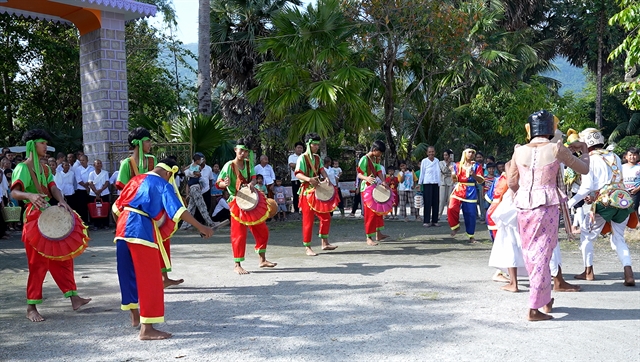 |
| Young Khmer performers take part in a Chhay-dăm drum dance at Snaydonkum Pagoda. — VNS Photos Đoàn Tùng |
Minh Hằng
AN GIANG — As the afternoon sun filters through the trees of Snaydonkum Pagoda, locally known as B52 Pagoda, in Ô Lâm Commune, An Giang Province, a familiar rhythm echoes across the quiet grounds, bringing tradition sharply back into beat.
The deep, resonant pulse of Chhay-dăm drums draws young Khmer men and women together. Sweat, smiles and sound blend as an age-old practice comes vividly to life.
In the cultural life of the Khmer community in the southern region, Chhay-dăm drum dancing, also known as Sa dăm, is far more than an energetic performance. It is a shared artistic space where music, movement and ancient epic traditions converge, reflecting beliefs, moral values and a cultural identity passed down through generations.
Chhay-dăm is closely linked to major Theravada Buddhist festivals of the Khmer community. Chol Chnam Thmay, the Khmer New Year, celebrates renewal and community cohesion. Sen Dolta honours ancestors and family lineage, while Ok Om Bok, the Moon Worship Festival, gives thanks for the harvest. In all three, Chhay-dăm is performed at pagodas and during processions as a ritual expression of joy, gratitude and shared cultural identity.
The drums themselves are striking cultural artefacts. Shaped like elephant legs, each Chhay-dăm drum is single-headed and handcrafted from the hollowed trunk of an old tree, then painted in vibrant traditional colours. Drum sizes vary according to the age and physical strength of the performer. The drumhead is typically made from sun-dried buffalo hide or python skin, producing a resonance that is deep and powerful without being harsh.
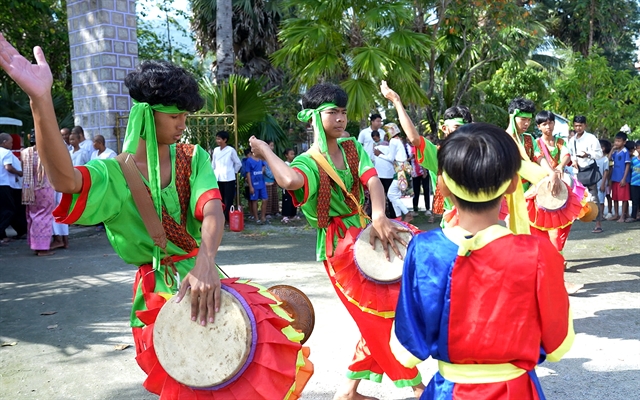 |
| Performers move fluidly to the rhythm of the Chhay-dăm drums. |
A typical performance features five to seven dancers playing four to six drums, accompanied by gongs, cymbals and wooden beaters. Using their hands, elbows and knees, sometimes performing close to the ground, the artists gradually build from steady rhythms to fast, dramatic climaxes marked by spinning movements, leaps and resounding shouts.
What sets Chhay-dăm apart is that it does not rely on rhythm alone. Performances often incorporate storytelling through theatrical characters, allowing the festival drums to open a gateway into the world of epic narrative.
In Chhay-dăm, drum rhythms are frequently intertwined with epic tales such as the Reamker, the Khmer adaptation of the Indian Ramayana. These stories centre on the timeless confrontation between good and evil, in which compassion and righteousness ultimately prevail. Rather than being narrated, this moral universe is expressed through movement, rhythm and physical embodiment, transforming pagoda courtyards and festival grounds into living epic stages.
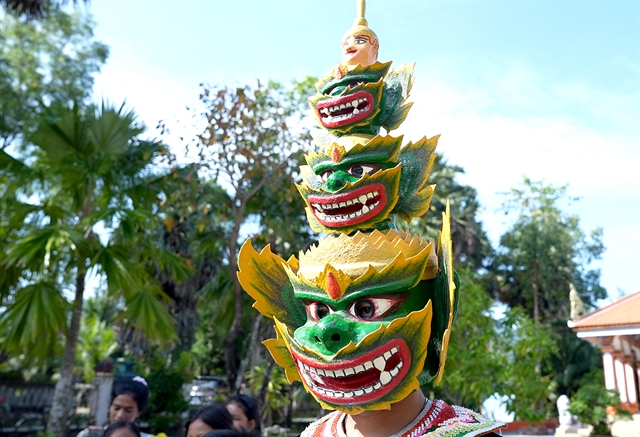 |
| A performer in the role of Chằn, the demon king. |
As the drums intensify, young performers step into familiar roles from the Reamker. Prince Phrah Ream emerges as a symbol of kindness and moral integrity, while his wife Neang Seda represents beauty, virtue and unwavering fidelity. Opposing them are the Chằn, known in Khmer as Yeak, demon figures led by Krong Reap, the king of the Yeak realm, along with his generals, fearsome antagonists who embody violence and ambition. Alongside these forces appears Hanuman, the heroic monkey god, celebrated for his bravery, loyalty and martial prowess.
Each character is vividly portrayed through physical form, costume and distinctive drum patterns. The sharp, forceful martial movements of the demon figures contrast with the calm, restrained grace of the righteous characters, creating a clear visual and emotional opposition.
Chau Nê Som Nath́, who performs the role of the demon king, said he and his friends practise every evening at Snaydonkum Pagoda, with each session lasting around two to three hours.
“At first it was very difficult because the movements have to be precise, powerful and decisive. I have loved the demon king character since I was a child because of its bravery, so the more I practise, the more fascinating it becomes,” Som Nath́ said.
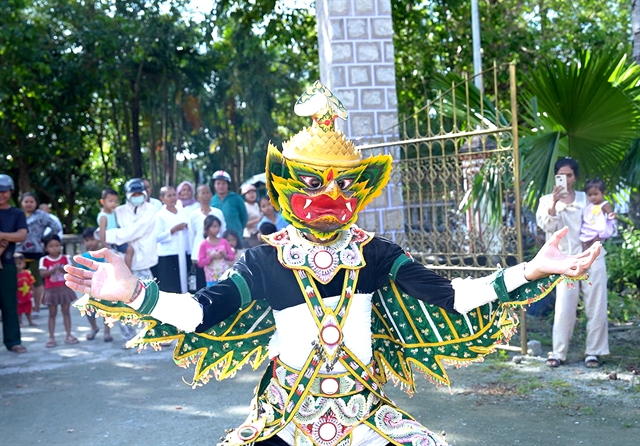 |
| Another Chằn figure in Chhay-dăm drum dancing performance. |
In May 2025, the performing art of Chhay-dăm drumming among the Khmer people of An Giang was officially recognised as a national intangible cultural heritage by the Ministry of Culture, Sports and Tourism.
However, preservation remains a challenge. While An Giang has more than 100 individuals capable of performing Chhay-dăm, fewer than 20 elderly artisans are actively involved in teaching the art.
In response, pagodas have become informal cultural classrooms. At Snaydonkum Pagoda, as well as Tà Ngáo and Tro Peang Trao pagodas, young performers learn everything from basic rhythms to physically demanding techniques under the guidance of experienced masters.
“Preserving tradition must go hand in hand with sustaining a vibrant community life,” said Neańg Sâm Bô, deputy chairwoman of the People’s Committee of Ô Lâm Commune.
“Alongside long-established festivals, local authorities are working closely with communities to organise cultural, sporting and tourism activities that create platforms for traditional performances. We are also focusing on providing opportunities and resources for young people to learn traditional songs, dances and music, which is essential to ensuring the long-term continuity of Khmer culture.” — VNS
Life & Style
 Life & Style
 Life & Style
 Life & Style
 Life & Style
 Life & Style
 Life & Style
 Life & Style
 Life & Style
 Life & Style
 Life & Style
 Life & Style
 Life & Style
 Life & Style
 Life & Style